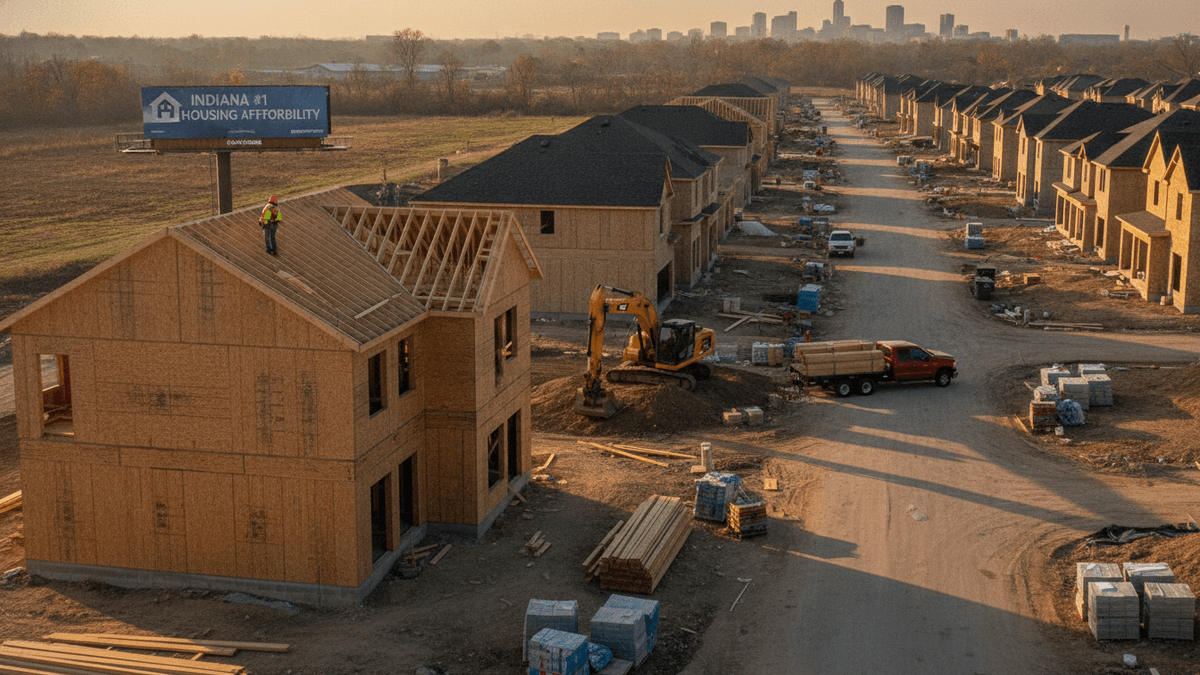
New home construction in progress with framing and partially finished houses at sunrise.
Indiana has claimed the top spot in Realtor.com’s 2026 housing report card, showcasing exceptional affordability and robust homebuilding activity. The state’s performance highlights a broader trend where Midwest and Southern regions are outperforming the Northeast and West in housing market health.
The report, which grades all 50 states and the District of Columbia, assigns half of a state’s grade to its housing affordability metrics and the other half to its homebuilding pace. While no state achieved a perfect A+ score, 12 of the top 13 highest-ranking states were located in the Midwest and South, earning grades between B- and A.
“This year’s refresh reveals a familiar regional divide, but also some notable shifts beneath the surface, with a new state at the top of the class and a handful of states whose grades moved dramatically in either direction,” said Realtor.com senior economist Joel Berner.
Indiana achieved a total score of 76.3 out of 100, earning an A grade. The median-priced home in Indiana was $295,810, requiring approximately 28% of the median household income of $71,469, which is below the 30% affordability benchmark. Iowa and South Carolina also received A grades, with median listing prices of $282,886 and $363,896, respectively.
Texas secured an A- with a median listing price of $364,749 and a median income of $76,585. North Carolina and Nebraska were the only states to receive B+ grades.
Delaware and Utah saw the most significant improvements, each climbing 12 spots in the rankings. Delaware moved from 19th to 7th, while Utah advanced from 29th to 17th.
Conversely, six states received F grades. New York ranked last with a median listing price of $668,173 and a median income of $82,657. Other states receiving F grades included Massachusetts, Rhode Island, Hawaii, California, and Connecticut, all situated in the Northeast or West.
States at the bottom of the list generally face challenges such as high prices, limited building space due to restrictive zoning, and construction costs that outpace middle-income affordability. Alabama, Maryland, and New Jersey experienced the largest drops in rankings, each falling eight spots.
About the Author