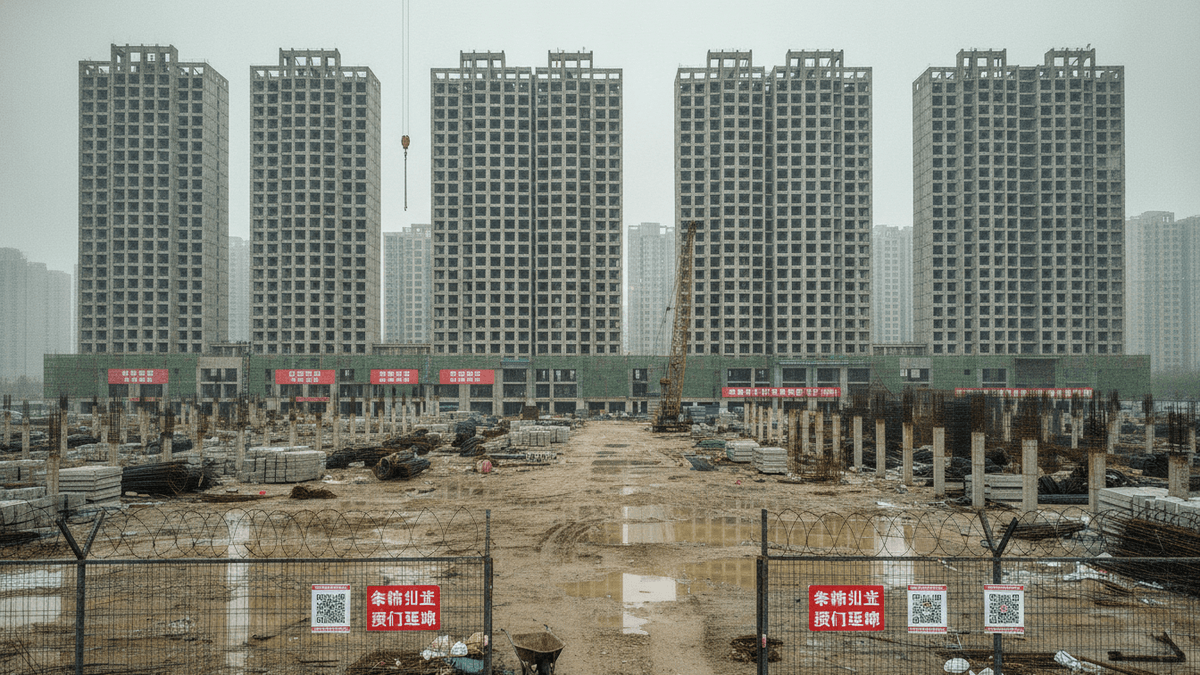
Stalled construction site, unfinished apartment blocks, rainy overcast day.
China, a global economic powerhouse, is flashing warning signs of a liquidity trap, a grim scenario where conventional monetary policy loses its grip. Despite aggressive easing from the People’s Bank of China, the nation’s economic engine is sputtering.
A liquidity trap manifests when interest rates are so low that people prefer to hoard cash rather than spend or invest, rendering monetary policy ineffective. Beijing’s current predicament fits this definition precisely. The economy expanded by a mere 4.3% in the second quarter of 2026, significantly missing its 5% annual target and marking its weakest quarterly performance in nearly three and a half years. This stagnation persists even as the People’s Bank of China (PBOC) maintains record-low benchmark lending rates and ensures ample bank liquidity, alongside extensive credit expansion.
The core issue is a profound lack of domestic demand. Data reveals that over 80% of Chinese consumers are choosing to save rather than spend, a stark indicator of eroded confidence. This hesitancy is deeply intertwined with the prolonged downturn in China’s property market. For 36 consecutive months, new home prices have been declining, dropping 3.3% year-on-year in June. Given that almost 70% of household wealth in China is tied to real estate, this sustained depreciation directly impacts consumer sentiment and discretionary spending, creating a vicious cycle where monetary stimulus simply pools as savings. The PBOC’s efforts, while significant, are akin to pushing on a string when households are more concerned with wealth preservation than consumption.
For startup founders, investors, and operators tracking the global economy, China’s potential liquidity trap presents a complex challenge. The traditional levers of economic stimulation are failing, suggesting that a deeper, structural shift in consumer psychology and market dynamics is underway. Businesses reliant on Chinese consumer spending or property market stability must re-evaluate their strategies. The situation calls for innovative policy solutions beyond just interest rate cuts, potentially involving fiscal stimulus or measures to directly restore household confidence. Without a significant shift, China risks a prolonged period of subdued growth, impacting global supply chains and investment flows.
About the Author