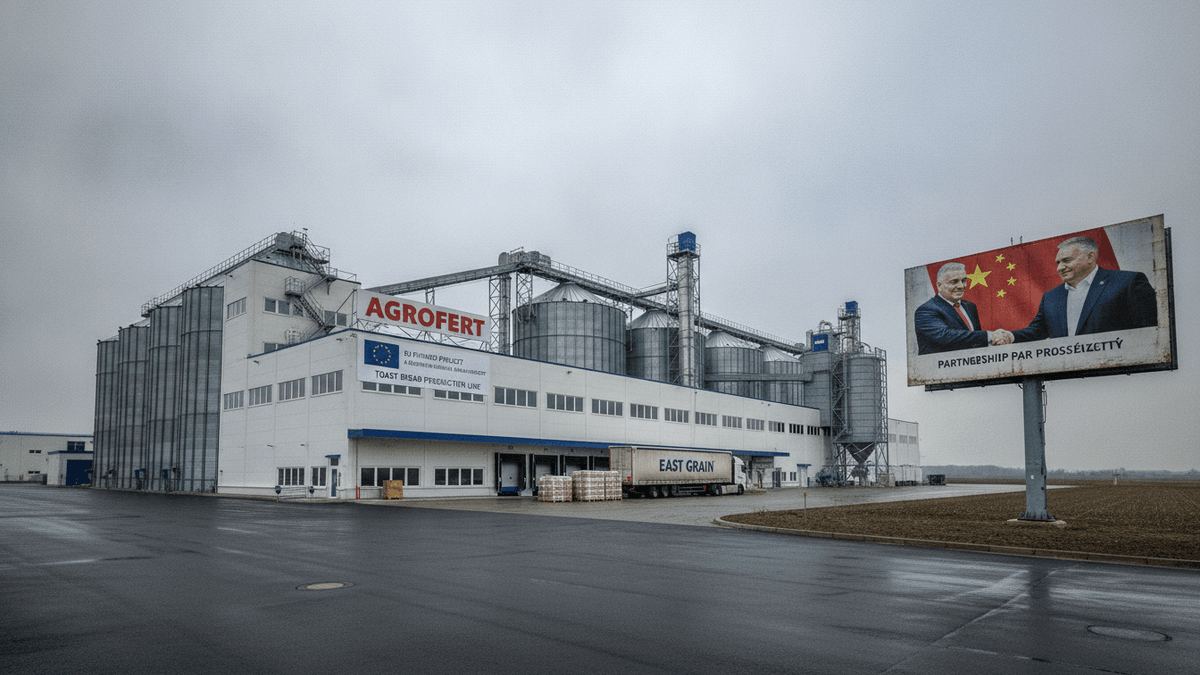
Agrofert production facility and billboard in rural Hungary under overcast sky
The close political alliance between Czech Prime Minister Andrej Babiš and former Hungarian Prime Minister Viktor Orbán appears to have directly fueled lucrative business opportunities for Babiš’s Agrofert holding within Hungary. As their friendship deepened, Agrofert reportedly secured significant financial backing, raising questions about the intersection of political influence and corporate gain.
Agrofert, a sprawling conglomerate, has significantly expanded its operations in both Hungary and Romania, benefiting from substantial loans and state subsidies. A key financial pipeline has been MKB Bank, now MBH Bank, which is partly owned by the Hungarian state and by Lőrinc Mészáros, a childhood friend of Orbán. Records indicate Agrofert received €8.7 million in 2021, €25.6 million in 2022, and a substantial €71 million in 2023 from this bank.
Beyond direct loans, Agrofert also tapped into Hungarian state support, including approximately €5 million in 2019 for job creation initiatives. Further illustrating the benefits of its regional presence, the company secured €11.37 million from the European Union to establish a toast bread production line in Hungary. In a notable expansion move in 2023, Agrofert acquired a stake in the Romanian firm East Grain, co-owning it with Hodler Capital, a group reportedly linked to former ministers in Orbán’s government. These financial flows, as highlighted in a Transparency International report, exemplify a mechanism where public money may be serving private interests.
The financial network extends further, with Agrofert receiving hundreds of millions of Czech crowns in loans from the Chinese Bank of China between 2018 and 2025. This move leveraged Hungary’s strategic ties with China, indicating a broader geopolitical dimension to Agrofert’s financing. The long-term implications of such arrangements are significant, particularly as Hungary’s foreign policy, under figures like Péter Magyar, might be seeking a more balanced approach between its Chinese partnerships and its commitments to the European Union.
While the financial gains for Agrofert are clear, the company’s spokesperson has not responded to inquiries regarding these findings, leaving many questions unanswered about the transparency and propriety of these dealings. This case underscores the complex interplay between political relationships, state-backed financial institutions, and the expansion of major private enterprises in Central Europe.
About the Author