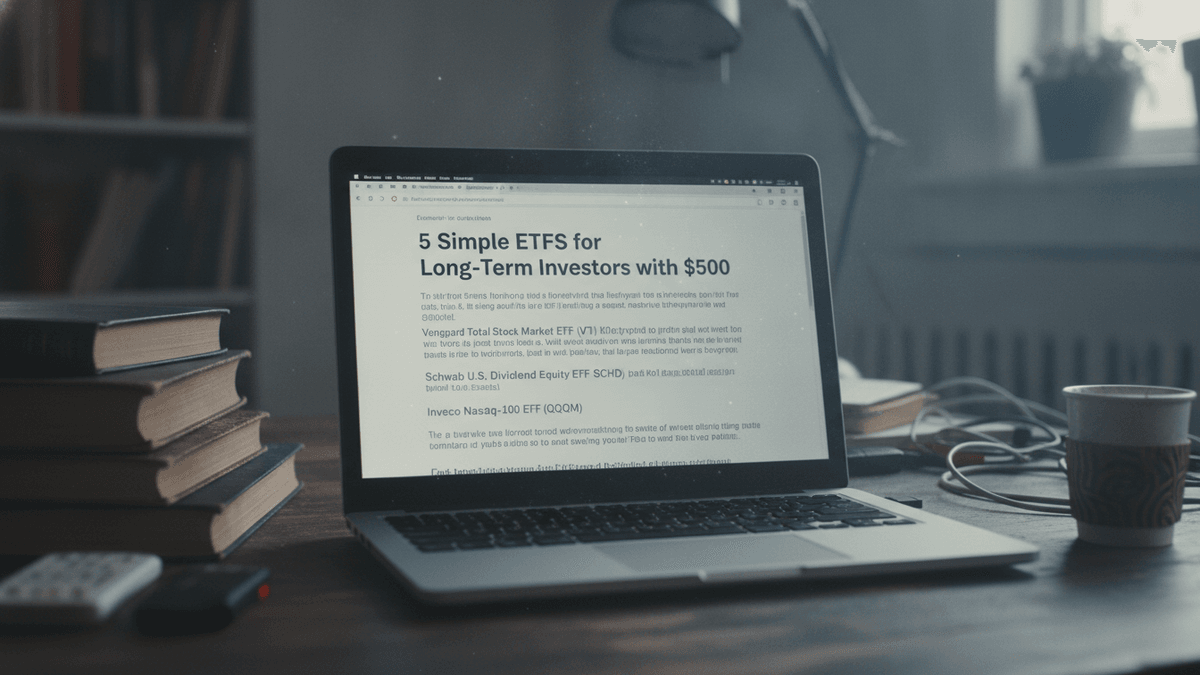
Laptop displaying a financial article on a cluttered desk with books and coffee.
The idea that you need a substantial amount of money to begin investing is a common misconception. With many brokerage accounts offering no initial deposit requirements and the ability to purchase single shares, your investment journey can commence with less than the cost of a single meal delivery. For those looking to start or expand their portfolios, ultra-low-cost index Exchange Traded Funds (ETFs) are often the most prudent choice, providing broad market exposure and serving as excellent core holdings for the long term.
Here are five recommended ETFs that balance low fees, comprehensive diversification, intelligent index construction, and a proven history of performance:
Vanguard Total Stock Market ETF (VTI)
This ETF is arguably the best core ETF available. It tracks an index that encompasses nearly the entire investable U.S. equity market, representing approximately 3,500 stocks across all market capitalizations and industries. While some prefer the Vanguard S&P 500 ETF, the Vanguard Total Stock Market ETF offers broader diversification by including mid- and small-cap stocks, which have distinct sector compositions, economic influences, and potentially higher growth prospects.
Schwab U.S. Dividend Equity ETF (SCHD)
For investors prioritizing dividend income, the Schwab U.S. Dividend Equity ETF stands out due to its strategic selection of stocks exhibiting strong balance sheet quality, a history of long-term dividend growth, and attractive yields. This fund holds stocks of durable companies designed to perform well across various economic conditions. Its current yield of approximately 3.3% is significantly higher than that of the S&P 500, appealing to those seeking income from their investments.
Invesco Nasdaq-100 ETF (QQQM)
Serving as a popular proxy for the U.S. technology sector, the Invesco Nasdaq-100 ETF, while comprising about two-thirds technology stocks, includes major players in tech and artificial intelligence (AI). Given the significant role of tech and growth stocks in driving U.S. market returns and fostering innovation, this segment is crucial for long-term portfolios. QQQM offers a lower expense ratio compared to its counterpart, the Invesco QQQ ETF.
Vanguard Mid-Cap ETF (VO)
This ETF targets the often-overlooked mid-cap segment of the market, situated between large-cap and small-cap stocks. Historically, mid-cap stocks have delivered competitive risk-adjusted returns. Despite lagging large-caps during the recent AI boom, they have outperformed the Vanguard S&P 500 ETF year-to-date. As market gains broaden beyond the largest companies, mid-caps offer a compelling balance of growth potential and lower volatility compared to smaller, more speculative stocks.
Vanguard Small-Cap ETF (VB)
The Vanguard Small-Cap ETF provides exposure to the higher-risk, higher-potential-reward segment of the U.S. stock market. These companies, often less developed or unproven, can be fast growers with the potential for significant returns. While this segment includes a higher percentage of unprofitable companies due to their growth phase, the fund’s diversification across more than 1,300 stocks mitigates the impact of any single company’s failure. A diversified portfolio of small-cap stocks is thus a sensible approach.
All these ETFs possess characteristics suitable for buy-and-hold strategies. They cover different market segments, can complement each other within a portfolio, are low-cost, and offer diversification. For individuals with even modest sums to invest, these five ETFs represent strong ownership candidates.
About the Author