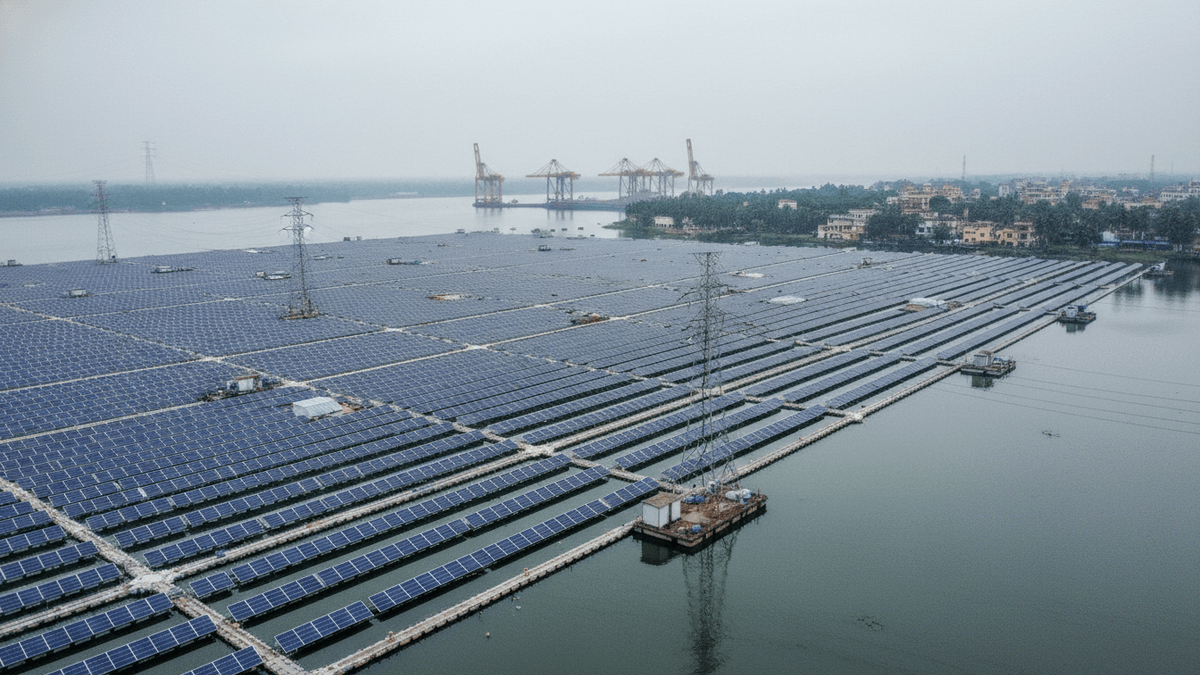
Floating solar array on a lake with transmission towers and port cranes in the distance.
West Bengal is at a pivotal juncture, aiming to revitalize manufacturing and attract investment by securing a reliable energy supply. With electricity demand projected to increase by nearly 5 percent annually over the next two decades and industrial captive power demand expected to surge by almost 19 percent annually between 2021 and 2032, the state’s economic future hinges on sustainable energy solutions, according to a recent Observer Research Foundation article.
The report underscores the dangers of over-reliance on imported fossil fuels, particularly amidst global geopolitical instability and price volatility. For a state historically dependent on coal, transitioning to cleaner energy sources is essential to reduce pollution and alleviate financial strain. West Bengal has significant renewable energy potential, with over 19,000 MW of ground-mounted solar, 3,567 MW of floating solar, nearly 23,000 MW of wind, and close to 2,900 MW of biomass potential.
Renewable Energy Round-the-Clock (RE-RTC) systems are key to West Bengal’s energy transition and economic growth. Unlike intermittent standalone solar or wind, RE-RTC combines renewable generation with storage solutions to provide consistent, reliable power, crucial for industrial sectors like manufacturing, logistics, and data centers.
The shift to RE-RTC offers several advantages. First, it enhances industrial competitiveness by providing uninterrupted electricity, reducing vulnerability to coal-related disruptions, and aligning with global supply chains that prioritize low-carbon manufacturing. Second, it strengthens economic resilience by moving away from expensive, coal-heavy power systems. RE-RTC systems offer greater long-term price certainty and reduced exposure to fuel volatility, with battery storage costs declining.
Currently, West Bengal largely procures renewable power from outside the state, missing an opportunity to build its own clean energy pipeline through floating solar, solar parks, biomass projects, and pumped-storage systems. Such a strategy could attract climate and development finance. Third, RE-RTC advances development outcomes by enabling a sustained reduction in pollution and emissions, improving air quality, and boosting workforce productivity.
A successful energy transition in West Bengal requires a just-transition strategy for coal districts, ensuring livelihoods are protected, workers are re-skilled, and industrial land is repurposed. By transforming its coal economy into a foundation for industrial revival through clean power, West Bengal can pave the way for future growth.
About the Author