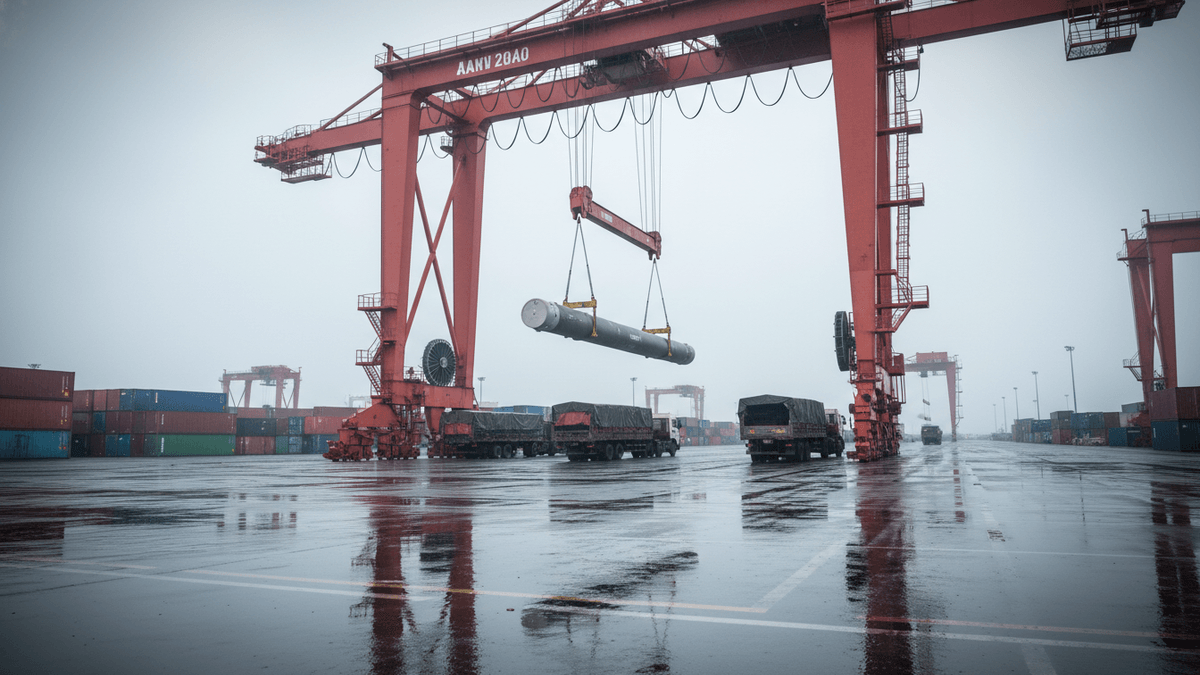
Gantry crane loads large missile component onto truck at a wet, overcast port terminal.
Vietnam has inked a $629 million deal to acquire BrahMos missiles from India, according to Defence Secretary Rajesh Kumar Singh. Speaking at the Shangri-La Dialogue in Singapore, Singh indicated that an agreement with Indonesia is also in the final stages. This move underscores India’s willingness to share advanced defense technologies with trusted partners in Southeast Asia.
The BrahMos missile, a supersonic cruise missile, is a joint product of India and Russia. It’s considered one of the most advanced missiles in its class, capable of engaging targets at a range of up to 400 kilometers. The deal with Vietnam is not just a sale; it’s a strategic alignment, signaling closer defense ties between the two nations.
For India, this deal serves multiple purposes. First, it boosts India’s defense industry, showcasing its ability to produce and export high-end military equipment. Second, it strengthens India’s strategic presence in Southeast Asia, a region of increasing geopolitical importance. By sharing defense technologies, India aims to build stronger relationships and foster regional stability.
However, the deal also has broader implications. It comes at a time when geopolitical tensions in the region are on the rise, particularly in the South China Sea. Vietnam, like several other Southeast Asian countries, has territorial disputes with China in these waters. The acquisition of BrahMos missiles could be seen as a move to bolster Vietnam’s defense capabilities and assert its sovereignty.
Looking ahead, the deal could pave the way for further defense cooperation between India and other Southeast Asian nations. As Singh noted, India is open to sharing advanced technologies with trusted partners. This could include not just missiles, but also other defense equipment and expertise. The key will be building trust and ensuring that these partnerships contribute to regional stability, rather than escalating tensions.
About the Author