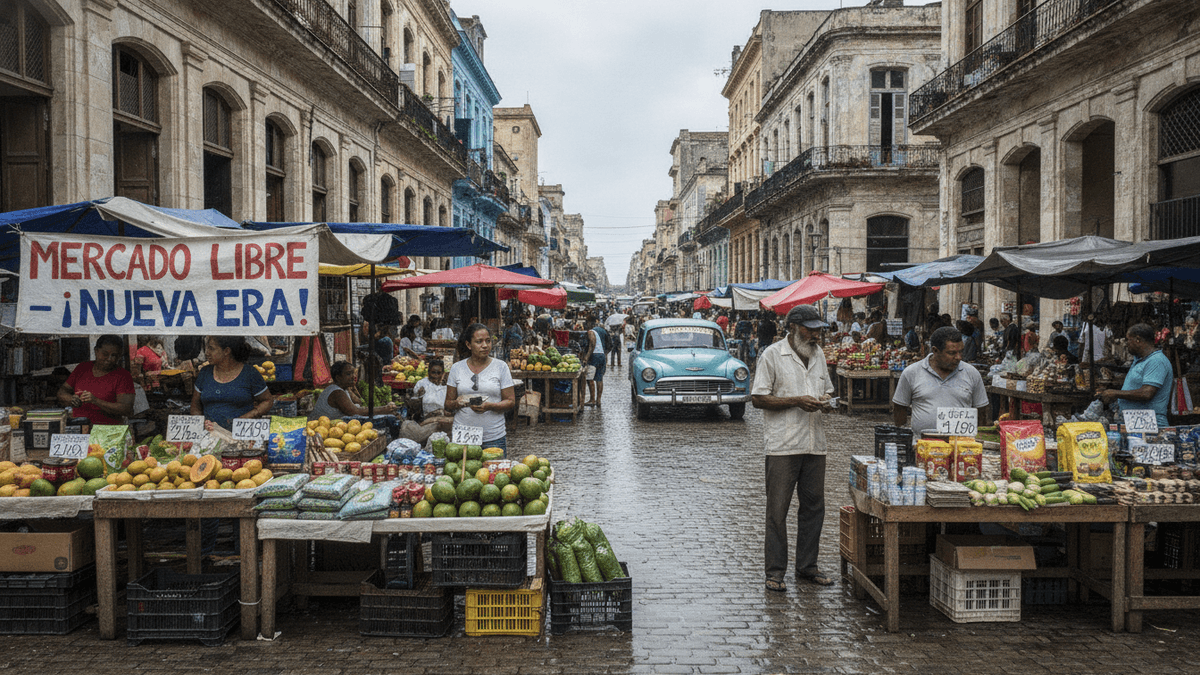
Havana street market with a "MERCADO LIBRE" banner under overcast sky
In a dramatic pivot, Cuba has unanimously passed 176 sweeping economic reforms, signaling the most significant shift towards free-market principles since the 1959 Cuban Revolution. This unprecedented move comes as the island nation grapples with a severe economic crisis, marked by a painful 7% contraction in its Gross Domestic Product.
The reforms, championed by Prime Minister Manuel Marrero and President Miguel Mario Díaz-Canel Bermúdez, are designed to drastically reduce the state’s footprint in the economy. The goal is clear: attract much-needed foreign investment and modernize a state-socialist system buckling under internal pressures and external sanctions. President Díaz-Canel emphasized the urgency, stating, “We cannot remain the same; we must transform. These are times of transformation.”
Key among the new measures is a significant expansion of the private sector, which will now see employee limits removed and corporate as well as multi-ownership structures permitted. The financial landscape is also set for a shake-up with the authorization of private banks and a partial dollarization of the economy. Furthermore, Cuba aims to transition from universal to more targeted subsidies, open up foreign trade, and facilitate foreign direct investment in critical sectors like agriculture, banking, and tourism.
This economic overhaul is a direct response to a confluence of crises. Prolonged blackouts, chronic shortages of fuel and basic goods, and capital flight by foreign businesses—exacerbated by U.S. sanctions that even led to the Central Bank of Cuba halting Visa and Mastercard transactions—have pushed the country to the brink. These reforms effectively dismantle longstanding state monopolies, creating avenues for investors to acquire stakes in previously state-owned enterprises. Even Raúl Guillermo Rodriguez Castro, grandson of Fidel Castro, has reportedly acknowledged the necessity for Cuba to diversify its economic and business practices, underscoring the broad consensus for change.
About the Author