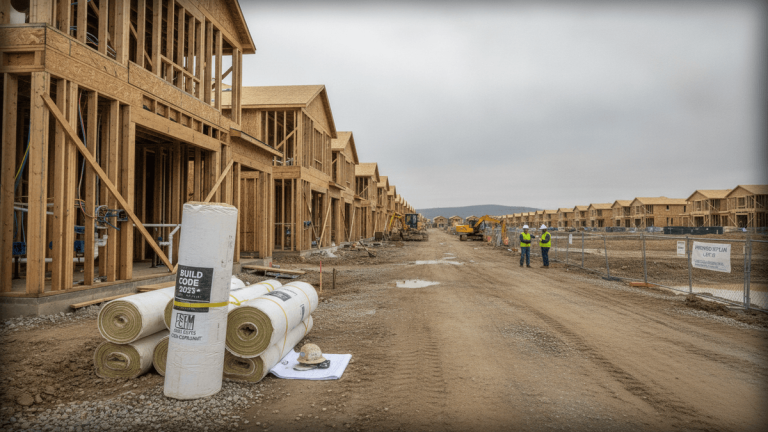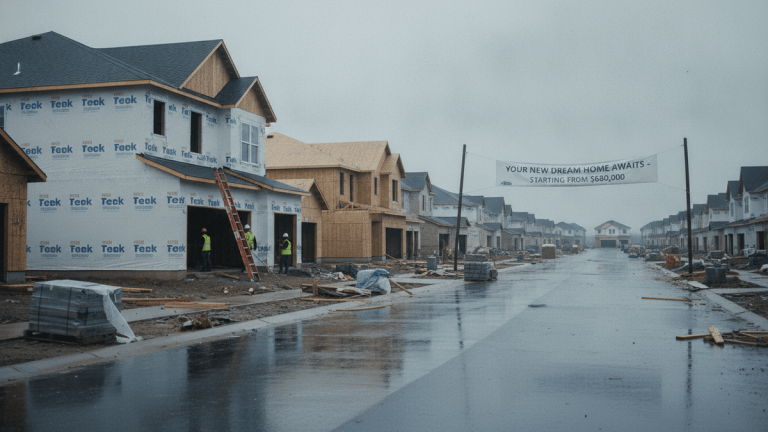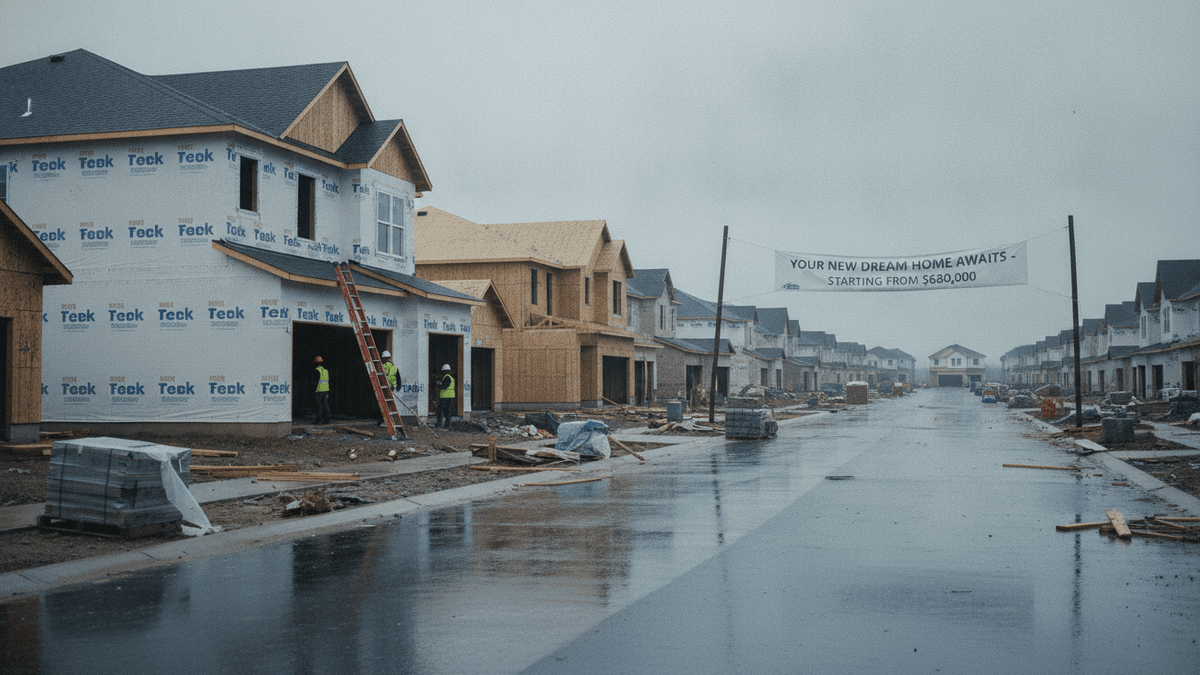
New housing construction site on an overcast, rainy day, banner advertising starting from $680,000.
Aspiring homeowners hoping for a return to the favorable housing affordability seen before 2022 may be disappointed, according to a new report from Morgan Stanley. The market is adjusting to a landscape of higher costs and tighter supply, making a significant rebound in affordability unlikely.
Sarah Wolfe, a senior economist and strategist at Morgan Stanley, noted that while modest improvements are possible, the market is unlikely to revert to past conditions. A brief dip in mortgage rates below 6% in February offered a fleeting moment of optimism, but rates quickly climbed back above 6%, dampening any potential momentum.
“In today’s market, small changes in rates have outsized effects on affordability, which remains historically strained, due in part to this rate-sensitivity,” Wolfe stated in the report. She highlighted that the period from 1990 to 2021 saw less affordable conditions than the present only about 15% of the time, indicating that even current modest improvements are tight compared to recent decades.
The financial strain on buyers is substantial. Morgan Stanley Research estimates that the monthly payment for a median-priced home is now around $2,000, approximately double the carrying cost from five years ago. This increased financial burden is compounded by a significant drop in housing turnover, with about 70% of existing homeowners holding mortgage rates below 5% and half having rates below 4%. These homeowners are reluctant to sell and take on new, higher-rate mortgages, leading to the lowest turnover in roughly 40 years.
With fewer existing homes on the market, new construction plays a more critical role. However, supply is not increasing fast enough to significantly lower entry barriers. This has also impacted first-time homebuyers, who, despite the average age remaining around 36, now have higher average credit scores (734, up from 718 in 2019) and larger mortgage balances, averaging $334,000 in 2024, up from $240,000 in 2019 and $195,000 in 2014. These buyers are also increasingly shifting to more affordable zip codes.
Looking ahead, Morgan Stanley projects that even if mortgage rates moderate to around 5%, mortgage payments would decrease from about 24% to 21% of household income. This is still considerably higher than the 15% seen after the 2007-2009 financial crisis. Wolfe advises that waiting for prices to revert to pre-2022 affordability levels might be an ineffective strategy, suggesting that buying when financially feasible and when the right opportunity arises is a more practical approach.
About the Author