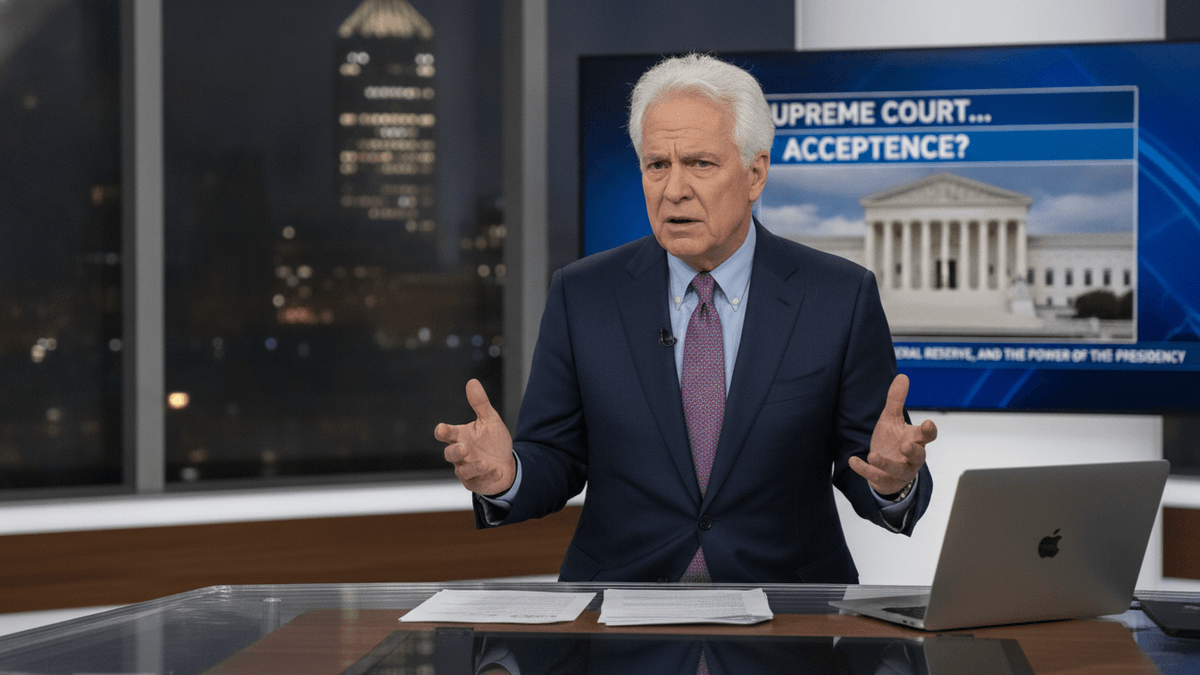
Larry Kudlow discusses Supreme Court decisions on a news set at night
Larry Kudlow, in a recent piece, shares his perspective on the inherent human experience of encountering situations and decisions that defy easy comprehension. He extends this observation to the realm of legal rulings, particularly those from the Supreme Court, suggesting that acceptance is often the most practical approach, even in the face of confusion or disagreement.
Kudlow highlights a recent Supreme Court decision that allows the President to fire an appointee to the Federal Trade Commission (FTC). He notes Justice Neil Gorsuch’s concurring opinion, which stated that “independent agencies are not so independent after all.” Kudlow finds this ruling agreeable, viewing it as a reversal of a previous decision and an affirmation of executive authority, allowing the chief executive to define “cause” for dismissal.
However, Kudlow expresses bewilderment regarding the Court’s handling of Governor Lisa Cook’s situation at the Federal Reserve. He contrasts this with the FTC ruling, suggesting that the Court deemed the Federal Reserve, another so-called independent agency, to be truly independent. He references historical precedents, including the First and Second Banks of the United States, and the Federal Reserve Act of 1913, noting that many believe the central bank’s charter to be ambiguous and that presidents should have the authority to remove its governors.
Further complicating the matter for Kudlow are the concurring opinions. Justice Brett Kavanaugh’s opinion, for instance, leaves open the question of whether the President can lawfully remove Governor Cook for cause, stating that the ultimate decision will depend on the facts regarding her actions, which are yet to be fully determined. Justice Clarence Thomas, in dissent, called the ruling “incorrect,” questioning the Court’s concern for the President’s removal of a Board member for the first time in the Federal Reserve’s history while upholding an injunction against the President’s removal of an executive officer for the first time in the Constitution’s history.
The article touches upon the accusations of mortgage fraud against Ms. Cook, who allegedly claimed multiple primary residences in different states. Kudlow questions her suitability for a position of monetary power given these allegations. He notes that her case was referred to the Justice Department for a criminal investigation in August 2025, but as of now, no charges have been filed, leaving the situation unresolved and open to speculation.
Kudlow concludes by referencing President Trump’s statement on Truth Social, which suggested the Supreme Court’s decision was procedural and did not settle the issue of firing Ms. Cook for cause. Kudlow finds himself in a state of acceptance, acknowledging that while he may not fully understand the intricacies of these judicial decisions, accepting them appears to be the only recourse for now.
About the Author