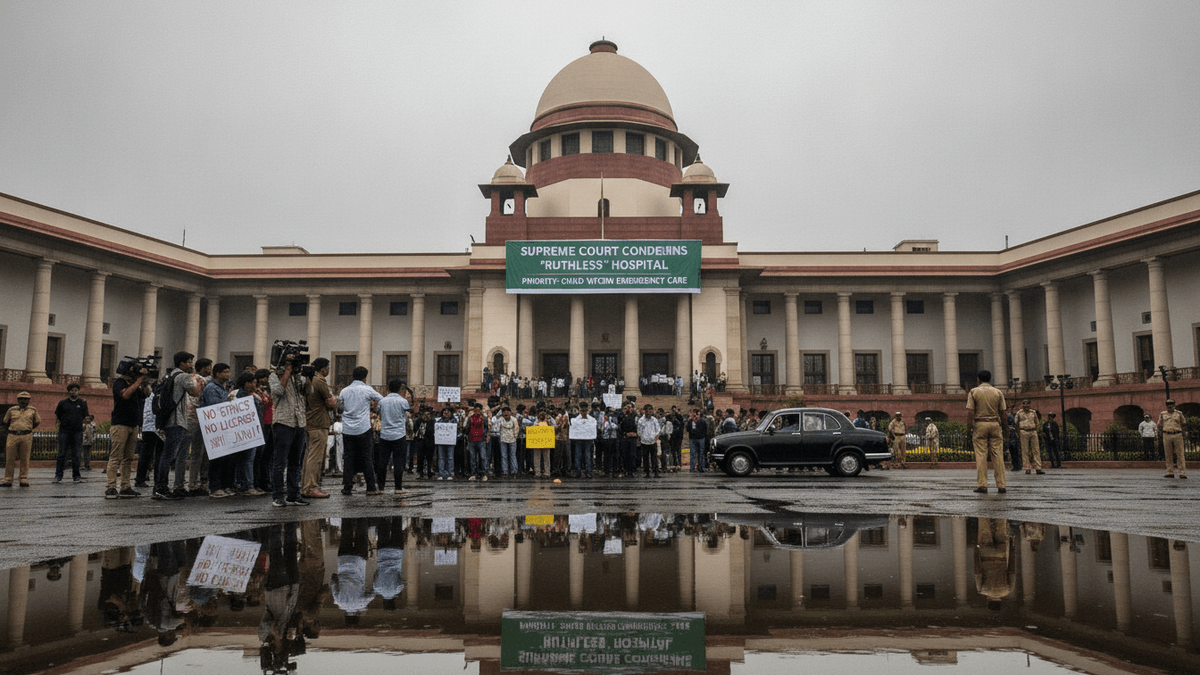
Protesters and media gather outside the Supreme Court of India on a rainy day.
The Supreme Court on Friday delivered a scathing rebuke to a private hospital and one of its doctors for allegedly denying critical emergency medical treatment to a four-year-old girl, who was later identified as a victim in the horrific Ghaziabad rape and murder case. The bench, led by Chief Justice of India Surya Kant, condemned the alleged conduct as “merciless,” “ruthless,” and “insensitive,” questioning the doctor’s professional ethics and warning the hospital of severe repercussions.
This incident brings into sharp focus the ethical obligations of healthcare providers, especially in emergency situations. The court emphasized that doctors have a fundamental duty to provide emergency care, irrespective of a patient’s financial condition or the specific facilities available at their hospital. The Chief Justice remarked that in such a critical situation, a doctor should have shown empathy and ensured the child received immediate medical assistance, even if it meant personally facilitating her transfer to another facility.
During the hearing, it was revealed that two private hospitals had allegedly refused to admit or provide emergency treatment to the child, effectively denying care during her crucial “golden hour,” before she eventually reached a government hospital. This alleged denial of immediate medical assistance formed a central focus of the court’s proceedings, highlighting a systemic failure in emergency response.
Beyond the hospital’s alleged conduct, the Supreme Court has previously raised significant concerns regarding the Ghaziabad Police’s handling of the overall investigation. The court pointed to inexplicable delays in registering the First Information Report (FIR) and noted that the case was initially investigated solely as a murder, despite post-mortem findings clearly indicating injuries consistent with sexual assault. Charges of rape and offenses under the Protection of Children from Sexual Offences (POCSO) Act were reportedly added only at a much later stage.
The bench had previously directed the Ghaziabad Commissioner of Police and the Station House Officer of Nandgram Police Station to appear in person to explain these discrepancies, remarking on a perceived “hush-hush approach” and a lack of proper initial inquiry. Further deficiencies were also pointed out in the medical and forensic processes, including the inquest report’s failure to record whether the child was clothed when found, despite mentioning bleeding injuries, and an inadequate addressing of crucial issues related to sexual assault in the initial post-mortem examination.
Senior Advocate N Hariharan, representing the victim’s father, further alleged that the family faced intimidation, wrongful confinement, assault, and pressure to remain silent after the incident, leading to a profound loss of faith in the local police. The ongoing Supreme Court intervention underscores the critical need for accountability from both healthcare institutions and law enforcement agencies in cases involving vulnerable victims. The matter is scheduled for further hearing next week, promising continued scrutiny into these grave allegations.
About the Author