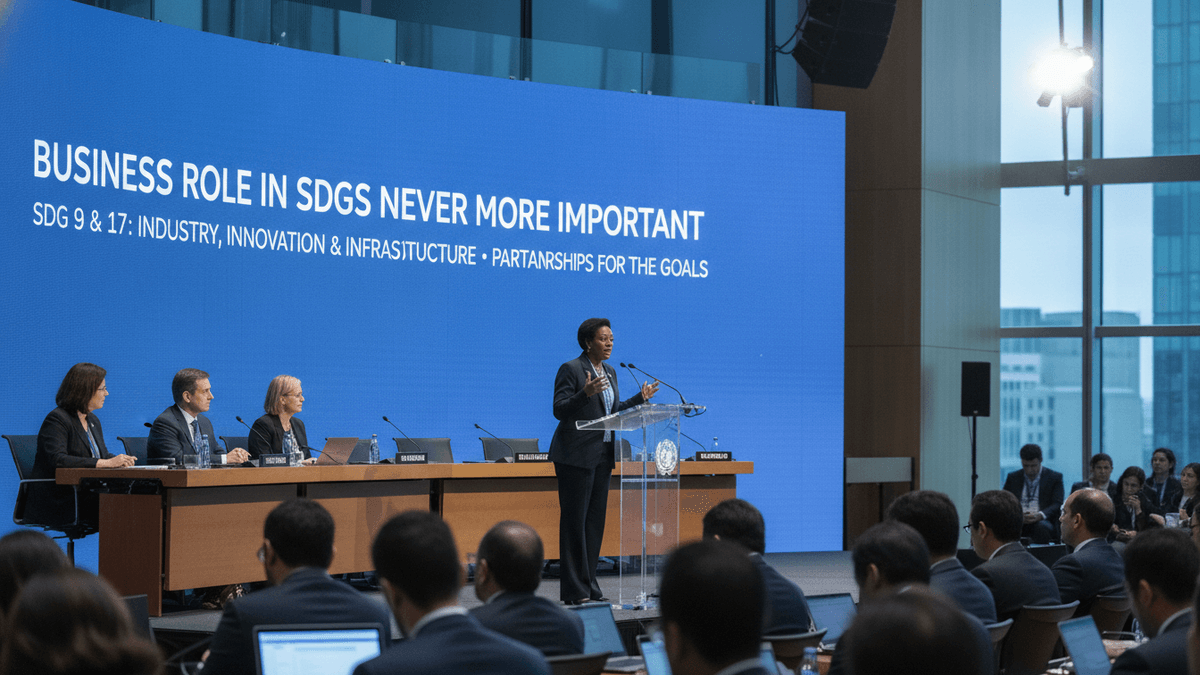
Sanda Ojiambo speaking at the UN Global Compact SDG Business Forum.
The global business landscape is at a critical juncture, with the private sector’s role in achieving the United Nations Sustainable Development Goals (SDGs) now more vital than ever. This was the resounding message from Sanda Ojiambo, CEO and executive director of the UN Global Compact, at the 2026 SDG Business Forum in New York.
Ojiambo underscored that sustainability isn’t merely a corporate social responsibility initiative; it’s a fundamental driver for competitiveness, resilience, and the creation of long-term value for any enterprise. For startup founders, investors, and operators, this translates into a strategic imperative: integrating sustainability is no longer optional but essential for future growth and market relevance.
The forum, co-convened by the UN Department of Economic and Social Affairs (UN DESA), the UN Global Compact, and the International Organisation of Employers (IOE), served as a crucial platform for bridging the public and private sectors. Discussions honed in on key SDGs, specifically SDG 9 (Industry, Innovation and Infrastructure) and SDG 17 (Partnerships for the Goals). These are particularly relevant for the business community, emphasizing the need for robust infrastructure, sustainable industrialization, and fostering global partnerships.
A significant portion of the dialogue focused on how industries must adapt to rapid technological changes, the transformative potential of artificial intelligence (AI), and the urgent shift towards cleaner energy systems. For businesses, this means not just mitigating environmental impact but actively innovating to create solutions that address these global challenges, thereby unlocking new markets and revenue streams.
The event also saw the launch of the UN Global Compact’s new Action 55(c) Insights Brief. This document provides actionable recommendations designed to strengthen private sector engagement within UN frameworks. For businesses looking to align their operations with global sustainability agendas, this brief offers a roadmap for more effective participation and influence, ensuring their contributions are recognized and amplified. Embracing these recommendations can provide a competitive edge, attract impact-driven investment, and build a more resilient business model in an increasingly interconnected world.
About the Author