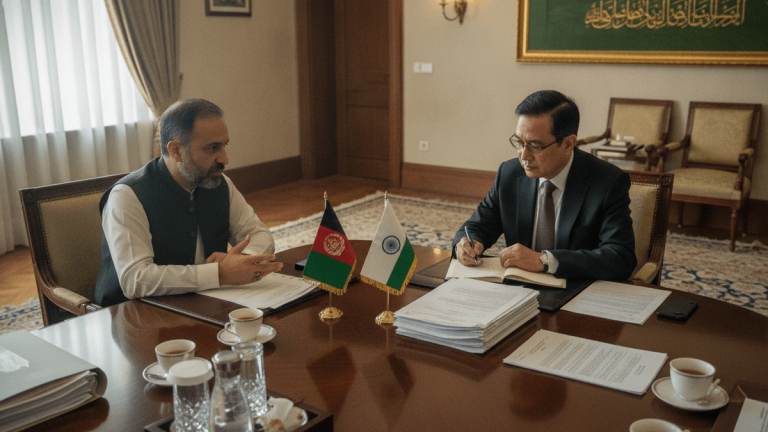
Afghanistan-India Joint Trade Dialogue meeting in progress
Afghanistan is strategically pivoting its trade focus, looking to India for deeper economic partnerships and eyeing Iran’s Chabahar port as a vital alternative route. This move comes as its traditional transit trade with Pakistan significantly declines, prompting a recalibration of regional economic strategy.
The Afghanistan Chamber of Commerce and Investment (ACCI), led by Chairman Sayed Karim Hashemi, recently met with Indian Ambassador Yatin Patel in Kabul. Discussions centered on streamlining business procedures, easing administrative hurdles, and facilitating business visas for Afghan traders. This initiative is a direct response to the reduced trade volume with Pakistan, making the India-developed Chabahar port in Iran a critical bypass for Afghan goods.
Bilateral trade between India and Afghanistan reached $907.85 million in 2025-26, signaling robust potential. India’s commitment to the relationship is further evidenced by the recent visit of Afghan Agriculture Minister Mawlawi Ataullah Omari to New Delhi and its investment in infrastructure, including the 218-km Zaranj-Delaram highway, crucial for boosting trade and humanitarian aid.
Mr. Hashemi emphasized key areas for sustained economic cooperation, including agricultural exports, handicrafts, mining, and mineral resources. Proposals for joint trade exhibitions and exchange programs for trade delegations underscore a long-term vision. This strategic shift isn’t just about trade; it represents a broader recalibration of regional economic and political influence, offering Afghanistan greater autonomy and potentially enhancing India’s access to Central Asian markets.
Both nations have committed to fostering long-term economic, political, and cultural ties through transparent, efficient, and mutually beneficial cooperation. For startup founders, investors, and operators, this opens new avenues in logistics, agricultural supply chains, and mineral extraction, alongside potential challenges in navigating new regulatory landscapes and infrastructure development in a evolving geopolitical environment.
About the Author