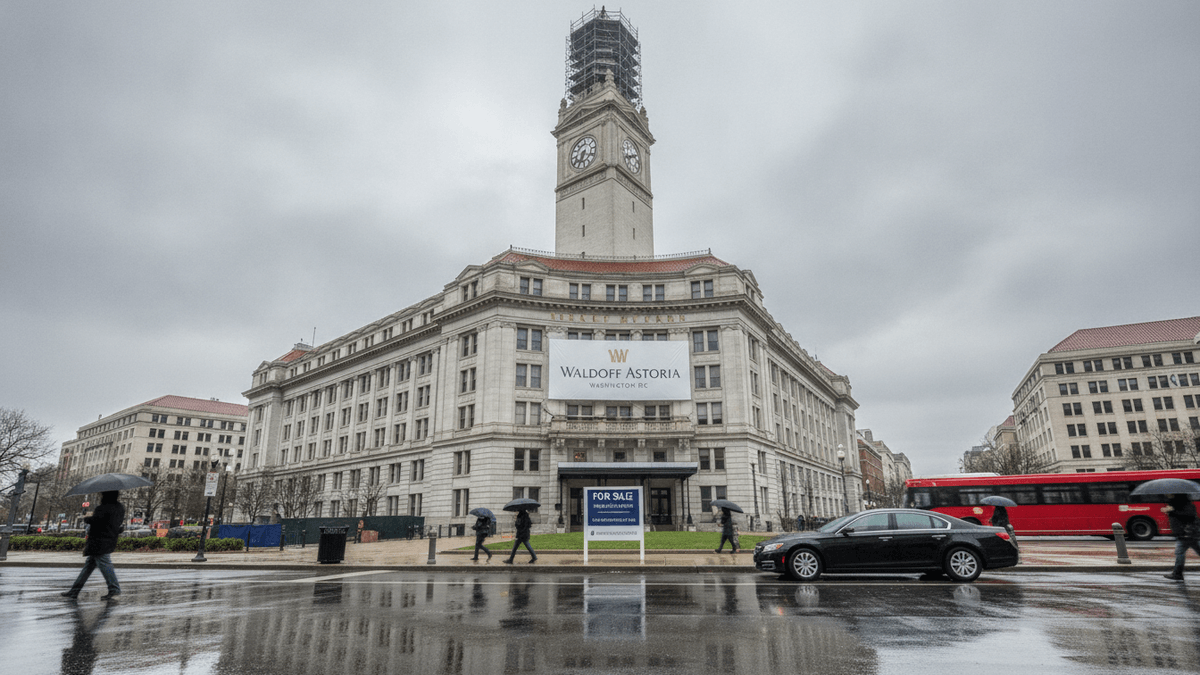
The Old Post Office Building, Washington D.C. under overcast sky
The General Services Administration (GSA) has announced the sale of the Old Post Office Building, a landmark at 1100 Pennsylvania Avenue in Washington, D.C. This historic structure formerly housed the Trump International Hotel from 2016 to 2022, before the Trump family firm sold the leasing rights for $375 million. The hotel subsequently reopened as the Waldorf Astoria Washington D.C., managed by Hilton.
The sale includes significant terms designed to protect the building’s heritage. These covenants ensure permanent public access to the iconic clock tower and establish strong protections for the building’s architectural integrity. Additionally, a fine arts covenant will maintain the American public’s ownership of artworks within the facility, including Robert Irwin’s “48 Shadow Planes” and a historic Benjamin Franklin Statue.
BDT & MSD Partners, a merchant bank, has acquired the building and land for $80 million, according to reports from The Wall Street Journal. The bank is reportedly discussing selling the property for a total of $400 million. Hilton will continue to operate the hotel as the Waldorf Astoria under a long-term agreement with the new leaseholder.
Completed in 1899, the Old Post Office Building originally served as the headquarters for the U.S. Post Office Department and the main post office for Washington, D.C. Its Romanesque Revival architecture, featuring a prominent clock tower and atrium, makes it one of Pennsylvania Avenue’s most recognizable buildings, situated near the White House and other key landmarks.
Before its redevelopment into a hotel, the building incurred approximately $6 million in annual losses for taxpayers. Since then, over $250 million in private sector capital has been invested. Taxpayer revenues from the property, including the current sale, are expected to exceed $110 million over the last decade.
The GSA has been actively selling off numerous federally-owned properties as part of an initiative to reduce federal spending on underutilized office space and real estate.
About the Author