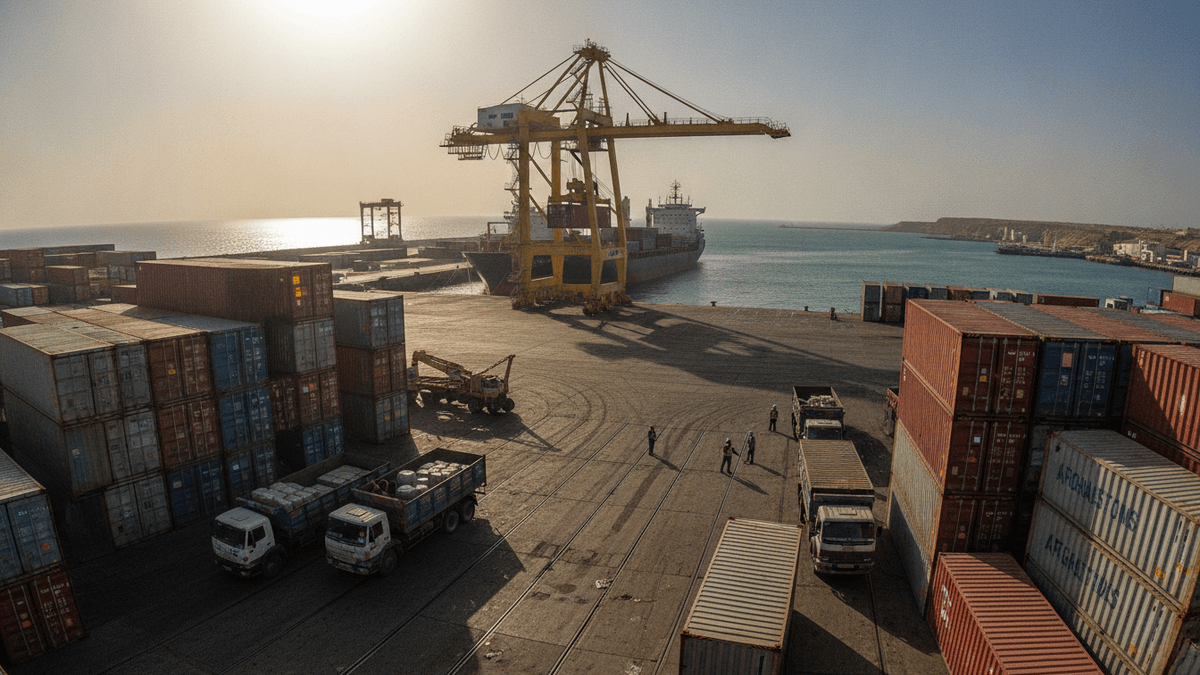
Chabahar Port container terminal at sunset
In a significant geopolitical and economic pivot, Afghanistan is actively pursuing deeper trade and investment ties with India. This strategic shift comes as Afghanistan’s transit trade with neighboring Pakistan has dramatically collapsed, prompting Kabul to seek more stable and reliable economic partnerships.
The Afghanistan Chamber of Commerce and Investment (ACCI) recently met with Indian Ambassador to Afghanistan Yatin Patel in Kabul, advocating for streamlined business procedures, reduced administrative hurdles, and faster issuance of business visas. This initiative underscores Afghanistan’s urgent need to diversify its economic routes and partners.
The backdrop to this push is stark: Afghanistan’s transit trade with Pakistan, once robust at approximately $5 billion in FY21, has plummeted to a mere $367 million by FY26. This precipitous decline has forced Afghanistan to explore alternative corridors, notably through Iran.
India has been a proactive partner in this regard, investing in connectivity projects like the Chabahar Port in Iran. This port offers Afghanistan direct access to the sea, strategically bypassing Pakistan, which has historically restricted overland transit of Indian goods to Afghanistan. Bilateral trade between India and Afghanistan has consistently hovered around the $1 billion mark over the past five years, reaching $907.85 million in 2025-26, demonstrating a resilient, albeit constrained, economic relationship.
ACCI Chairman Sayed Karim Hashemi emphasized Afghanistan’s commitment to long-term economic cooperation with India, proposing measures to boost Afghan exports, enhance logistics infrastructure, and facilitate business visas. Ambassador Patel welcomed these proposals, affirming India’s support and outlining plans for joint trade exhibitions, specialized business forums, and exchanges of trade delegations.
This renewed focus on India is not isolated. India’s engagement has been steadily increasing, highlighted by a recent visit from Afghan Agriculture Minister Mawlawi Ataullah Omari to New Delhi. Furthermore, India’s construction of the 218-km Zaranj-Delaram highway in western Afghanistan, linking the Iranian border with Afghanistan’s ring road network, is a critical piece of infrastructure designed to facilitate trade and humanitarian supplies, extending India’s reach into Central Asia.
For businesses and investors, this evolving dynamic presents both challenges and opportunities. The reorientation of Afghanistan’s trade routes could unlock new corridors for goods and services, potentially reducing reliance on traditional, often volatile, pathways. While the immediate economic impact of the Pakistan trade crash is severe for Afghanistan, the proactive engagement with India signals a strategic move towards a more diversified and potentially more stable economic future for the landlocked nation.
About the Author




