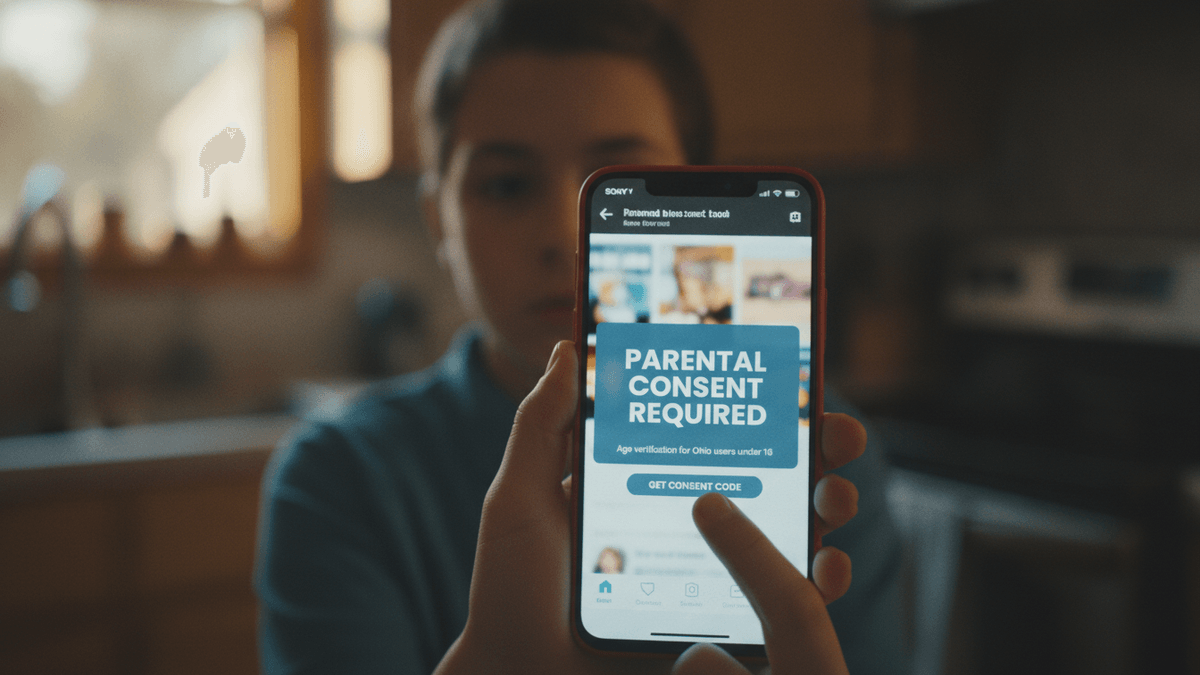
A person holding a smartphone displays a "Parental Consent Required" notification.
In a significant ruling for digital safety and parental rights, a federal appeals court has determined that Ohio can enforce a law mandating parental consent for children under 16 to access social media platforms. The 6th U.S. Circuit Court of Appeals, in a 2-1 decision, overturned a previous lower-court injunction that had blocked the implementation of Ohio’s Social Media Parental Notification Act.
The law, enacted in 2023 and effective since 2024, requires social media companies to verify the ages of their users and obtain consent from a parent or guardian before allowing individuals under the age of 16 to create or maintain accounts. The legislation includes a specific 11-factor test to identify websites likely to be accessed by minors and outlines several exceptions.
State officials in Ohio have argued that the law is crucial for protecting children from various online risks, including exposure to inappropriate content, excessive usage, and invasive data collection practices by social media companies.
The law faced an immediate legal challenge from NetChoice, a technology industry trade group representing major platforms like YouTube, TikTok, and Meta (parent company of Facebook and Instagram). NetChoice contended that the law was unconstitutionally vague and infringed upon minors’ First Amendment rights by restricting their access to protected speech and potentially forcing them to reveal personal information for age verification.
However, the appeals court disagreed. U.S. Circuit Judge Eric Clay, writing the majority opinion, stated that the Act’s parental consent requirement represents a “marginal burden” that “precisely targets the multi-faceted problem that Ohio has identified: Children’s unsupervised assent to terms and conditions for use of platforms that take advantage of and harm them.”
Ohio Attorney General Andy Wilson hailed the ruling as a victory for families, emphasizing that parents, not social media companies, should have the final say in their children’s online activities. “We have an obligation to keep our children safe, and today, the most dangerous place for our kids is the internet,” Wilson stated, adding that the decision empowers parents with oversight tools.
NetChoice has indicated its disapproval of the ruling, asserting that it jeopardizes the privacy and constitutional rights of Ohio residents. The group remains confident that the law will ultimately be struck down, with a spokesperson for the NetChoice Litigation Center stating, “An unconstitutional law protects no one, and we remain focused on ensuring the First Amendment rights of Ohioans are protected.” The organization is currently reviewing its legal options.
About the Author