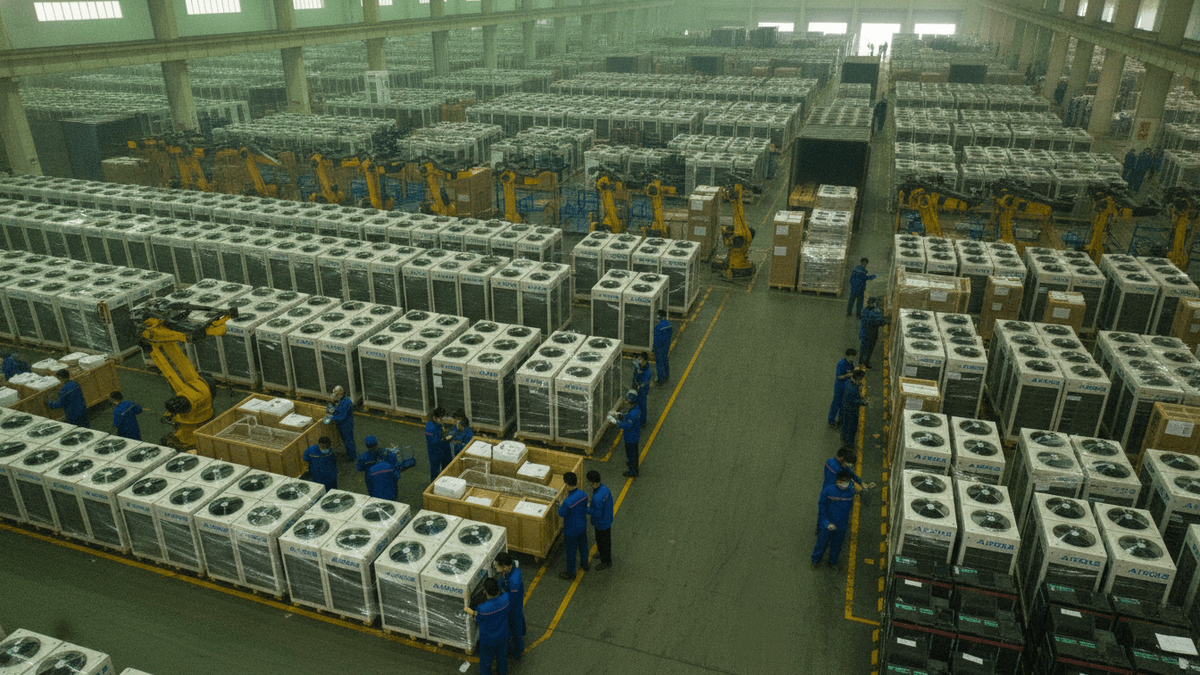
Workers and robotic arms in a large Chinese factory prepare cooling units for export.
As persistent heatwaves grip the Northern Hemisphere, a significant shift is underway in the global cooling market: Chinese manufacturers are experiencing an unprecedented surge in demand for their heat pumps and air conditioners from the United States and Europe.
This isn’t just a minor uptick; it’s a dramatic increase. Companies like Foshan Airosd Thermal Technology Co. are reporting a substantial boost in heat pump exports, devices lauded for their superior energy efficiency. Data further illustrates this trend: household air conditioner exports to Western Europe jumped 9.7 percent year-on-year between January and May, with portable units alone skyrocketing over 70 percent. The North American market followed suit, seeing a 12 percent rise in air conditioner exports in May.
Several factors are converging to drive this demand. First, the obvious: record-breaking temperatures are forcing consumers and businesses to seek immediate cooling solutions. Second, there’s a growing global emphasis on energy efficiency, making heat pumps particularly attractive. This push is amplified by policy, notably the US Inflation Reduction Act, which offers subsidies that make energy-efficient upgrades more accessible to American consumers.
The strategic implication for startup founders and investors is clear: Chinese manufacturing’s agility and capacity are proving critical in meeting sudden, large-scale overseas demand. This isn’t just about consumer convenience; it highlights the resilience and responsiveness of global supply chains when confronted with climate-driven market shifts. While analysts suggest this particular surge might be phase-specific, normalizing as temperatures ease, the underlying drivers — climate change and the imperative for energy efficiency — are long-term trends.
What does this mean for the future? Companies that can rapidly innovate, scale production, and navigate international logistics effectively will be best positioned to capitalize on these evolving market dynamics. The current demand for Chinese cooling devices, even extending to bulk fan purchases on B2B platforms with orders in France up 31 percent and Sweden surging 375 percent, underscores a crucial lesson: the climate crisis is not just an environmental challenge, but a powerful economic catalyst reshaping industries and creating new opportunities for agile players.
About the Author