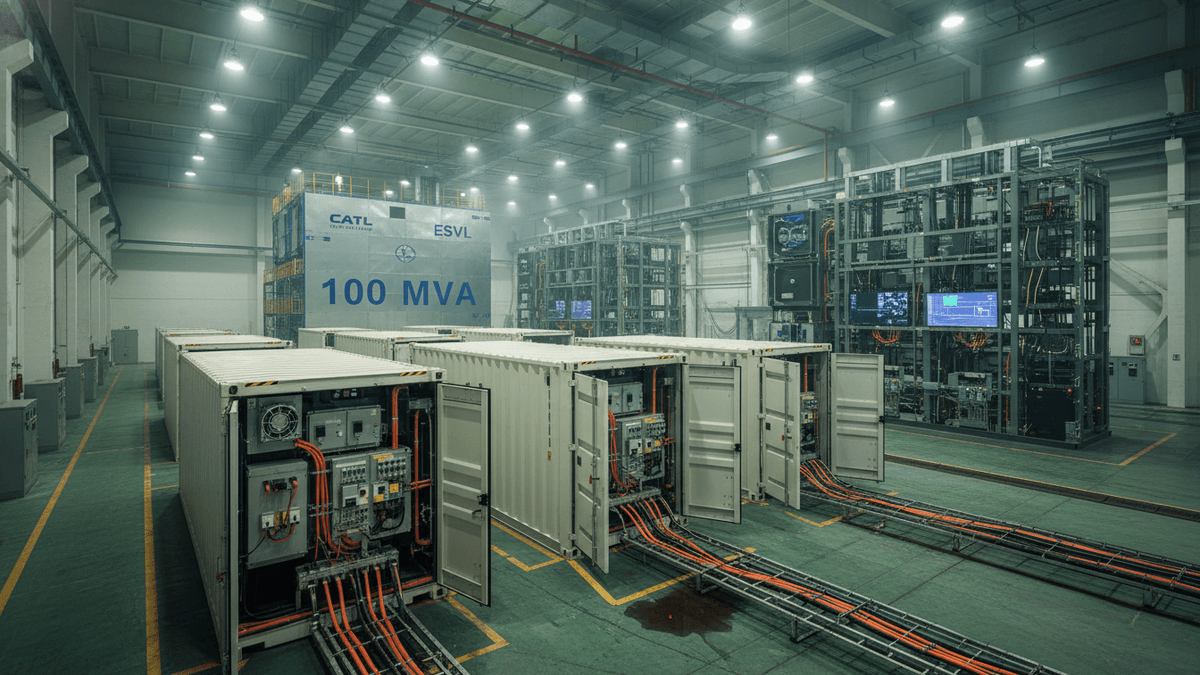
CATL ESVL 100 MVA grid integration laboratory with multiple energy storage containers
CATL, the global leader in energy storage battery sales, has launched the Xiamen Energy Storage Validation Research Institute (ESVL), a 3 billion yuan ($440 million) facility. This aims to be the world’s largest one-stop testing platform for energy storage, addressing disconnects between equipment performance and real-world operation, which often lead to grid-connection delays.
Currently, nearly one-fifth of large-scale energy storage power stations globally underperform, and 46.5% experience grid-connection delays exceeding two months. These issues impact the bankability of energy storage projects by complicating financial modeling and risk assessment.
The ESVL platform elevates testing standards to the entire station level, featuring five core laboratories that simulate real grid conditions, extreme climates, and high-voltage failures. It houses the world’s first station-level grid integration laboratory, equipped with a 100 MVA grid simulator—14 times larger than a similar platform at the US National Renewable Energy Laboratory. This allows simultaneous testing of over 10 large-scale energy storage containers, reducing on-site commissioning times. The thermal safety and combustion laboratory provides ample space for real-fire and explosion-proof tests, offering crucial data for equipment iteration and safety design.
Wu Kai, CATL’s chief scientist, emphasized the need for scientific rigor as the energy storage industry expands, advocating for higher quality standards and pre-delivery validation. Chen Xiaobo, head of ESVL, stated that the platform is open to the global energy storage industry and collaborates with certification bodies like TÜV SÜD and TÜV Rheinland to provide globally recognized testing services.
CATL, with 121 GWh in energy storage battery sales in 2025 and a 30.4% market share, aims to establish a new trust framework for global energy storage assets through ESVL, transforming energy storage into a long-term infrastructure asset backed by solid evidence.
About the Author