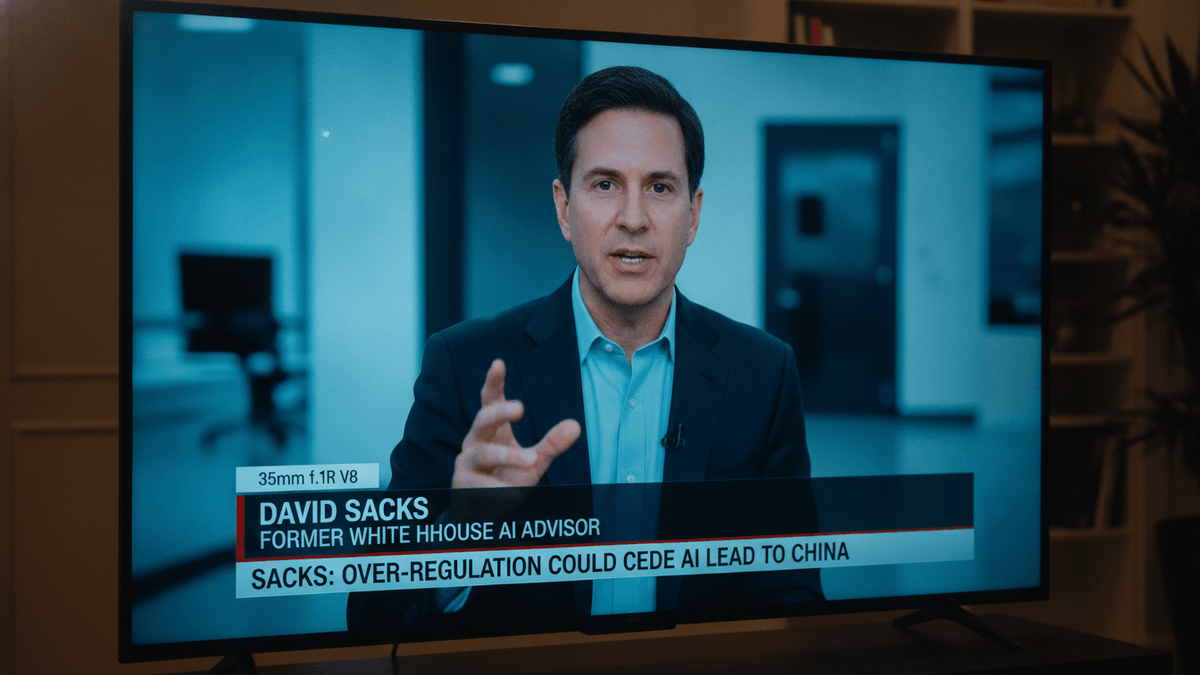
Television screen displaying David Sacks, "Former Whitehouse AI Advisor."
Former White House “AI czar” David Sacks issued a stark warning this week: overregulating artificial intelligence in the United States could effectively hand over the global AI race to China. Sacks, a prominent Silicon Valley entrepreneur, believes the U.S. currently holds only a slim lead, estimated at six to nine months, making every month critical in the competition.
Speaking on “Kudlow,” Sacks expressed concern that a desire for extensive government oversight, akin to an “FDA for AI,” could stifle innovation at a crucial juncture. He drew parallels between the current discourse around AI regulation and the approach to climate change, suggesting a potential “moral panic” driving premature and excessive governmental intervention without sufficient evidence of imminent catastrophe.
“If you try to have an FDA for AI and there are some people who want to go that far, then I think we could lose this AI race to China,” Sacks stated. “We’re only six to nine months ahead of China. So really, every month counts.”
His remarks follow President Donald Trump’s recent executive order establishing a voluntary framework for AI companies to share advanced models with the federal government prior to public release. Sacks advocated for a more measured, less restrictive regulatory approach, arguing that “too many guardrails” risk hindering progress.
While acknowledging that certain advanced AI models, such as Anthropic’s Mythos, present legitimate cybersecurity concerns comparable to “cyber weapons,” Sacks cautioned against a knee-jerk reaction. He urged a focus on addressing actual problems rather than succumbing to widespread anxiety about emerging technologies.
Countering fears of widespread job displacement due to AI, Sacks pointed to the recent strength of the U.S. labor market. He cited the May jobs report, which showed significantly more new jobs than economists predicted, suggesting that AI is, in fact, contributing to job growth rather than causing an “imminent job apocalypse.”
Sacks also emphasized the need for a unified federal approach to AI governance. He suggested that a single, cohesive playbook would be more beneficial than the current patchwork of state-by-state regulations. He indicated support for efforts to work with Congress to establish a compromise, favoring a singular rulebook over fragmented state-level controls.
President Trump is reportedly scheduled to meet with executives from leading AI companies this week, signaling the administration’s continued focus on shaping the future of AI policy.
About the Author