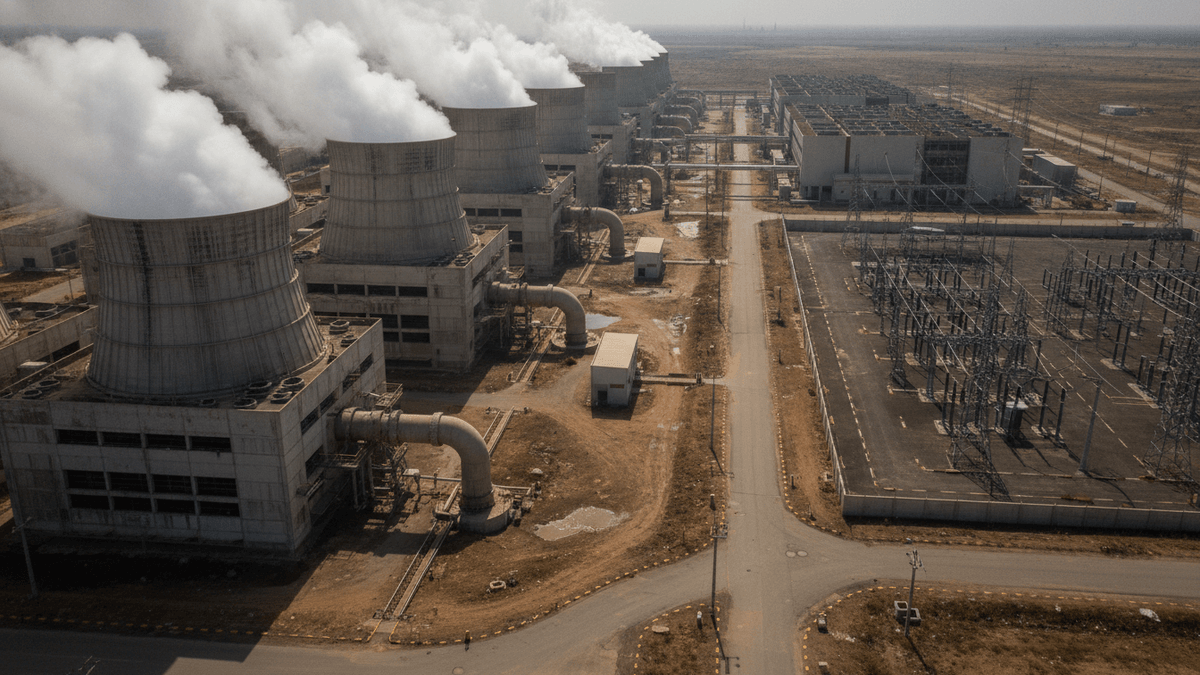
Aerial view of a large power plant with multiple cooling towers emitting steam
Artificial intelligence is no longer confined to research labs; it’s actively reshaping industries from hospitals to courtrooms, and critically, the landscape for small businesses. In India, this transformation is generating both opportunity and considerable anxiety, particularly as platforms like Google and ChatGPT redefine how customers discover and interact with local enterprises.
Traditionally, small businesses thrived on word-of-mouth referrals and prominent Google listings. Mohammad Amir, an AC repair business owner, exemplifies this, noting Google as a vital source of new clients. However, the advent of AI search is fundamentally altering this dynamic. Unlike traditional search, AI now aggregates Google listings with a broader digital footprint—websites, social media, and directories—to recommend businesses. This shift prioritizes structured data and established online authority over mere advertising spend, demanding that small businesses develop a complementary AI strategy to remain competitive. While traditional search still holds sway, AI search is rapidly gaining traction, with ChatGPT alone processing billions of prompts daily. This presents a significant challenge for small businesses, often engrossed in daily operations, unlike their knowledge-based counterparts with established digital presences.
Beyond customer discovery, the AI boom is also shifting hardware demands. The primary constraint is moving from training AI models to serving them efficiently (inference), which requires continuous, high-performance computation. Chipmakers like Nvidia are innovating with processors specifically optimized for inference, and AI developers are redesigning models for greater efficiency. Ankur Edkie, CEO of Murf AI, highlights that user expectations for millisecond response times are driving this demand for faster, cheaper, and scalable inference solutions. India’s AI ecosystem is largely focused on building applications atop existing models, emphasizing domain-specific use cases and crucial Indic-language capabilities.
However, the AI expansion comes with a less visible, yet critical, constraint: water consumption. Data centers, the backbone of AI operations, require immense amounts of water for cooling. Major Indian data center hubs—Noida, Greater Noida, Bengaluru, Mumbai, and Pune—are already experiencing receding groundwater levels. A typical hyperscale data center can consume millions of liters daily. With India undergoing a significant data center expansion, water scarcity is emerging as a critical factor influencing future data center locations, alongside the perennial need for reliable electricity.
Finally, the strategic imperative of “guarding the moat of data” cannot be overstated. Palantir’s warnings against transferring proprietary data to external AI systems underscore a fundamental truth: institutional knowledge and customer insights are a company’s most significant competitive advantage. To ensure long-term technological resilience and sustained competitive edge, businesses must maintain ownership of their AI infrastructure and avoid undue dependency on external providers. For small businesses in India, navigating this complex AI landscape requires not just adaptation, but also a strategic focus on data sovereignty and resource management to thrive in the evolving digital economy.
About the Author