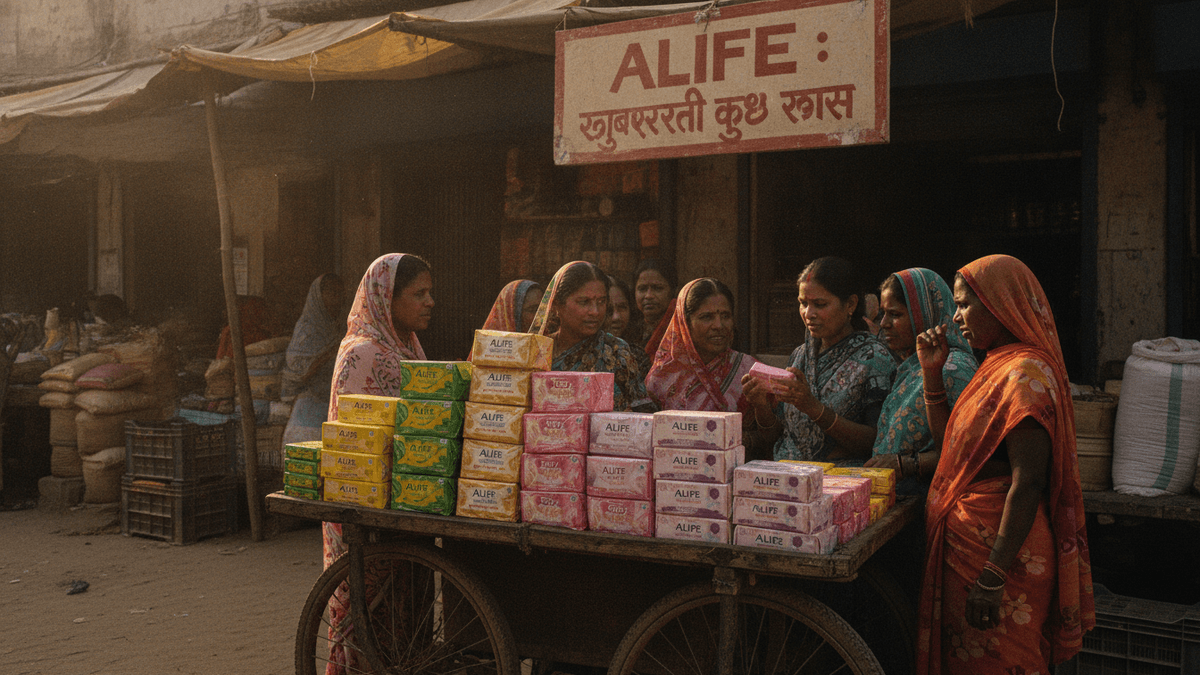
Women examining soaps on a cart under an "ALIFE" sign in a market.
India’s fast-moving consumer goods (FMCG) landscape is buzzing with strategic maneuvers, as two prominent players, AWL Agri Business and Godrej Consumer, demonstrate robust growth and a sharp focus on profitability. These developments offer key insights for founders and investors tracking the dynamic Indian market.
AWL Agri Business, formerly Adani Wilmar Limited, is making a significant play in the personal care segment with the relaunch of its Alife bathing soap range. Introduced in 2020, the Alife brand has already surpassed ₹150 crore in value. The recent overhaul introduces four new premium, skincare-led variants—Active Nimboo, Haldi Chandan, Rozy Glow, and Fresh Lily—under the new promise ‘Khubsurati Kuchh Khaas’. This strategic shift aims to elevate Alife from a value-oriented hygiene product to a premium offering, directly leveraging AWL’s backward integration in oleochemical manufacturing. This allows the company to utilize in-house raw materials like soap noodles and glycerine, significantly enhancing margins.
The impact of such strategic moves is already evident in AWL’s financials. Its Food & FMCG segment reported an impressive revenue increase of over 20% year-on-year in Q1 FY27, with volume expanding over 17%. The company has also aggressively expanded its direct retail reach to approximately 9.7 lakh outlets across India, laying a strong foundation for future growth. The premiumization of Alife soap is expected to further boost overall segment profitability and reduce the company’s reliance on lower-margin edible oils, although challenges like intense competition and raw material price volatility persist. Recent corporate actions include a brand licensing agreement for ‘Madhur’ on July 1, 2026, and a shareholder-approved dividend of ₹1 per share on July 7, 2026.
Meanwhile, Godrej Consumer has achieved a notable milestone in its international operations. After four years, its Bangladesh and Sri Lanka businesses have returned to profitability. This turnaround is largely attributed to the strong sales performance of electric liquid variants within its popular Goodknight product range. This success underscores the importance of tailored product strategies and market-specific execution in achieving profitability in diverse international markets.
For operators and investors, these developments highlight several critical trends. Firstly, the move towards premiumization in the Indian FMCG sector is a clear driver of margin expansion, even in competitive segments like bathing soaps. Companies with strong backward integration, like AWL, are uniquely positioned to capitalize on this. Secondly, strategic focus on specific product categories and geographies can yield significant results in international markets, as demonstrated by Godrej Consumer’s success. The ability to adapt and innovate, whether through product relaunches or targeted market strategies, remains paramount for sustained growth in the consumer goods industry.
About the Author