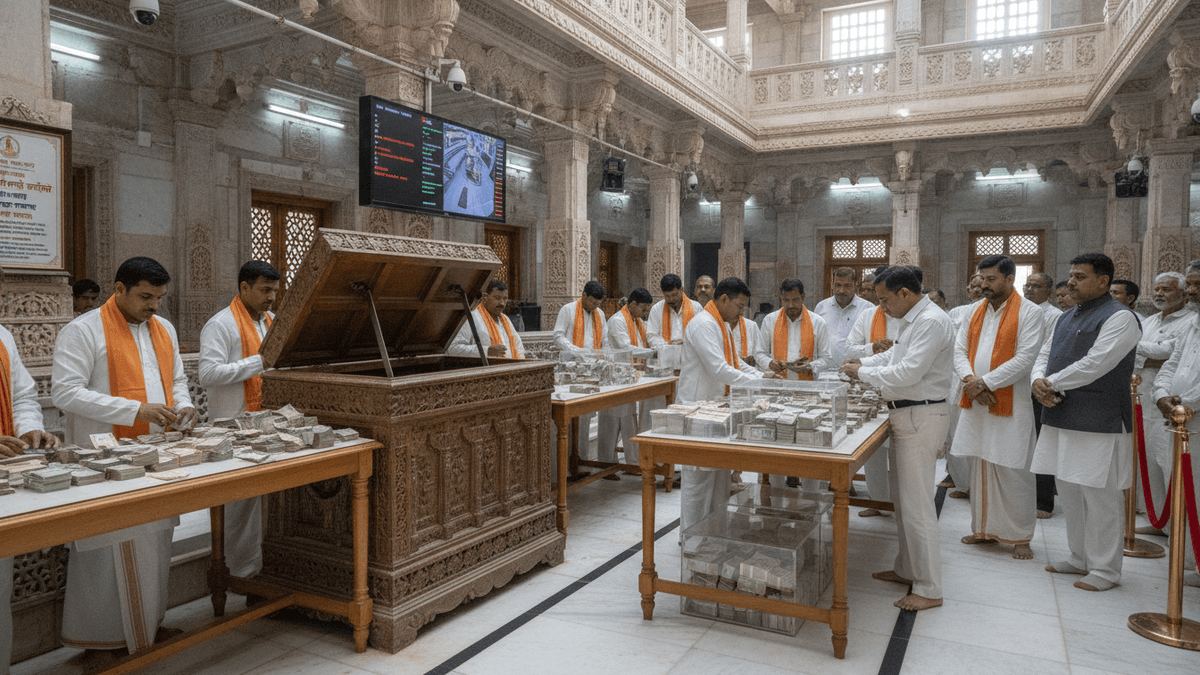
Volunteers and staff count donations inside the Shri Sanwalia Seth Temple in Chittorgarh, Rajasthan.
Amidst growing scrutiny over financial management in religious institutions, a temple in Rajasthan offers a surprising lesson in transparency and trust. The Shri Sanwalia Seth Temple in Chittorgarh isn’t just a place of worship; for many Indian business tycoons, its deity is considered a legitimate ‘business partner’.
This unique relationship isn’t symbolic. The temple reportedly receives an astonishing Rs 30-40 crore in donations monthly, with devotees — particularly entrepreneurs — regularly contributing a share of their business profits. What sets this apart is not merely the volume of funds, but the meticulous, almost corporate-level, accounting practices.
The temple operates with a rigorous system: all donations are recorded, counted under constant CCTV surveillance, and deposited across accounts with five different banks. Donation boxes are opened 11 times a year, with the entire process, from opening to cash verification, conducted under strict monitoring. Daily counts are even publicized through media, solidifying public trust.
These substantial funds aren’t just accumulating. They’re strategically deployed for the temple’s expansion and beautification, enhancing facilities for its many devotees. Crucially, a significant portion is invested in impactful development initiatives across 16 surrounding villages, with current projects estimated at Rs 100 crore. This demonstrates a model where spiritual contributions directly fuel tangible community development, offering a powerful case study in accountable philanthropy.
For business leaders, this temple represents more than faith; it embodies a rare institutional integrity. It highlights how robust governance, even in a non-profit spiritual context, can build profound trust and attract consistent, significant contributions, proving that transparency can be a powerful engine for growth and impact, whether in business or philanthropy.
About the Author