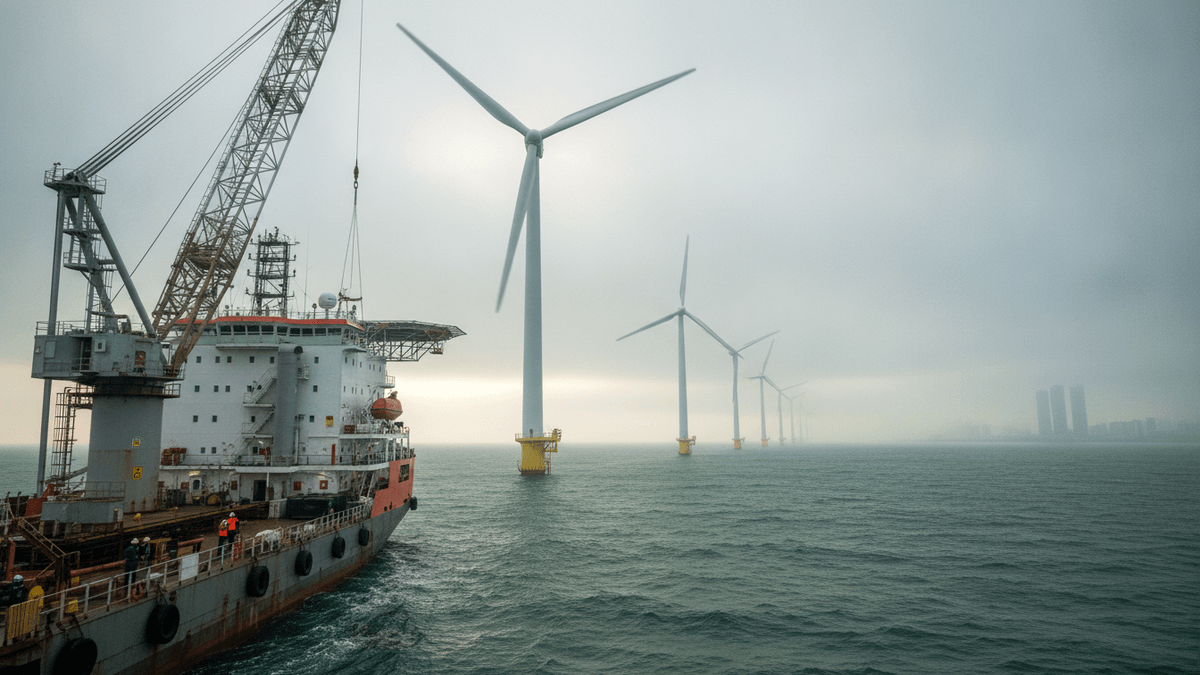
Offshore wind turbine installation vessel working in foggy conditions
The launch of South Korea’s largest renewable energy platform, a joint venture between global investment firm KKR and local conglomerate SK Group, marks a significant strategic move in the region’s energy transition. Valued at a substantial KRW2 trillion (USD1.3 billion), this platform is not merely an investment; it’s a blueprint for scaling green infrastructure and addressing the burgeoning energy demands of a digital economy.
This new entity consolidates the renewable energy businesses and assets from SK Innovation, SK ecoplant, and SK eternix. Its diversified portfolio spans solar, offshore and onshore wind, and fuel cells, essentially covering all major forms of renewable energy generation except hydrogen. Currently, the platform boasts 1.7GW of operating capacity, with an ambitious development pipeline targeting an expansion to 10GW. To put that in perspective, 10GW is enough to power 100 large-scale, 100MW-class data centers simultaneously and continuously—a critical capability given the exponential growth of data infrastructure.
The strategic partnership sees KKR taking initial management control, providing its global expertise in large-scale infrastructure and operational efficiency. Meanwhile, SK Group participates as a significant equity investor, crucially retaining the option to pursue control rights in the future. This structure suggests a thoughtful approach to leveraging KKR’s investment prowess for rapid scaling while preserving SK’s long-term strategic interest in the burgeoning renewable sector. Legal advisement for the deal was provided by Lee & Ko for SK, and by Bae, Kim & Lee alongside Simpson Thacher & Bartlett for KKR.
This venture underscores a broader trend: the increasing convergence of institutional capital with corporate strategic assets to accelerate the energy transition. For startup founders and investors, this move highlights the massive scale of capital now flowing into renewable infrastructure, especially in markets with strong government support for decarbonization. The focus on powering data centers also signals a growing, high-demand niche within the renewable energy sector, demonstrating a clear business case beyond just environmental mandates. Competitors in the Asian renewable energy market will undoubtedly be watching closely, as this platform’s scale could set new benchmarks for efficiency and market penetration.
About the Author