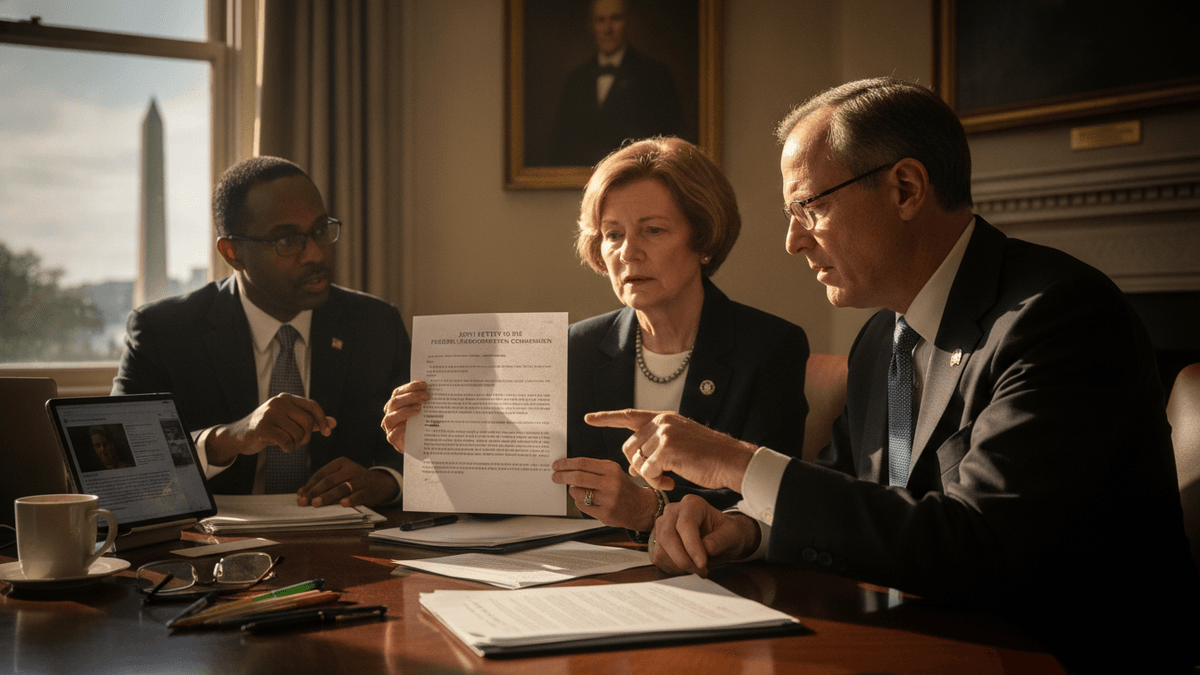
Senators reviewing documents regarding the FCC and proposed merger.
Three Democratic senators have formally requested that the Federal Communications Commission (FCC) pause the proposed merger between Paramount and Warner Bros. Discovery. The lawmakers are raising alarms about the extent of foreign investment in the combined entity, which they argue warrants a more thorough due diligence process.
In a joint letter addressed to FCC Chairman Brendan Carr, Senators Cory Booker (D-N.J.), Adam Schiff (D-Calif.), and Elizabeth Warren (D-Mass.) urged the commission to prevent the transaction from closing until an adequate review of foreign investors is completed. The senators expressed concerns that the merger could pose national security threats due to foreign government investment in what would become one of the largest media companies in the United States.
The proposed merger, valued at approximately $110 billion, would consolidate significant news media assets, including CNN and CBS News, under a single corporate owner. According to a financial disclosure filed by Paramount, foreign ownership in the new corporation is expected to reach approximately 49.5%. While Paramount stated that all voting rights would be controlled by the Ellison family through U.S. entities, the disclosure also indicated that Saudi Arabia’s Public Investment Fund and entities from the United Arab Emirates and Qatar would be equity holders.
Paramount had previously informed the FCC that this ownership structure would not raise any national security, law enforcement, or foreign policy concerns. However, the senators are pushing for a more rigorous examination, advising Chairman Carr not to accept the Ellison family’s assurances at face value. They are advocating for the rejection of Paramount’s petition for preemptive approval, citing Section 310 of the 1934 Communications Act, which generally prohibits foreign entities from owning more than 25% of a U.S. firm with an FCC broadcast license.
The senators have set a July 1 deadline for Chairman Carr to notify Paramount that the deal cannot proceed until the foreign investment review is finalized. The FCC’s approval remains the most significant regulatory obstacle for the merger, as the Department of Justice recently signaled it would not challenge the acquisition after an eight-month antitrust review concluded that the deal was unlikely to harm competition or consumers.
The Department of Justice’s antitrust division stated that the transaction would not negatively impact competition in on-demand streaming, linear television, studio development, or film production and distribution. Despite this clearance, Senator Warren has criticized the DOJ’s decision and encouraged state attorneys general to continue opposing the transaction. A coalition of states, led by California Attorney General Rob Bonta, is reportedly preparing a lawsuit to block the merger.
The potential consolidation has also drawn criticism from within the entertainment industry. Over 5,000 filmmakers and actors signed an open letter in April, arguing that the merger would stifle competition and reduce job opportunities, exacerbating the existing strains on the industry due to previous consolidation.
About the Author