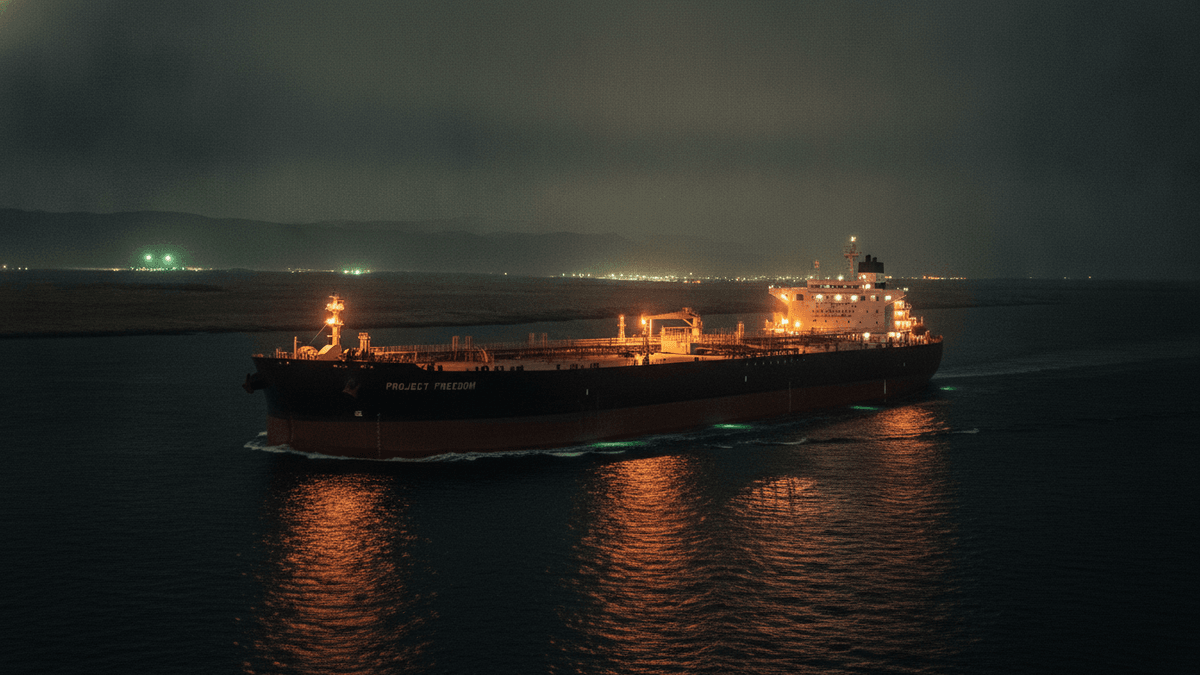
Oil tanker "Project Freedom" transiting a waterway at night, distant shore lights.
In a surprising disclosure, former White House economic advisor Larry Kudlow revealed that President Trump’s administration secretly facilitated the passage of over 100 million barrels of oil through the Strait of Hormuz over the past month. This covert operation, dubbed ‘Project Freedom,’ involved communicating with commercial ships to ensure their safe transit, rather than direct military escort.
Trump stated, “We’ve been taking out millions of barrels of oil. Nobody knows it. You know who doesn’t know about it? Iran. Until right now.” He further elaborated that the military disabled Iranian radar systems, allowing 22 ships to pass undetected late at night. This action, according to Kudlow, is a significant factor in oil prices stabilizing around $85 a barrel.
The 3 million barrels per day increase in global oil supply, a roughly 3 percent addition to the world’s 100 million barrel per day consumption, has likely prevented prices from soaring to $150 or $200 a barrel. For context, the U.S. currently produces 13.6 million barrels per day.
This intervention appears to have had a tangible effect on energy prices. West Texas Intermediate (WTI) crude oil peaked at $113 and has since fallen to around $90, a nearly 20 percent decrease. Gasoline prices have also seen a drop, from a May peak of $4.56 to $4.15 nationally, according to AAA. Kudlow suggests that this action, alongside efforts to counter radical Islam in Iran, will lead to further price reductions.
Kudlow connected these developments to the latest Consumer Price Index (CPI) report, which showed a 4.2 percent year-on-year increase. However, he noted that excluding food and energy, the inflation rate was only 2.9 percent. The significant jump in the topline CPI was largely driven by a 104 percent annual increase in energy costs and a 250 percent surge in gasoline prices over the past three months. Goods prices, excluding food and energy, remained relatively flat.
Despite inflationary pressures, Kudlow highlighted the booming U.S. economy, citing strong manufacturing, business investment, factory output, construction, corporate profits, productivity, and stock market performance. He attributed this growth to policies such as lower taxes, deregulation, increased domestic oil production (‘drill, baby, drill’), and the AI boom, which are collectively driving economic growth at nearly 4 percent with low unemployment.
Looking ahead, Kudlow expressed hope that Federal Reserve Chairman Kevin Warsh, at the upcoming Fed meeting, will articulate that economic growth does not inherently cause inflation, and that temporary energy price hikes are not a cause for alarm. He anticipates a ‘new breath of fresh air’ from the new Fed leadership.
About the Author