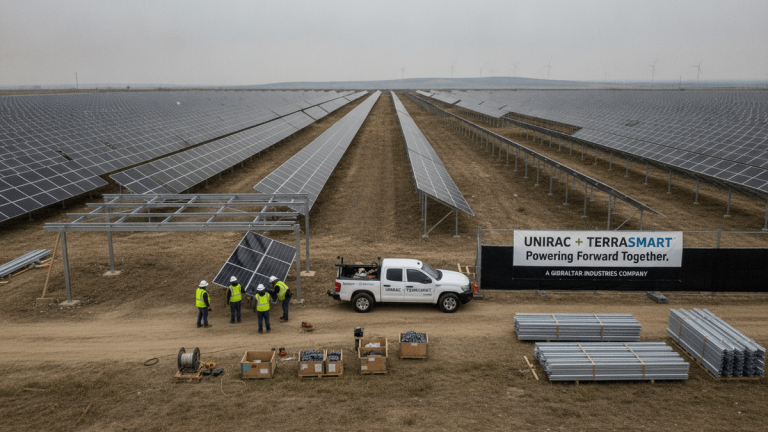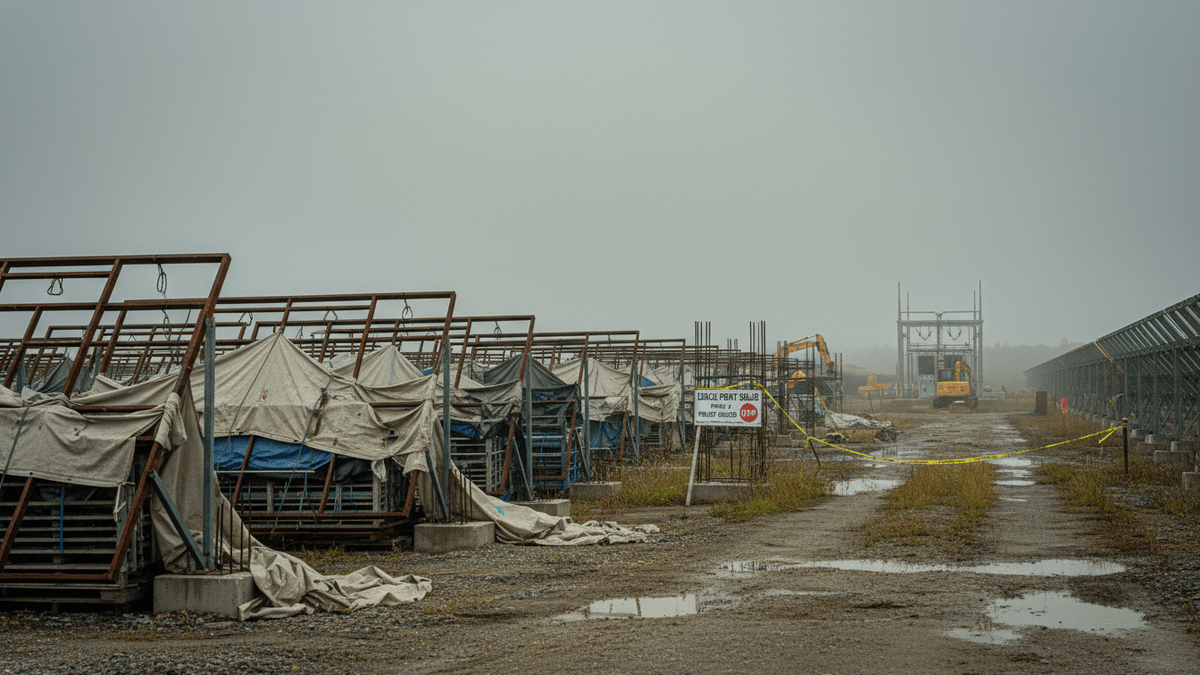
Partially constructed solar farm under overcast skies, abandoned equipment.
A rush to capitalize on soon-to-expire federal tax credits spurred a flurry of clean energy project announcements in early 2026, but the sector is facing significant headwinds. According to a report by E2, clean energy developers announced over 50 new utility-scale generation and storage projects in Q1 2026, totaling more than 12 GW of capacity and $18 billion in investments. This burst of activity more than doubled the total for all of 2025.
However, the surge was accompanied by a sharp increase in project cancellations and downsizing. By March 2026, nearly 8 GW of generation capacity and over $14 billion in planned investments had been scrapped, closed, or scaled back, representing over half of the total capacity losses recorded throughout 2025. These losses underscore the precariousness of clean energy development amid evolving federal policies.
E2 Communications Director Michael Timberlake pointed to the market’s uncertainty, noting that while developers are racing to initiate projects before tax credits expire, increasing cancellations reflect the adverse effects of policies designed to hinder clean energy. Timberlake emphasized the broader implications of these losses, including job losses, reduced investment, and the delayed deployment of new electricity sources needed to power homes and lower energy bills.
The report reveals a stark contrast: over $19 billion in investments across 66 manufacturing and generation projects announced in Q1 2026, versus $14 billion in investments and 45 projects being canceled. This divergence highlights the volatility within the sector.
New project development remains significantly lower than the 2022-2024 period, when over 720 utility-scale projects were announced. Since the start of 2025, only 82 new projects have been announced, indicating a slowdown in overall momentum. Manufacturing investment has also decelerated, with $1.4 billion in projects canceled or downsized compared to just $750 million in new investments during Q1 2026.
Since mid-2022, clean energy companies have announced $400 billion in investments across 1,200 generation and manufacturing projects. However, a total of 332 projects, representing over $120 billion in planned investments, have been canceled, underscoring the risks and challenges facing the industry.
Electric vehicle and battery manufacturing have proven particularly volatile, accounting for four of the seven manufacturing facilities canceled or downsized in Q1 2026, and 38 canceled projects since 2025. Grid and transmission equipment manufacturing, in contrast, have shown greater resilience. Within generation, solar projects dominated both new announcements (37 out of 54) and cancellations (25 out of 38), indicating a concentrated area of risk.
Geographically, Republican-held congressional districts have seen the largest share of both clean energy investment and project losses. Texas leads in new generation projects, investment, and capacity announced, but also accounts for 12 of the 38 generation project cancellations in Q1 2026, underscoring the complex interplay of policy, investment, and market dynamics.
About the Author