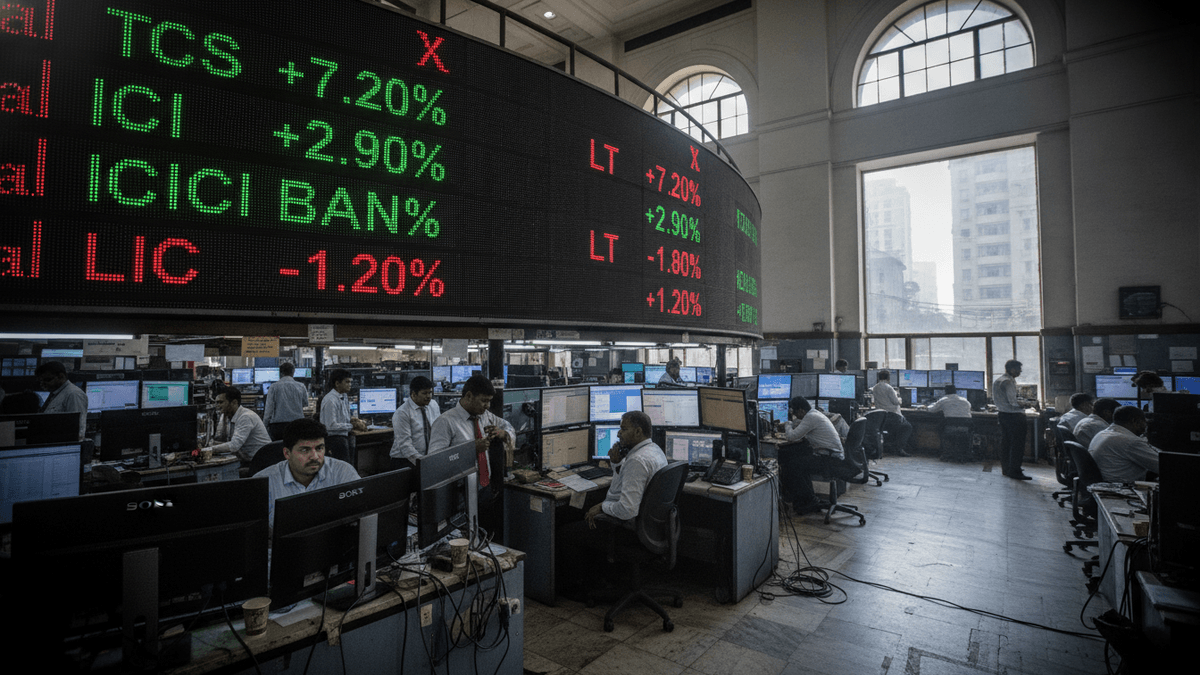
Traders work under a stock ticker displaying market data at a financial institution in Mumbai.
Last week, India’s equity markets saw a significant uplift, particularly for a select group of its most influential companies, signaling robust investor confidence and strategic shifts. This isn’t just a headline; it’s a look into where capital is flowing and why.
The combined market valuation of five out of India’s top 10 most-valued firms surged by an impressive ₹1.54 trillion. This notable increase was mirrored by a positive broader market trend, with the BSE Sensex climbing 0.75% and the NSE Nifty gaining 0.52%.
Leading this charge was IT giant Tata Consultancy Services (TCS), which added a substantial ₹72,072.3 crore to its market cap, pushing its valuation to ₹8,20,672.70 crore. This gain was largely propelled by encouraging Q1 FY27 earnings and an optimistic outlook on future demand. Other significant beneficiaries included ICICI Bank (up ₹29,062.06 crore), Reliance Industries (up ₹23,884.93 crore), Bajaj Finance (up ₹21,946.5 crore), and State Bank of India (up ₹7,338.34 crore).
However, the market wasn’t uniformly buoyant. While these five firms celebrated considerable gains, several other heavyweights experienced a contraction in their valuations. Larsen & Toubro saw its market capitalization decline by ₹18,097.72 crore, followed by Life Insurance Corporation of India (LIC) with a drop of ₹12,080.75 crore. Bharti Airtel, HDFC Bank, and Hindustan Unilever also recorded declines of ₹7,706.45 crore, ₹7,084.61 crore, and ₹1,221.79 crore, respectively.
Despite these fluctuations, the pecking order among the top firms largely held. Reliance Industries firmly maintained its position as India’s most valued company, continuing to be followed by HDFC Bank, Bharti Airtel, ICICI Bank, State Bank of India, TCS, Bajaj Finance, LIC, Larsen & Toubro, and Hindustan Unilever. This divergence in performance among top-tier companies highlights the selective nature of market rallies. For founders and investors, it underscores the importance of scrutinizing individual company fundamentals and sector-specific catalysts, even during broader market uptrends. TCS’s robust earnings and positive demand outlook, for instance, proved a stronger driver than general market sentiment for its peers.
About the Author