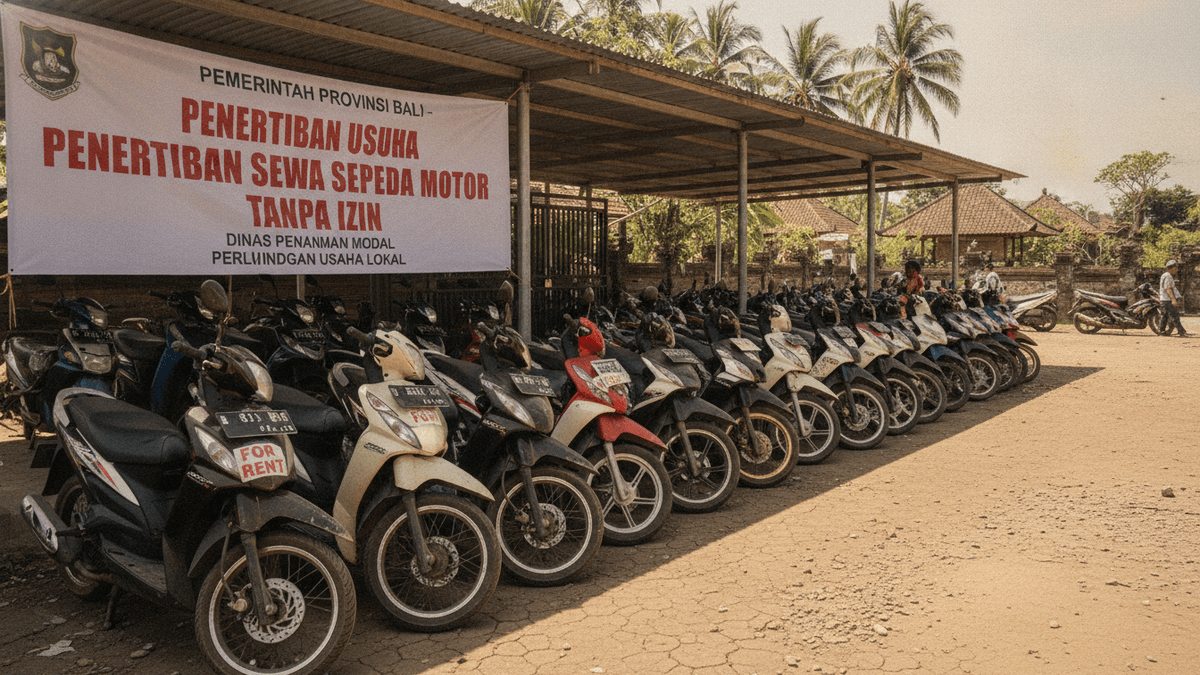
Bali motorcycle rental parking lot under a banner regarding unlicensed operations
Bali, a magnet for tourists and investors, is drawing a new line in the sand for foreign capital. The provincial government has just implemented a significant ban on new foreign investment in motorcycle rental businesses, a move aimed squarely at protecting its local small and medium-sized enterprises (SMEs). This isn’t just about scooters; it signals a broader shift in how the island intends to manage its economic development and foreign participation.
I Ketut Sukra Negara, head of Bali’s Investment and One-Stop Integrated Services Agency (DPMPTSP), confirmed the ban, emphasizing that these businesses are traditionally the domain of local entrepreneurs. The policy comes after a stark discovery: while only about 150 foreign investment companies hold proper licenses, authorities found over 500 foreign-owned motorcycle rental operators. Many of these unlicensed entities reportedly exploited virtual office addresses to secure permits, bypassing regulations. The provincial government is now cracking down, with unlicensed operators facing closure and an investment task force established to monitor and enforce these new rules. This initiative extends beyond motorcycle rentals, covering car and truck rentals and other “low-risk” sectors, with 56 business classifications now closed to new foreign investment.
This policy reflects a growing tension between fostering foreign direct investment (FDI) and safeguarding local economic interests. For startup founders and investors eyeing the lucrative Balinese market, this signals a need for meticulous due diligence and a deeper understanding of local regulatory nuances. The crackdown on virtual office exploitation highlights the government’s intent to enforce genuine local presence and compliance. While Bali remains attractive for investment, evidenced by Rp 13.31 trillion ($735.23 million) in realized investment during Q1 2026 (Rp 4.27 trillion of which was FDI), this move indicates a more selective approach to foreign capital, prioritizing sectors where local businesses can thrive without direct foreign competition. It’s a strategic pivot to ensure that economic growth benefits the local community directly.
Businesses currently operating in these newly restricted sectors, especially those without proper licensing or relying on loopholes, face immediate risks of closure and enforcement actions. For prospective foreign investors, the message is clear: Bali is open for business, but on its own terms, particularly in sectors deemed critical for local entrepreneurship. This could push foreign investment towards higher-value, more complex sectors, or encourage partnerships with local entities, fostering a different kind of economic integration. The investment task force’s vigilance will be key to the policy’s success, shaping Bali’s investment landscape for the foreseeable future.
About the Author