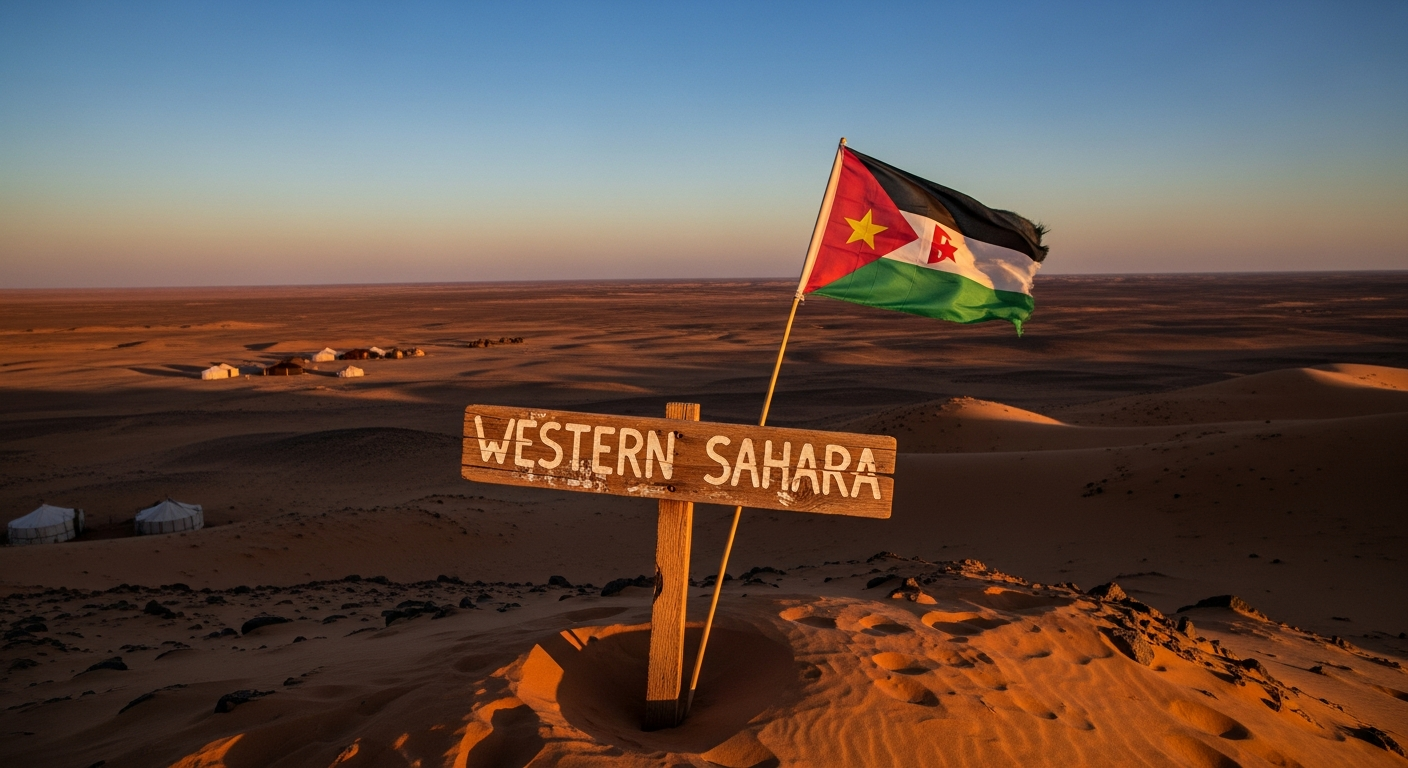
Western Sahara: Africa’s Last Colonial Dispute
The Western Sahara, a former Spanish colony, is the only region in Africa whose status remains unresolved since the colonial era. The United Nations considers it a non-self-governing territory, with the central question being its future.
A Contested Territory
Morocco currently controls the majority of the region and has proposed broad autonomy under its sovereignty. In contrast, the Polisario Front, backed by Algeria, seeks a referendum on self-determination to decide the territory’s fate. The United Nations has been involved in the dispute for years.
Geographic Overview
The Western Sahara stretches over 266,000 square kilometers along the Atlantic coast, bordered by Morocco, Mauritania, and Algeria. A defensive wall, as the Moroccan authorities call it, runs through the area for 2,700 kilometers from north to south. The region is rich in phosphates, and its waters are rich in fish. The main cities in the region are El Aaiún, Dakhla, and Smara, all of which are under Moroccan administration.
Key Players and Disputes
The core dispute between Morocco and Algeria is over the Western Sahara. In 1975, 350,000 Moroccans participated in the Green March, a demonstration to assert Morocco’s claim. In 1976, the Polisario Front declared the Sahrawi Arab Democratic Republic, backed by Algeria, Cuba, and South Africa. Morocco gained control of most of the Western Sahara in 1979 and built several defensive walls to deter Polisario attacks.
The Moroccan government has invested heavily in the region, which it claims has led to its development. However, the Polisario Front argues that the Sahrawi people do not benefit from this development and that Morocco’s exploitation of the region’s natural resources is an act of plunder. Approximately 175,000 Sahrawi refugees reside in camps near Tindouf, Algeria, close to the border with Morocco.
International Involvement and Stalled Negotiations
A ceasefire agreement came into effect in 1991, with a buffer zone monitored by the United Nations Mission for the Referendum in Western Sahara (MINURSO). MINURSO, with approximately 240 employees, monitors the ceasefire through land and air patrols. The UN has listed the Western Sahara as a non-self-governing territory.
In 2020, Moroccan forces deployed in the far south of the region to remove separatists who were blocking the road to Mauritania. Since October 2021, the UN envoy to the Western Sahara, Staffan de Mistura, has made several visits to the region, but has been unable to resolve the conflict. The UN has called for Morocco, the Polisario Front, Algeria, and Mauritania to resume negotiations, which have been stalled since 2019, to reach a practical political solution.
Recent Developments
In 2007, Morocco put forward an autonomy plan for the Western Sahara, which has gained support from Germany, Spain, and Britain. In the summer of 2024, France announced its support for the plan by recognizing Moroccan sovereignty over the Western Sahara. The United States recognized Morocco’s sovereignty over the disputed territory in 2020 as part of an agreement to normalize relations between Morocco and Israel.
About the Author