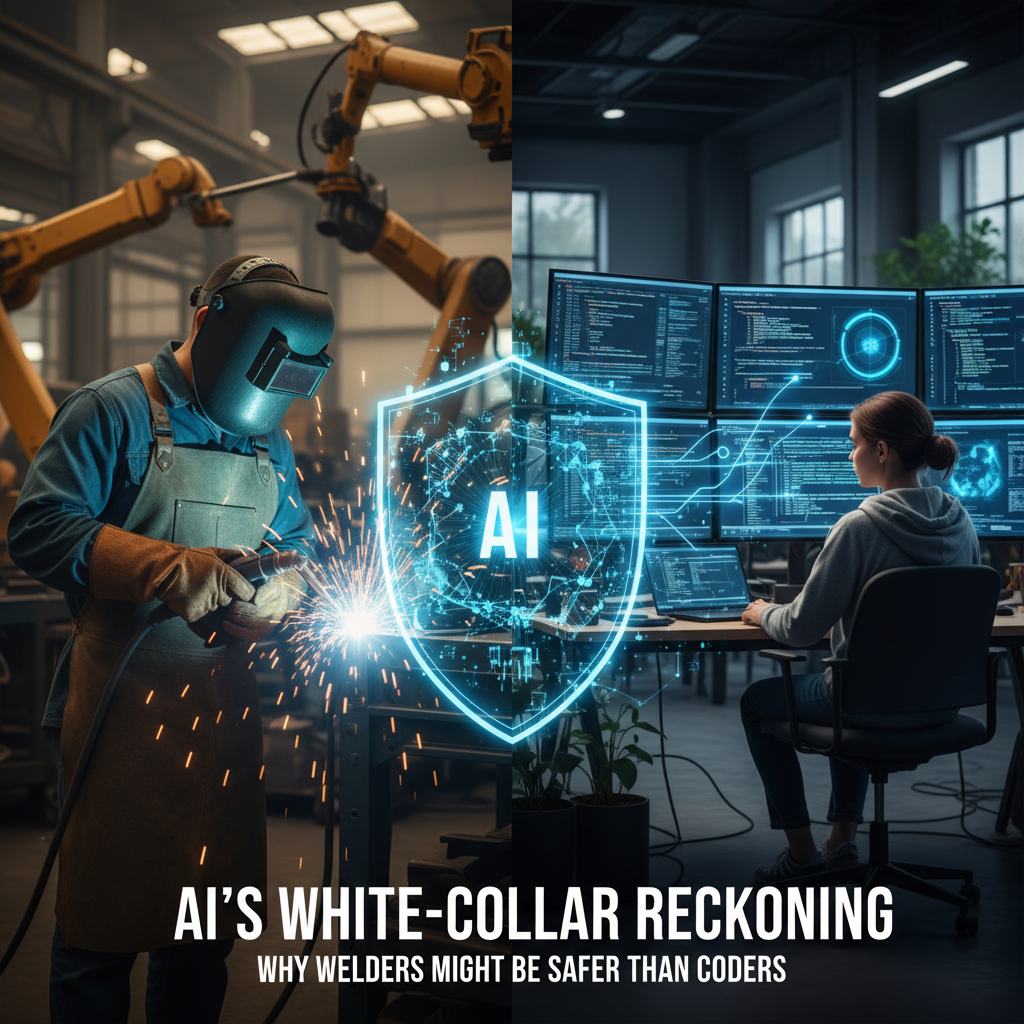
The hum of servers fills the air, a constant thrum in the otherwise silent data center. Engineers, heads bent over glowing screens, pore over thermal tests for the latest AI model. It’s late 2024, and the race to build bigger, faster, and more efficient large language models (LLMs) is in full swing. But a different kind of disruption is brewing, one that might reshape the job market in unexpected ways. Mike Rowe, known for his work highlighting skilled trades, recently warned that AI will hit white-collar workers hardest, while welders, for now, are relatively safe.
This isn’t just a prediction; it’s a reflection of the economic realities. AI, particularly generative AI, is rapidly automating tasks previously handled by coders, analysts, and other white-collar professionals. Meanwhile, the demand for skilled trades like welding remains strong, driven by infrastructure projects, manufacturing, and a shortage of qualified workers. This divergence, as Deutsche Bank analysts noted in a recent report, is creating a two-tiered job market. One where software engineers face the prospect of their jobs being automated, and another where welders are in high demand.
The technical details matter. LLMs are trained on massive datasets, allowing them to perform tasks like code generation, data analysis, and even creative writing. The processing power required is immense, driving companies to invest heavily in advanced hardware. Think of the Nvidia H100 or its successors, the H200 and the forthcoming B100. The cost of training these models is astronomical, but the potential returns are even greater. It’s a high-stakes game, and the stakes are getting higher.
“The automation of white-collar jobs is happening faster than many predicted,” says Dr. Emily Chen, a leading AI researcher at the Lilly School. “The ability of AI to write code, analyze data, and even create marketing copy is becoming increasingly sophisticated.”
But what about the welders? Their skills are rooted in physical processes, in the ability to manipulate materials and build things. These are tasks that AI, at least for now, struggles to replicate. The precision, dexterity, and problem-solving skills required in welding are difficult to automate. Manufacturing, construction, and infrastructure development, all rely on welders. It’s a practical skill, and a practical need.
The conversation shifts to export controls. China’s access to advanced chips from companies like Nvidia is severely limited by US regulations. SMIC, China’s largest chip manufacturer, is years behind TSMC in terms of manufacturing capabilities. This creates a bottleneck and adds to the pressure. The US government’s focus on domestic procurement policies is also a factor, favoring American-made goods and services. It’s the macro context, the policy walls, that engineers have to navigate.
The conference call pauses. An executive at a major tech firm sighs, then says, “We’re shifting timelines. The M300 roadmap, originally slated for 2026, might be pushed back to 2027. Supply chain, you know.” They know that the future is uncertain, and the pressures are mounting. The demand is there, but the ability to deliver is not.
This isn’t just about technology; it’s about economics and policy. It’s about the collision of hardware, software, and human skill. In the long run, the question becomes: how will the job market adapt to this new reality? The answer, it seems, might lie in the hands of those who build, not just those who code. Or maybe that’s how the supply shock reads from here.
About the Author