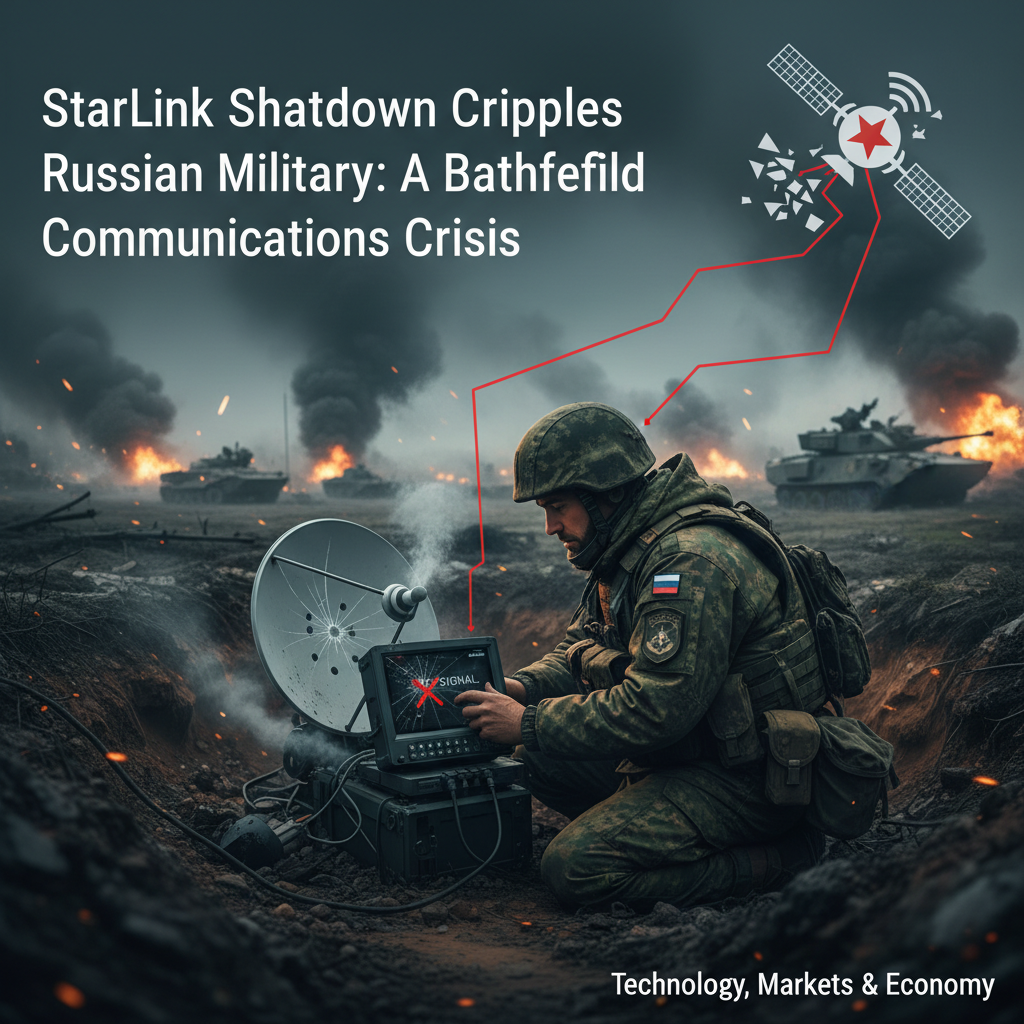
The hum of the server room was a low thrum, punctuated by the staccato clicks of keyboards. Engineers at a European defense contractor, faces illuminated by the glow of multiple monitors, were scrambling. Data streams, once flowing smoothly from the Ukrainian front, had flatlined. The cause? An unexpected, widespread disruption of Starlink services used by Russian forces, according to multiple sources within the defense and intelligence communities.
The situation crystallized rapidly. On Tuesday morning, the first reports trickled in: a sharp drop in data transmission rates, followed by complete outages in key areas of the battlefield. The implications were immediate and brutal. Russian units, heavily reliant on Starlink for everything from drone control to secure communications, found themselves cut off, their assault operations grinding to a halt. This wasn’t a glitch; it was a strategic intervention, a digital decapitation.
“It’s a game changer,” said Dr. Michael O’Hanlon, a senior fellow at the Brookings Institution. “Without reliable communications, modern military operations become incredibly difficult. Coordination breaks down, situational awareness degrades, and the enemy gains a significant advantage.” He went on to explain that the loss of Starlink access meant that troop movements became far more difficult to coordinate. Furthermore, it made it more difficult for soldiers to call for fire support or to send intelligence back to headquarters.
The technical details are complex, but the core issue is straightforward. Starlink, operated by SpaceX, provides broadband internet access via a constellation of low Earth orbit (LEO) satellites. The company has stated it does not permit its use for military purposes, and has taken steps to limit its availability in the conflict zone. However, reports surfaced that Russian forces were able to acquire and use the terminals, likely through third-party channels. The exact mechanism of the shutdown remains unclear, but it appears to be a targeted effort, possibly involving geofencing or software updates to disable the terminals.
This situation underscores the inherent fragility of relying on commercial, non-military satellite systems in a high-stakes conflict. While Starlink offers undeniable advantages in terms of speed and bandwidth, it is ultimately controlled by a private company, subject to its own policies and external pressures. The sudden loss of service throws into sharp relief the vulnerabilities of a military force dependent on a commercial provider. It also raises questions about the long-term reliability of such systems in a globalized, interconnected world.
The ripple effects are already being felt. Military analysts are recalibrating their assessments of the war’s progress. Supply chains, already strained by sanctions and logistical challenges, face further disruption. And the incident serves as a stark reminder of the evolving nature of modern warfare, where control of the electromagnetic spectrum can be as decisive as control of territory. Or maybe that’s how the supply shock reads from here.
The incident also highlights the need for robust, secure, and independent communication infrastructure. It underscores the necessity for militaries to develop their own resilient communication systems, less vulnerable to external interference or policy shifts. The race is on, and the stakes are higher than ever.
About the Author