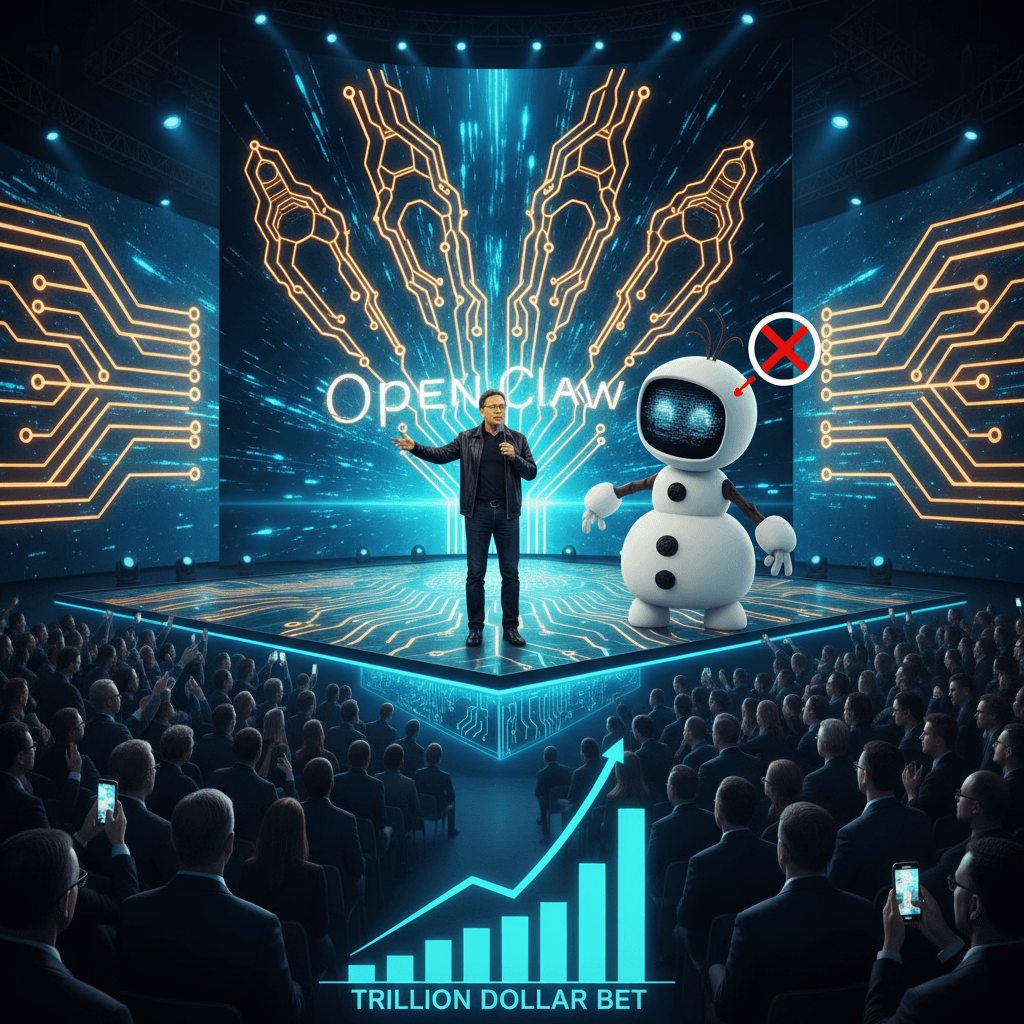
Jensen Huang on stage, a robot next to him, and a rising graph.
Nvidia’s GTC conference this week was a spectacle, to say the least. CEO Jensen Huang, ever the showman, took the stage in his trademark leather jacket to lay out Nvidia’s vision for the future of AI. The keynote, clocking in at two and a half hours, was packed with announcements, bold predictions, and a slightly awkward robot encounter.
Huang projected a staggering $1 trillion in AI chip sales through 2027, signaling Nvidia’s confidence in the continued exponential growth of the AI market. He also introduced “OpenClaw,” urging every company to adopt this strategy. While details remain somewhat nebulous, the underlying message is clear: Nvidia wants to be at the center of every organization’s AI infrastructure.
The conference wasn’t without its bizarre moments. A rambling Olaf robot, intended to showcase Nvidia’s robotics capabilities, had its microphone cut off mid-demonstration. While the intent was likely to highlight cutting-edge technology, the execution fell flat, leaving some attendees scratching their heads.
Strategic Implications:
AI Dominance: Nvidia’s $1 trillion projection isn’t just hype. It reflects the company’s firm grip on the AI hardware market and its ambition to maintain that position. Companies building AI solutions will likely remain heavily reliant on Nvidia’s chips for the foreseeable future.
“OpenClaw” Strategy: While the specifics of “OpenClaw” need further clarification, it likely involves a combination of open-source initiatives and proprietary technologies designed to lock customers into the Nvidia ecosystem. This could create both opportunities and challenges for businesses seeking to integrate AI into their operations.
Robotics Reality Check: The Robot Olaf incident serves as a reminder that even for a tech giant like Nvidia, robotics is still a work in progress. While the potential of AI-powered robots is immense, practical applications are still evolving.
What’s Next:
Nvidia’s GTC set the stage for the next few years in AI development. Keep an eye on how the “OpenClaw” strategy unfolds and whether Nvidia can maintain its dominance in the face of increasing competition from other chipmakers and cloud providers. Also, expect more advancements (and perhaps a few more awkward moments) in the rapidly evolving field of robotics.
About the Author