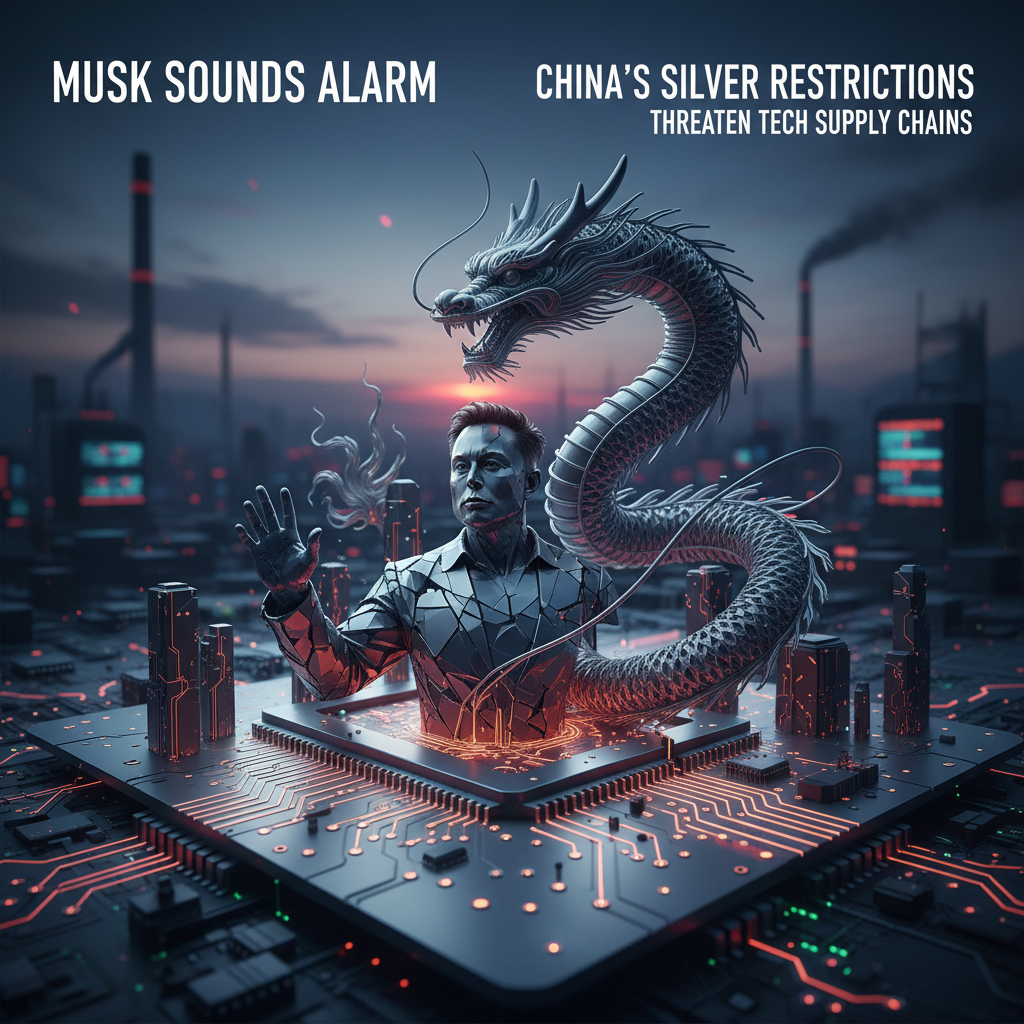
The hum of servers filled the air at the Shanghai data center, a low thrum that punctuated the silence. Engineers hunched over thermal tests, their faces illuminated by the glow of monitors. The task: optimize the cooling systems for the latest generation of AI chips, a process now complicated by events thousands of miles away. News had just broken: China’s tightening of silver exports.
Elon Musk’s warning on social media, a blunt assessment of the situation, echoed through the industry. The restrictions, aimed at protecting domestic industries, were already sending shockwaves through global supply chains. Silver, a critical component in numerous industrial processes, including semiconductor manufacturing, was becoming a scarce commodity. Or, at least, that’s how the supply shock reads from here.
“It’s a perfect storm,” said Dr. Mei Lin, a materials analyst at the Lilly School, during a hastily arranged conference call. “Demand is soaring, driven by the rapid expansion of AI and EV sectors, while supply is suddenly constrained. We’re looking at potential bottlenecks across the board.” She paused, the silence on the line punctuated by a single ping from someone’s Slack.
The impact is immediate. Silver’s price has already hit record highs. Companies reliant on the metal for components are scrambling to secure supplies. The manufacturing sector, already grappling with geopolitical tensions and export controls, faces another hurdle. The production of advanced semiconductors, in particular, requires high-purity silver for various applications, like the metallization of contacts. These are critical for the function of chips like the NVIDIA H100 or the upcoming H200. The same goes for the advanced logic of the new AMD MI300 series. And, of course, the next-generation chips slated for 2026 and 2027.
The implications are far-reaching. China’s move could be seen as a strategic play, prioritizing its domestic industries at the expense of global competitors. While SMIC, China’s leading chip manufacturer, may benefit, other firms, especially those reliant on TSMC, could face significant challenges. One engineer in Shenzhen mentioned that his team was already reviewing alternative materials, a process that would inevitably slow down production and increase costs.
“We’re talking about a ripple effect,” Dr. Lin explained. “From the initial chip fabrication to the final product, the entire ecosystem is vulnerable.” Deutsche Bank analysts predict that the restrictions could lead to a 10-15% increase in the cost of certain electronic devices within the next quarter. The situation is further complicated by the fact that the U.S. has its own export rules, which could limit access to alternative sources of silver.
The scene at the data center shifted. The engineers, previously focused on the fine details of thermal management, were now discussing contingency plans, potential delays, and the scramble to secure alternative supplies. The hum of the servers, still present, now carried a note of urgency. The implications of China’s silver restrictions are becoming clearer every minute.
About the Author