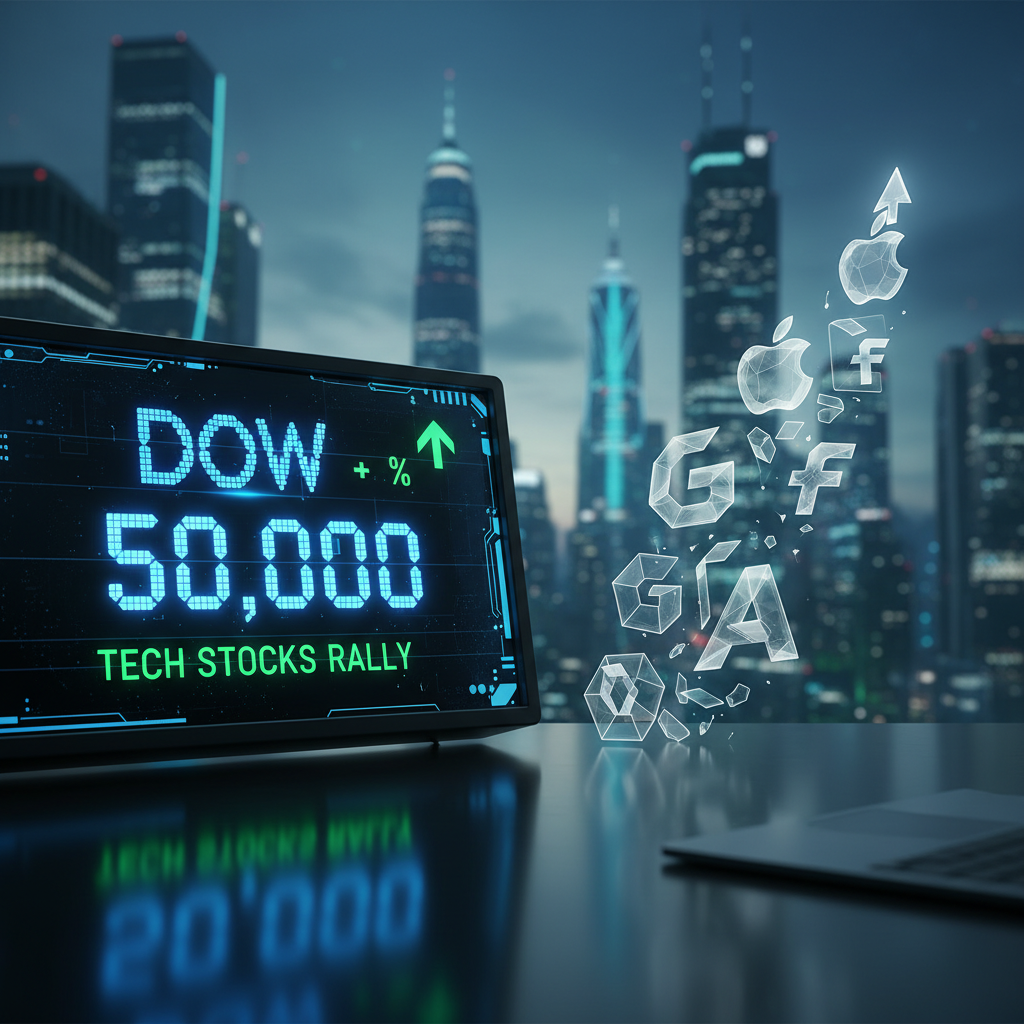
The hum of the servers was almost a physical presence, a low thrumming that vibrated through the floor of the data center. Engineers at a major investment firm, eyes glued to multiple screens, watched the market’s reaction. It was Friday, and the Dow Jones Industrial Average had just closed above 50,000 for the first time.
Earlier in the week, a tech stock sell-off had sent tremors through the market. Now, the index was rebounding, a surge of buying pushing the numbers higher. This recovery felt significant, a testament to the market’s resilience, or maybe just a correction before the next downturn, depending on who you asked.
“We’re seeing a shift,” said Sarah Chen, a senior analyst at Deutsche Bank, during a call that morning. “Investors are reevaluating their portfolios, looking beyond the initial panic. The long-term potential of the tech sector is still there, despite short-term volatility.” She pointed to specific companies: Nvidia, whose H100 chips remained in high demand, and AMD, whose upcoming MI300 accelerators were generating buzz. Each company’s roadmap, filled with dates and projected capabilities, became a focal point.
The engineers, meanwhile, were focused on the immediate. Thermal tests, power consumption, and latency figures dominated their screens. The supply chain, a constant concern, added another layer of complexity. Export controls and domestic procurement policies played a role too, as did the manufacturing constraints at foundries like SMIC and TSMC. The entire industry was a balancing act.
The market’s reaction, in this context, was understandable. The initial sell-off had been sharp, driven by fears of rising interest rates and inflation. But the rebound suggested that the underlying strength of the tech sector was still intact. Companies like Google and Microsoft were still reporting strong earnings, and the demand for cloud services and AI infrastructure remained high.
The implications were vast. The Dow’s climb above 50,000 was a symbolic victory, a sign of confidence in the economy. It was also a reminder of the power of the tech sector, its ability to drive growth and innovation, even in the face of uncertainty. The question was, how long would this last? Or maybe, how long could it last? The answer, of course, was never simple, but the market’s reaction was clear: the tech sector was not down for the count.
About the Author