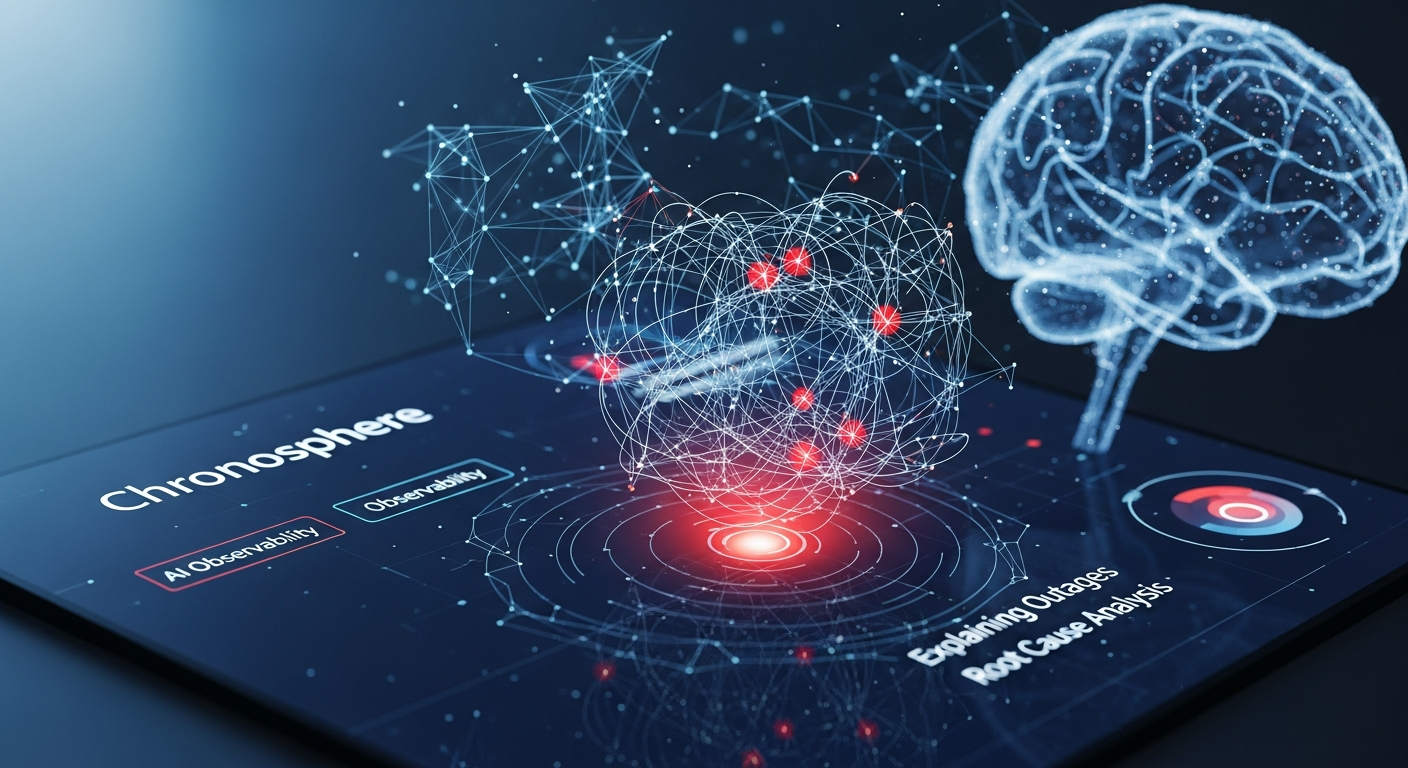
In the ever-evolving world of tech, where code seems to write itself faster than ever, keeping systems running smoothly is, well, a bit of a nightmare. That’s where Chronosphere comes in. This New York-based startup, valued at a cool $1.6 billion, is diving headfirst into the observability game. Their aim? To make it easier for engineers to understand and fix those inevitable software failures.
It’s not just about spotting the problem; it’s about explaining it. Their AI-Guided Troubleshooting, launched recently, combines AI smarts with something called a Temporal Knowledge Graph. Think of it as a constantly updated map of your company’s services and how they all connect. It’s a response to a growing issue: developers are speeding up code creation with the help of AI, but the troubleshooting side of things hasn’t quite caught up.
Notably, Chronosphere’s CEO, Martin Mao, put it this way: “For AI to be effective in observability, it needs more than pattern recognition and summarization.” It seems like they’ve spent years building the foundation for their AI to actually help engineers. They’re giving the AI the understanding it needs, and giving engineers the confidence to trust it. Not a bad combo.
The AI Angle
The announcement comes at a time when the observability market is under pressure to prove its worth, especially with costs climbing. Data volumes are exploding – Chronosphere’s own research shows a 250% year-over-year increase in enterprise log data. Generative AI is speeding up code creation, too, but that also means more complexity.
Chronosphere’s answer is AI-Guided Troubleshooting, built on four core capabilities: automated “Suggestions” for investigation, the Temporal Knowledge Graph, Investigation Notebooks, and natural language query building. Mao explained that the Temporal Knowledge Graph is a living, time-aware model of your system, connecting all the pieces and updating as your system evolves.
This differs from competitors like Datadog, Dynatrace, and Splunk. It’s not just about showing the topology; it’s about adding time and context. It tracks changes and connects them to incidents. Many tools use standardized integrations, but Chronosphere goes further to normalize custom telemetry, so those application-specific signals aren’t missed.
Keeping Humans in the Loop
Unlike fully automated systems, Chronosphere wants to keep engineers in control. The AI shows its work, proposes next steps, and lets engineers verify or override. Every suggestion includes evidence and a “Why was this suggested?” view. It’s about giving engineers the information they need to make the right decisions.
Mao gave a concrete example: An SLO alert fires on Checkout. Chronosphere immediately surfaces a ranked Suggestion: errors appear to have started in the dependent Payment service. An engineer can click Investigate to see the charts and reasoning, and dig deeper. As they dig into Payment, the system adapts with new Suggestions scoped to that service. The whole process is captured in an Investigation Notebook.
The Competition
Chronosphere’s entering a crowded field. Datadog, Dynatrace, and Splunk all offer their own AI-powered troubleshooting features. Mao argues that early AI for observability leaned heavily on pattern-spotting and summarization, which doesn’t always work in real incidents. These approaches often produce explanations without the deeper analysis and causal reasoning that engineers need.
Chronosphere’s competitive advantage lies in custom application telemetry. With an incomplete picture, large language models will ‘fill in the gaps,’ producing confident-but-wrong guidance. Chronosphere aims to avoid that.
Beyond the tech, Chronosphere is focused on cost control, which is important. They claim their platform reduces data volumes and costs by 84% on average while cutting critical incidents by up to 75%. They’ve got case studies to back this up, including Robinhood, DoorDash, and Affirm. It’s a compelling argument, especially as organizations are drowning in data.
Looking Ahead
Chronosphere’s AI-Guided Troubleshooting capabilities are now in limited availability, with full general availability planned for 2026. They’re also rolling out the Model Context Protocol (MCP) Server, which allows engineers to integrate Chronosphere directly into internal AI workflows. It’s a cautious approach, gathering feedback before a broad release, refining its guidance algorithms, and validating that its suggestions genuinely accelerate troubleshooting. The longer game is about earning engineers’ trust by explaining what it knows, admitting what it doesn’t, and letting humans make the final call. In an industry drowning in data, showing your work still matters.
About the Author