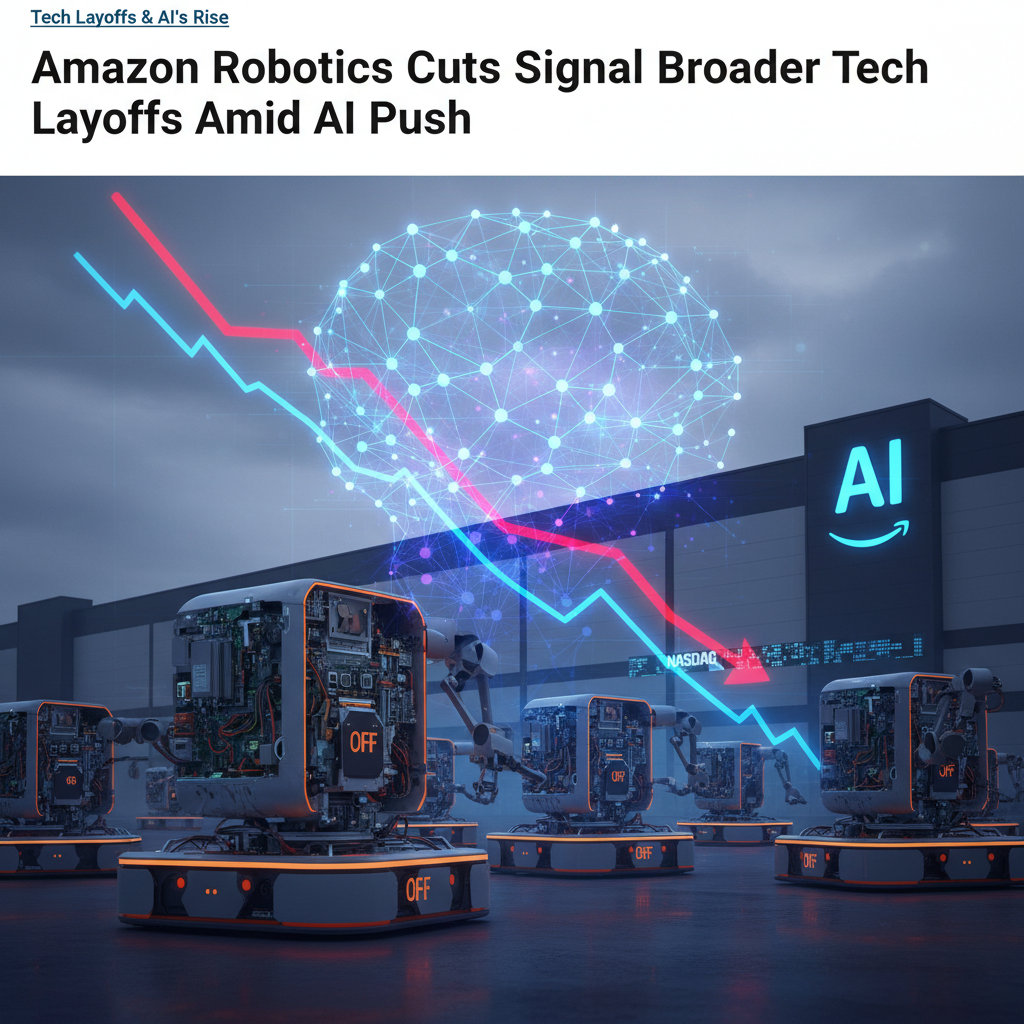
The fluorescent lights of the Amazon robotics lab hummed, a low thrumming that usually faded into the background. Today, however, it seemed to amplify the silence. At least 100 positions were cut from the unit in February, as the company restructured, a move reflecting a broader trend in the tech sector.
U.S. layoff announcements decreased significantly in February, down 55% to 48,307 job cuts. This offers some relief after a period of elevated numbers in January, according to a Fox Business report. But the Amazon cuts, part of a larger corporate downsizing strategy, point to a strategic shift.
“They’re not just trimming fat,” observed Sarah Jones, a tech analyst at Forrester. “This is about reallocating resources toward AI-driven automation. It’s about how to build more with less.”
The robotics unit’s cuts are tied to artificial intelligence efficiencies and cost controls. The goal: optimizing warehouse operations, and likely, reducing the need for human labor in the long run. The strategy aligns with the broader push towards automation, a trend accelerated by both economic pressures and technological advancements.
The transition isn’t seamless. At the lab, engineers reviewed thermal tests, their faces illuminated by the glow of monitors. The air crackled with unspoken tension. Supply-chain constraints, especially for advanced chips, continue to be a factor. SMIC’s limitations, versus TSMC’s capabilities, are a constant consideration. U.S. export rules and domestic procurement policies add another layer of complexity.
The move also reflects a broader economic reality. Rising costs and economic uncertainty are forcing companies to make tough choices. AI offers a pathway to increase productivity, but the upfront investment can be substantial. The shift toward AI-driven automation is not just a technological imperative, it’s a financial one.
The impact of AI on job markets is a recurring concern. In a recent report, Goldman Sachs predicted that AI could automate jobs that make up 300 million full-time positions. The Amazon cuts are a concrete example of this trend, and one that is likely to continue as AI technologies mature. Or maybe that’s how the supply shock reads from here.
The implications are far-reaching. Companies are re-evaluating their workforce needs. Investors are scrutinizing the long-term viability of business models. And policymakers are grappling with the social and economic consequences of automation. The cuts are a sign of the times, a moment that will resonate throughout the tech industry for months to come.
About the Author