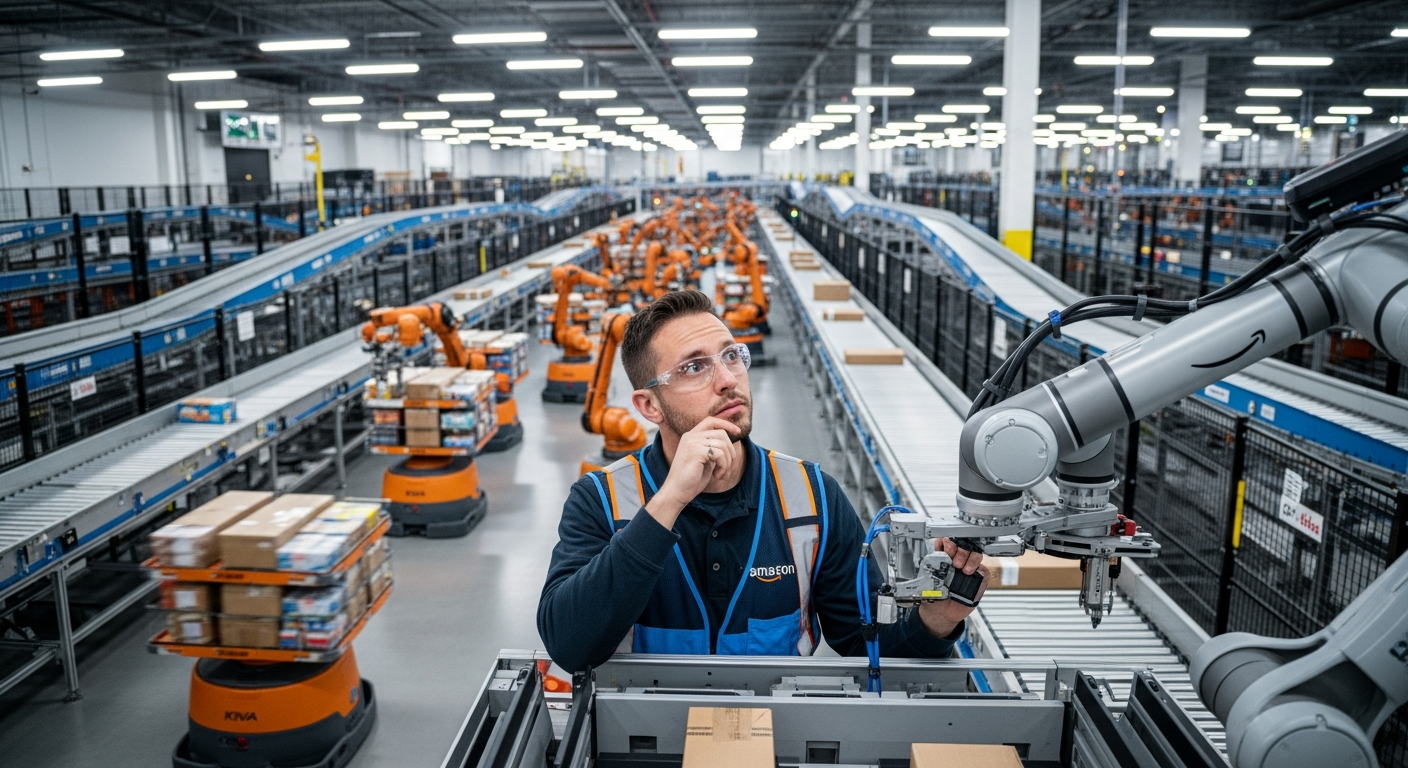
The news hit my desk this morning, and it’s still settling in. Amazon, the behemoth, the everything-store, is planning to eliminate “every menial, mundane job” in its warehouses. The statement came from the company’s robotics chief. Within years, he said. It’s hard to know where to begin.
The details, as reported, are stark. The aim is to completely reshape warehouse operations with advanced robotics and AI. It’s a move that, on the surface, seems like a cold, calculated efficiency play. But when you zoom out, you see the human cost. And that’s what I keep circling back to.
This isn’t just about a few jobs. It’s about a fundamental shift in how work is done, and who does it. Amazon, as per reports from Fox Business, is already deep into automation. They’ve been testing and implementing robotics in their fulfillment centers for years. This isn’t new. But the scale of the ambition, the complete elimination of “menial” tasks… that’s different.
According to the article, Amazon’s robotics chief made this statement quite clearly. He wants to replace human workers with machines. The company has already invested heavily in AI and robotics, and this seems like the next logical step.
The question that hangs in the air, of course, is what happens to the people whose jobs disappear? The article doesn’t dwell on that directly. It’s a business piece, after all. But the implications are vast. It’s hard not to think about the thousands of warehouse workers, many of whom rely on these jobs to support their families. What happens to them?
Earlier today, I spoke with a union representative, who wished to remain anonymous. He said, “We’ve seen this coming. But the speed of it… it’s what’s alarming. It’s like a tidal wave.” That tidal wave is AI, crashing into the shores of the working class. It feels… inevitable, in a way. The march of technology. The relentless pursuit of efficiency.
Meanwhile, the company is also investing in training programs for its employees. But even those efforts feel… reactive, somehow. A bit like rearranging deck chairs on the Titanic.
And I keep wondering: what does a “menial, mundane job” even mean in this context? Is it just the tasks that are easily automated? Or is it something more? Something… human?
By evening, the news cycle will have moved on. Another headline, another story. But the questions remain, hanging in the air like dust motes in a shaft of sunlight. The future of work. The future of humans. Still, it feels like we are at a turning point, and it’s not clear where we’re headed.
About the Author