Unveiling Ancient Egypt: 5 Films That Shaped Our View
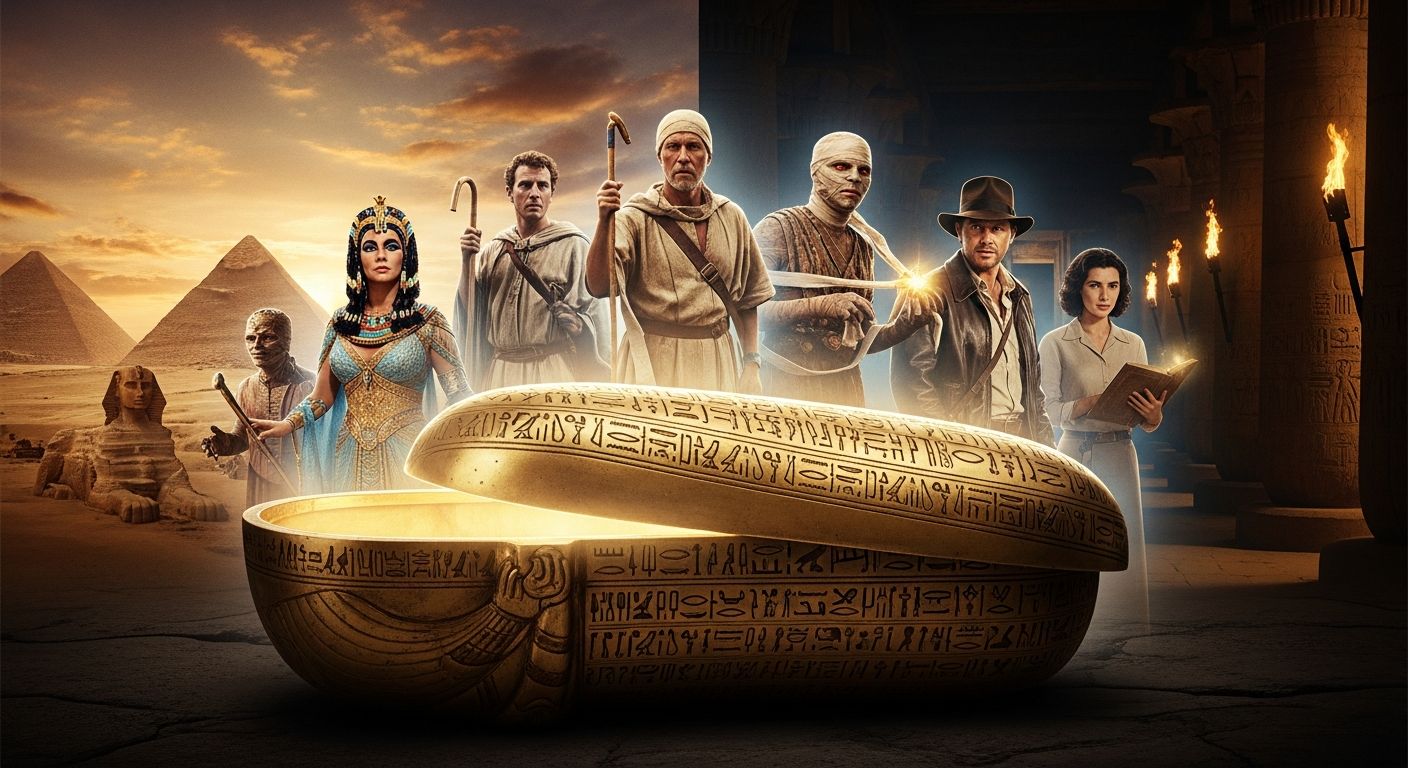
Egypt is doing today what cinema has strived to do for a century: bring the pharaonic story under one roof. With the recent opening of the Grand Egyptian Museum on the Giza Plateau, where the complete treasure of Tutankhamun is displayed, and Ramses II welcomes visitors with his royal dignity, Egypt is presenting a visual, political, and tourism statement about its civilizational memory and rewriting its history. This is an ideal opportunity to revisit the most prominent films that, each in its own time and with varying degrees of historical accuracy, attempted to achieve what the Grand Egyptian Museum is doing today: reviving ancient Egypt on a massive, legendary scale. From religious Hollywood epics to the gleaming 1950s cinemascope pyramids, these films remain among the best for anyone fascinated by the history of the pharaohs and ancient Egypt.
Cleopatra (1963): A Cinematic Icon of a Queen
Despite addressing the later Ptolemaic period, Joseph L. Mankiewicz’s film provides a distinctive cinematic image of Egypt’s last rulers. The film almost bankrupted 20th Century Fox in its quest to make Elizabeth Taylor an eternal icon embodying Cleopatra. After Julius Caesar’s victory over Pompey, Cleopatra VII bets on regaining her throne and maintaining Egypt’s independence. She begins with an alliance and a relationship with Caesar, then, after his assassination, with Mark Antony, attempting to play the politics of Roman power from Alexandria. Her brilliant reign soon collapses before the rise of Augustus, ending with her death and the end of pharaonic rule. Four hours of epic combine empire, seduction, and politics.
Land of the Pharaohs (1955): Architectural Epic
Howard Hawks’ film is the only classic that practically shows how the pyramid was built and how it was completed. Hawks turned the construction process into an exciting engineering epic, and among his admirers is director Martin Scorsese. Khufu, the pharaoh obsessed with safely transferring his treasures to the afterlife, enslaves thousands to build a pyramid that cannot be penetrated by thieves. He makes a deal with Vashtar, the captive architect, to design a self-sealing tomb in exchange for the freedom of his people. Over the decades, Egypt is exhausted by the project, and Queen Nelpher conspires inside the palace. The film’s climax—the moment the tomb is closed—remains one of the greatest scenes in 1950s cinema.
The Egyptian (1954): A Glimpse into Religious Revolution
Adapted from a novel by Mika Waltari, this film is set in the era of Akhenaten and is one of the few films that addressed the religious revolution in ancient Egypt—the transition towards the worship of Aten—from within the royal court. It is an ideal film for anyone who wants to take a look at an important part of ancient Egyptian history. Sinuhe, a poor boy who becomes a doctor in the court, enters the inner circle of Akhenaten, who dreams of unifying worship in one god, the sun. Sinuhe sees how a visionary ruler can be politically naive at the same time; the priests rebel, the leaders conspire, and the hero’s moral contradictions—between love, ambition, and betrayal—become a reflection of the collapse of the dream of a new Egypt and its return to its old traditions.
The Ten Commandments (1956): The Iconic Confrontation
Cecil B. DeMille’s film remains the clearest model of the confrontation between the pharaoh and the prophet Moses, who was raised in the royal palace. Partly filmed in Egypt, with huge sets built for it, it is still taught today as a template for the Egyptian religious epic on screen. In modern Egypt, the child Moses is saved from Pharaoh’s decision to kill the newborns and is raised as an Egyptian prince, becoming a great military and architectural leader. When he discovers his Hebrew origins and witnesses the suffering of his people, he confronts Ramses, demanding their release. The pharaoh refuses, so the divine strikes begin and end with the exodus of the Israelites and the splitting of the Red Sea, where Moses leads his people to freedom and receives the Ten Commandments.
The Mummy (1999): Reviving the Adventure Genre
The film revived the ancient Egyptian adventure genre with a huge budget, combining supernatural horror and romantic adventure, and consecrating Egypt as a mythical space for treasure hunting and curses. It embodies how cinema has transformed Egypt’s past into a popular legend. In Egypt, around 1290 BC, the high priest Imhotep falls into a forbidden relationship with the mistress of Pharaoh Seti I, Anck-su-Namun. After the betrayal is exposed, they kill the pharaoh and flee to the city of the dead, Hamunaptra, to try to revive her with magic. In Cairo in 1926, the American adventurer Rick O’Connell meets the archaeologist Evelyn Carnahan and her brother Jonathan, who force him to guide them to Hamunaptra in search of a lost treasure. There, Evelyn steals the Book of the Dead and reads a spell that brings Imhotep back to life. The cursed priest begins to take revenge, unleashing curses, storms, and terror in Egypt, while Rick, Evelyn, and Jonathan try to stop him before he resurrects Anck-su-Namun and plunges the world into chaos.
These films, each in their own way, have contributed to shaping our understanding and fascination with ancient Egypt. They offer a glimpse into the grandeur, mystery, and enduring legacy of a civilization that continues to captivate the world.
About the Author