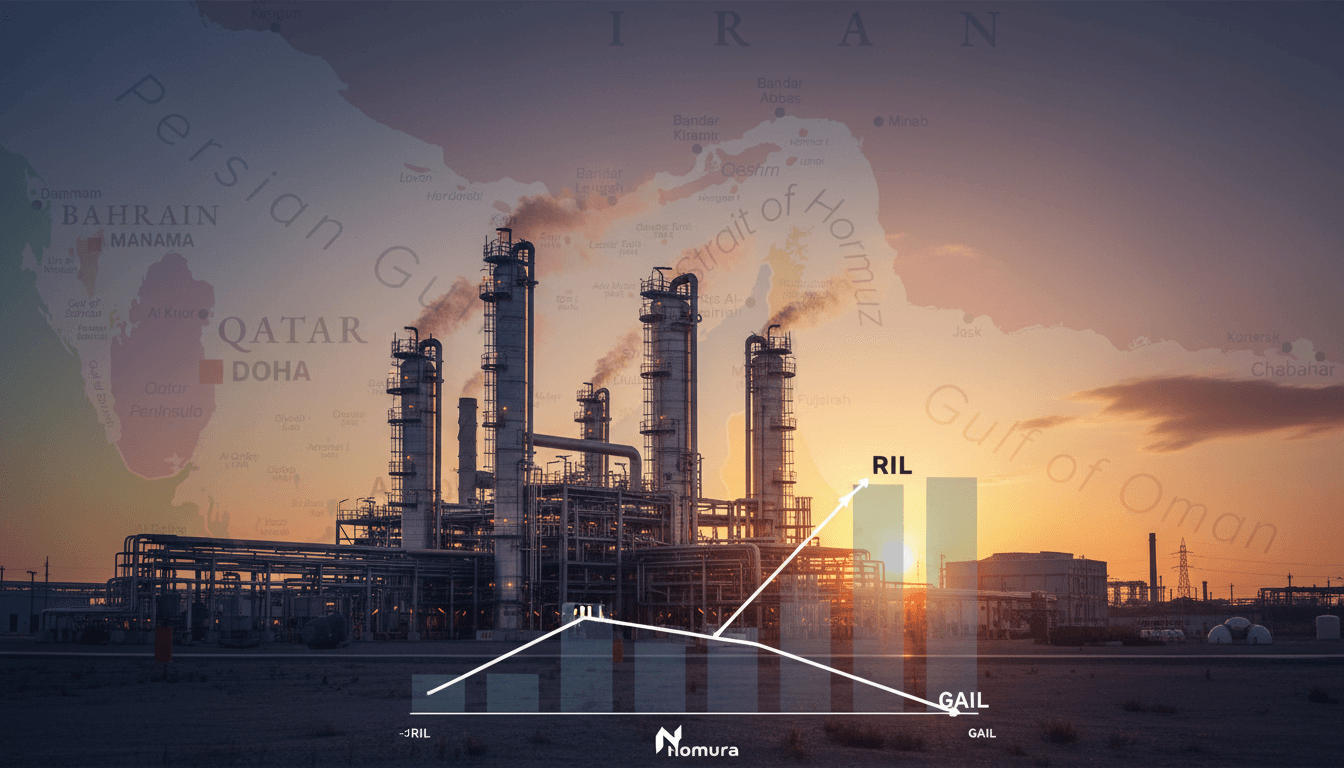
Oil refinery with rising charts against a map of the Persian Gulf and Iran, symbolizing market trends.
As geopolitical tensions simmer in West Asia, Nomura has pinpointed Reliance Industries Ltd (RIL) as its top stock pick, favoring a refining-centric strategy to navigate the crisis. The investment firm anticipates that Indian refiners, especially those heavily exposed to diesel (50% of output), stand to gain from robust diesel cracks.
RIL’s unique positioning stems from its relatively small fuel retailing footprint—less than 10% of its refinery throughput. This allows the company to fully capitalize on increased refinery margins, with Nomura projecting a 2.3% rise in RIL’s consolidated EBITDA for every $1 per barrel increase in these margins.
Conversely, Nomura expects oil marketing companies (OMCs) to face challenges, potentially incurring greater losses from petrol and diesel retailing than any gains from refining. Diesel and aviation turbine fuel (ATF) cracks have already seen dramatic increases since the onset of the Iran war, reaching $76 and $107 per barrel, respectively—well above the typical $15-20 per barrel. Factors contributing to this surge include refinery shutdowns due to crude shortages, damage from attacks in West Asia, disruptions in oil product supplies, and China’s ban on refined product exports.
GAIL (India) Ltd is viewed as the least affected gas player, thanks to its tariff-based business model. This model minimizes the margin impact from gas price volatility and includes a 12% tariff increase slated for January 2026. While transmission volumes are expected to decline by 20%, GAIL’s reliance on unaffected domestic gas volumes should cushion the blow from lower imported LNG. The company may also see upside in its marketing segment and LPG production if the government allocates more Administered Price Mechanism (APM) gas to address LPG shortages.
Petronet LNG, being an LNG importer, faces a potential volume impact of up to 40% due to Qatar Energy’s force majeure declaration. However, its EBITDA margin is expected to remain relatively stable due to a 5% annual tariff escalation starting in January 2026. Nomura also suggests that if crude prices remain above $100 per barrel by the end of March, a Special Additional Excise Duty (SAED), or windfall tax, might be reimposed on domestic oil producers like ONGC and Oil India.
About the Author