Grand Egyptian Museum vs. National Museum of Egyptian Civilization: A Comparative Overview
The upcoming grand opening of the Grand Egyptian Museum, situated near the Giza Pyramids, marks a significant moment in Egypt’s rich museum history. This event reflects Egypt’s long-standing dedication to diverse museum experiences, a concept that dates back to the open-air museums of ancient pharaonic temples. This approach is widely recognized internationally for its role in preserving cultural heritage and making it accessible to the world. The Grand Egyptian Museum joins a network of nearly a hundred exceptional museums, including the National Museum of Egyptian Civilization in Fustat, the first of its kind in Egypt and the Arab world, showcasing the entirety of Egyptian civilizations throughout history.
Two Wings of Egyptian History
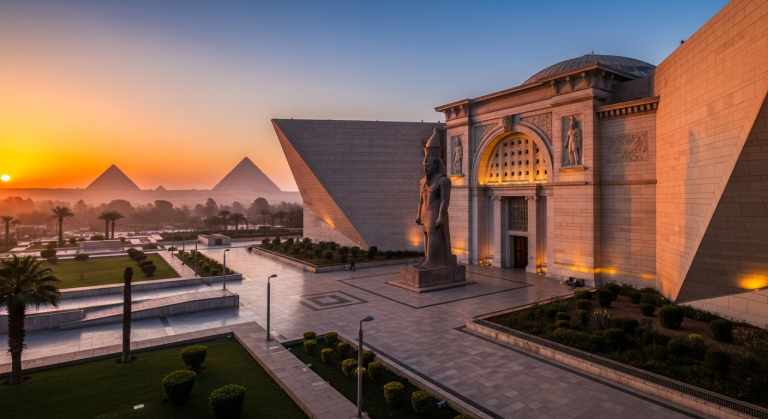
According to Dr. Hussein Abdel Basir, an archaeological expert and the director of the antiquities museum at the Bibliotheca Alexandrina, the Grand Egyptian Museum and the National Museum of Egyptian Civilization represent two main pillars in modern Egypt’s vision for presenting its great human history through different display methods and philosophies. The Grand Egyptian Museum is dedicated to the ancient Egyptian civilization at its finest. It is the largest museum in the world dedicated to a single civilization, located at the foot of the pyramids, creating a visual and spiritual extension of the archaeological site. Its philosophy centers on showcasing the evolution of thought, society, art, and religion in ancient Egypt, from prehistoric times to the end of the Greco-Roman era. The museum’s unique architectural design, inspired by the lines of the pyramids and natural light, has earned international recognition, including the Versailles Prize as one of the most beautiful museums in the world in 2024, the Best Global Project Award from the International Federation of Consulting Engineers, and the Green Buildings Certificate as the first green museum in Africa and the Middle East.
Distinctive Features and Collections
The Grand Egyptian Museum houses around one hundred thousand artifacts, most notably the complete collection of King Tutankhamun, displayed together for the first time. It also features statues, inscriptions, and architectural treasures that document stages of Egyptian glory from the Old Kingdom to the end of the Ptolemaic rule. The museum does not include artifacts from Islamic, Coptic, or modern eras; it focuses solely on ancient Egyptian civilization, including the pharaonic and Ptolemaic periods. The museum, however, does not include artifacts from the periods of invaders such as the Persians, Hyksos, and others due to its focus on the ancient Egyptian civilization and is not a military museum.
In contrast, the National Museum of Egyptian Civilization in Fustat has a broader scope, detailing the history of the Egyptian people across all eras: ancient, Greco-Roman, Coptic, Islamic, and modern. The National Museum focuses on the evolution of Egyptian life and society through exhibits that document social, scientific, and artistic transformations over time, rather than just the grandeur or rarity of the artifacts. Its most important halls include the Royal Mummies Hall, which houses the mummies of Egypt’s greatest kings and queens, transferred there in the famous Golden Parade in 2021.
A Tale of Two Museums
Dr. Abdel Basir summarizes the difference by stating that the Grand Egyptian Museum is a museum that is unique to the pharaonic identity and ancient civilization, while the National Museum of Egyptian Civilization is a museum of national identity that extends across the ages. The former overlooks the pyramids, a symbol of eternity, and the latter is located in Fustat, the first Islamic capital of Egypt, creating a beautiful intersection between the beginning and the end, the deep roots, and the constant renewal. The official opening of the Grand Egyptian Museum comes after a long journey that took twenty years since the project site was prepared, with construction starting in 2016 and the experimental operation of the museum beginning in October 2024. The museum includes a vast entrance spanning approximately 7,000 square meters, with a statue of King Ramses II in the center, and the Great Staircase, which extends over an area of 6,000 square meters. The museum’s collection includes more than 57,000 artifacts representing ancient Egyptian eras, including more than 5,000 pieces from the treasures of King Tutankhamun, displayed together for the first time since their discovery.
The idea of establishing the National Museum of Egyptian Civilization began with efforts by UNESCO and the Egyptian government in 1982, with the foundation stone laid in 2002 in the heart of Fustat, the oldest Islamic capital in Africa. The museum includes many diverse artifacts that highlight Egypt’s tangible and intangible heritage across the different eras of Egyptian civilization, in addition to a hall for mummies and another for Egyptian textiles. [Source: Annahar]
About the Author