Unveiling the Grand Egyptian Museum: A Journey Through Ancient History
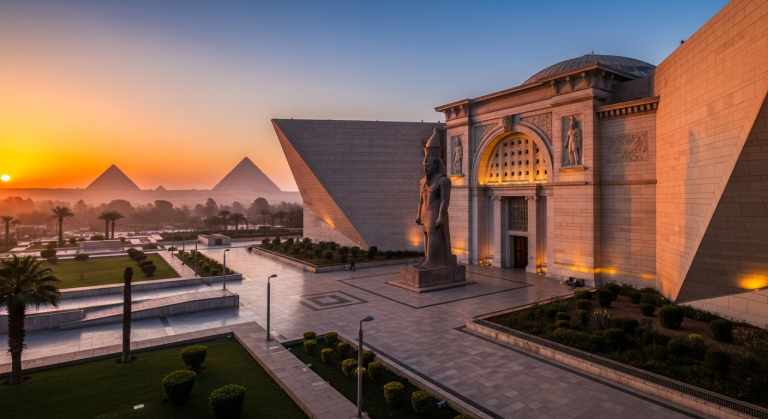
Poised on the Giza Plateau, overlooking the majestic pyramids, the Grand Egyptian Museum (GEM) is more than just a museum; it’s a monumental tribute to a glorious past. In an interview with Annahar, the CEO of the GEM, Ahmed Ghoneim, shared insights into the museum’s contents and its innovative approach to presenting ancient Egyptian history. Scheduled to open its doors in November 2025, the GEM promises to be a must-visit destination for history enthusiasts worldwide.
A Modern Marvel Rooted in Ancient Design
The museum’s design, inspired by the geometric lines of the Giza pyramids, covers an impressive 117 acres (490,000 square meters). The sunlight extending from the three pyramids converges to form a conical mass, which is the Grand Egyptian Museum. The goal is to blend modernity with the symbolism of ancient Egypt, creating a bridge between eras. According to Ahmed Ghoneim, the museum distinguishes itself as the largest globally dedicated to a single civilization: ancient Egypt. It will leverage 21st-century technologies to present history in a fresh and engaging manner.
A Long-Awaited Dream Realized
The journey to the GEM’s grand opening has been a lengthy one. The foundation stone was laid in 2002, with construction beginning in 2012. The pace of work accelerated in 2016, marking the beginning of the final push towards the soft opening and the official inauguration in November 2025. During the trial phase, the museum welcomed between 5,000 and 6,000 visitors daily. This number is expected to surge to between 15,000 and 20,000 visitors per day after the grand opening.
Treasures Within: A Glimpse of the Past
The GEM will showcase approximately 57,000 artifacts, including the hanging obelisk of King Ramses II at the museum’s entrance, which will be the first sight for visitors. The museum’s exhibition plan is based on three main themes: society, royalty, and religious beliefs. Twelve main halls will present ancient Egyptian history across different eras, revealing the lifestyles of the ancient Egyptians, the rule of kings, and the making of history. The Grand Staircase is designed to reflect the ancient Egyptians’ eternal journey toward immortality, serving as an open-air exhibition of individual artifacts representing the most important kings and deities of the ancient Egyptians. A colossal stone statue of King Ramses II is one of the most prominent artifacts in the hall.
King Tutankhamun’s Treasures
The King Tutankhamun halls are undoubtedly a highlight. They will feature the complete collection of the golden king, displayed together for the first time since the discovery of his tomb in November 1922. The collection includes over 5,000 artifacts from the young king’s tomb, including the burial mask, the golden throne, and the royal crown.
Technological Innovations
The GEM integrates modern technology to enhance the visitor experience. Digital screens in the main hall provide information about the museum and its contents. Digital simulation halls depict tombs from the Middle Kingdom era, showcasing tomb designs and excerpts from wall paintings. The museum also features a mixed reality (HoloLens) room, which allows visitors to experience a virtual journey through the evolution of burial methods in ancient Egypt. Interactive exhibits in the King Tutankhamun halls include a simulation of his tomb and the story of its discovery. The museum also houses the Restoration Center, a global educational and research institution for museology, Egyptology, and archaeology, equipped with laboratories in all specializations and the latest technological devices.
A Monument to History
The Grand Egyptian Museum is poised to become a global landmark, offering an immersive and educational experience that celebrates the rich heritage of ancient Egypt. With its vast collection, innovative technology, and thoughtful design, the GEM promises to transport visitors back in time, providing a unique and unforgettable journey through one of the world’s most fascinating civilizations. As Ahmed Ghoneim revealed, the museum is more than just a repository of artifacts; it’s a living testament to the enduring legacy of ancient Egypt.
Source: Annahar
About the Author