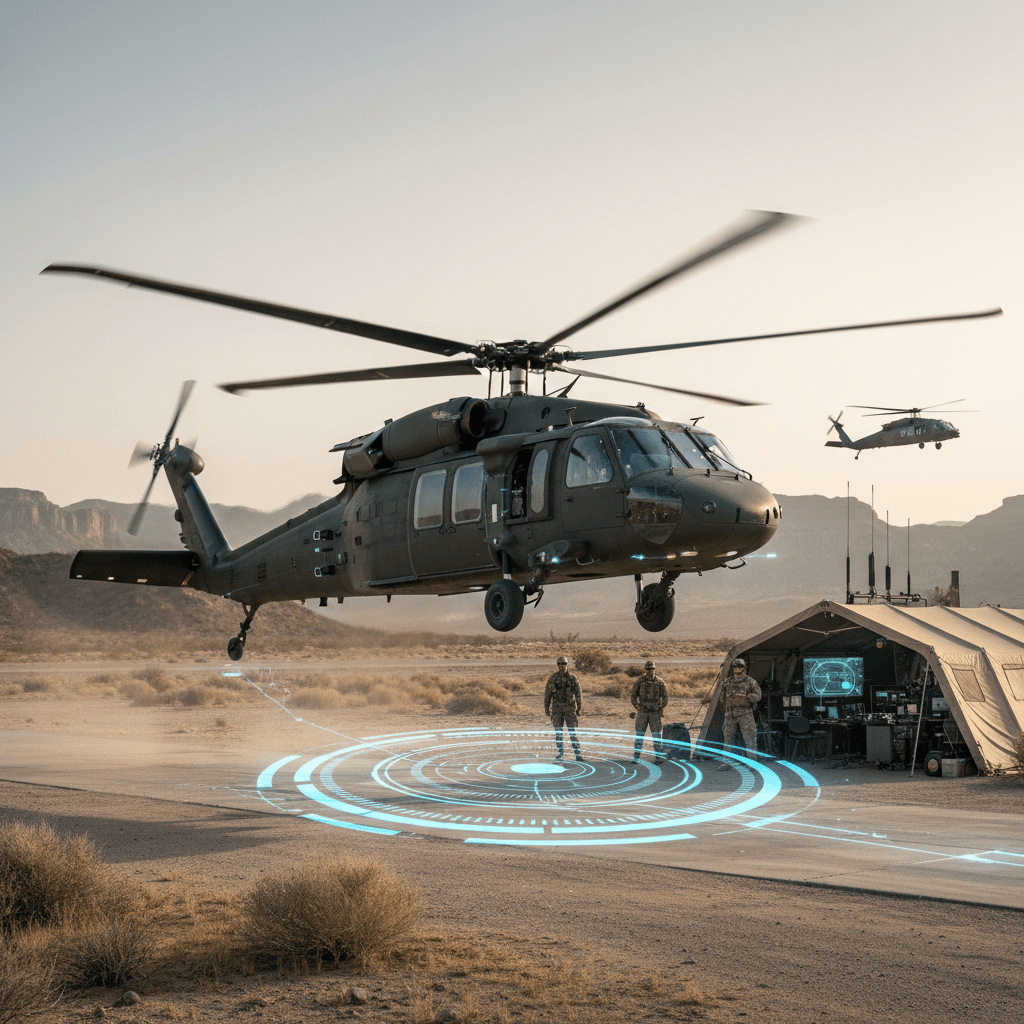
Pilot-optional Black Hawk in a desert test environment with soldiers and futuristic tech.
The U.S. Army is taking a leap toward autonomous aviation, having received its first Black Hawk helicopter capable of operating with or without a pilot, according to a recent announcement. This next-generation UH-60MX Black Hawk, developed in collaboration with Lockheed Martin’s Sikorsky unit, is poised to enter rigorous testing, marking a significant step in the Army’s push to integrate autonomy into its fleet.
Equipped with advanced flight systems, the aircraft can function as a traditional helicopter, an optionally piloted vehicle, or a fully autonomous platform controlled remotely. Army officials state that this advancement enhances mission effectiveness and reduces risks for soldiers in hazardous environments.
Rich Benton, VP and general manager at Sikorsky, noted that the new tech will enhance mission effectiveness. The core technology stems from the Defense Advanced Research Projects Agency’s Aircrew Labor In-Cockpit Automation System (ALIAS), initiated over a decade ago to streamline flight operations and bolster safety.
Sikorsky’s MATRIX autonomy suite serves as a digital co-pilot, adept at handling complex flight tasks like takeoff, navigation, and landing. The system enhances the helicopter’s ability to identify landing zones, avoid obstacles, and operate in low-visibility conditions, all while reducing the pilot’s workload. Additionally, a fly-by-wire system replaces traditional mechanical controls with electronic ones, simplifying handling in challenging conditions.
The UH-60MX will be used by the Army Combat Capabilities Development Command to assess its performance in real-world missions, including remote and autonomous operations. This initiative is part of the Army’s Strategic Autonomy Flight Enabler program, aimed at creating a scalable autonomy kit for the Black Hawk fleet.
The long-term goal is to enable helicopters to perform missions independently or with minimal human oversight, potentially transforming combat and support operations. Prior tests on earlier Black Hawk models, including a 30-minute uncrewed flight in 2022, indicate that the technology is nearing operational readiness.
The latest aircraft signifies a transition from experimental testing to operational evaluation, emphasizing real-world missions and future fleet deployment.
About the Author