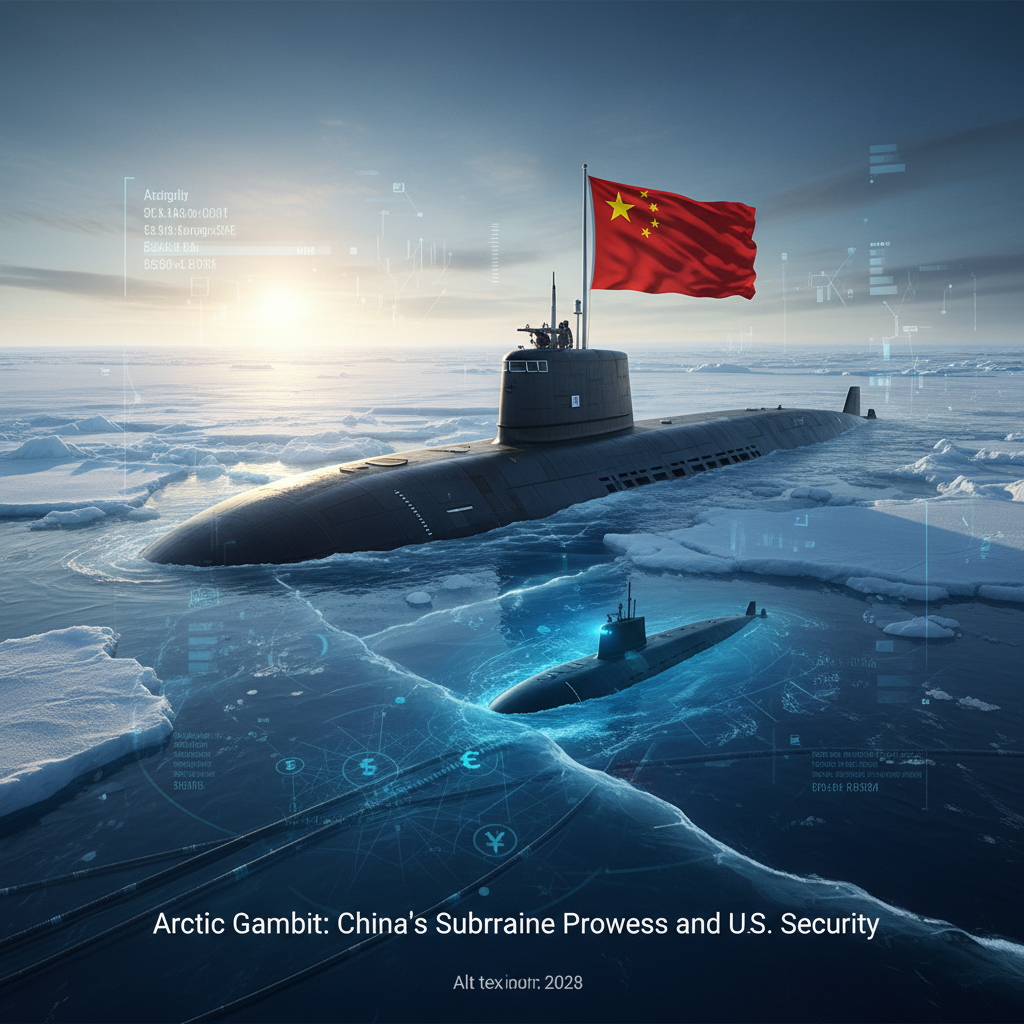
The hum of the server room is a constant presence, a low thrum that vibrates through the floor. It’s late, but the engineers at the unnamed national security think tank are still poring over satellite imagery. The images, updated just hours ago, show something unsettling: the potential deployment of Chinese submarines in the Arctic, worryingly close to U.S. waters near Alaska. This, according to national security expert Gordon Chang, is a clear and present danger.
Chang, speaking on Fox Business, didn’t mince words. He urged the U.S. to treat China as an “enemy combatant,” pointing to Beijing’s expanding undersea capabilities. The concern isn’t just theoretical; it’s about the practical reality of Chinese subs, possibly operating in the very backyard of the U.S.
The implications are serious. The Arctic, once a remote theater, is rapidly becoming a strategic hotspot. As the ice melts, new sea lanes open up, and with them, the potential for increased military activity. The U.S. Navy has been tracking Chinese naval movements for years, but the notion of submarines lurking near U.S. shores, capable of launching a surprise attack, is a stark reminder of the escalating tensions.
“We are talking about a significant shift in the balance of power,” says Dr. Emily Carter, a senior fellow at the Center for Strategic and International Studies. “China’s investment in its submarine fleet, coupled with its increasing presence in the Arctic, is something we need to watch closely. This isn’t just about military hardware; it’s about strategic intent.”
The details are difficult to confirm independently, but the trend is clear. Beijing is investing heavily in its submarine program. This includes advanced technologies, like quieter propulsion systems and long-range cruise missiles. The goal? To project power globally and to challenge the U.S. Navy’s dominance in the Pacific. It’s a game of cat and mouse, played out beneath the waves.
The situation in the Arctic is particularly concerning, though. The vast, icy expanse provides a natural cover for submarines, making them difficult to detect. This, combined with the proximity to the U.S. mainland, creates a dangerous scenario. The challenge for the U.S. is to maintain its surveillance capabilities in the face of this growing threat, or maybe that’s how the supply shock reads from here.
The engineers in the server room, their faces illuminated by the glow of the screens, know this all too well. They’re constantly updating their models, analyzing data, and preparing for any eventuality. The air is thick with the weight of responsibility; it’s a silent pressure.
The expansion of undersea capabilities is not just a military issue; it’s a technological one. China’s ability to build advanced submarines is a reflection of its industrial capacity and its access to critical technologies. This includes things like advanced materials, stealth technology, and sophisticated sonar systems, all of which are subject to export controls. The U.S. government has been actively working to limit China’s access to these technologies, but the challenge is ongoing.
The clock ticks on. The silence of the server room is broken only by the whir of the fans and the tapping of keyboards. The stakes are high, and the world is watching.
About the Author