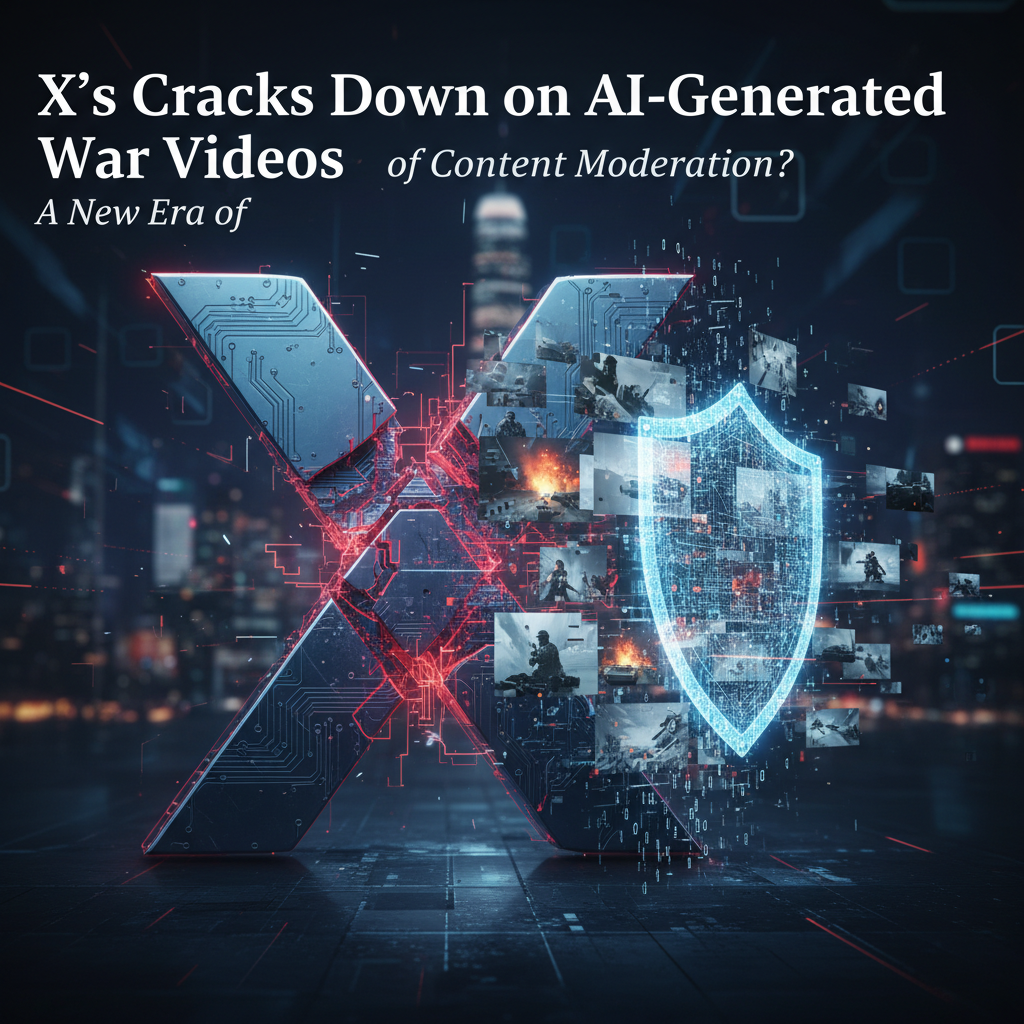
The hum of servers fills the air, a constant white noise punctuated by the staccato clicks of keyboards. Engineers at X, poring over lines of code, are racing against the clock. The platform’s new policy, announced this week, is clear: creators who post undisclosed AI-generated videos of armed conflicts will face consequences. Specifically, a 90-day suspension from revenue sharing.
It’s a bold move, and one that feels inevitable given the rapid advancement of AI and the proliferation of deepfakes. The goal, as X’s official statement put it, is to curb the spread of misinformation and maintain platform integrity. But in practice, the policy’s implementation will be a complex dance of detection and enforcement.
“This is a direct response to the increasing sophistication of AI-generated content,” says Emily Carter, a tech analyst at Forrester. “Platforms are scrambling to keep up, and X’s move is a clear indication of the stakes.” The stakes are high indeed. The potential for AI to generate realistic, yet entirely fabricated, videos of armed conflicts is a threat to both the public and the platform’s reputation.
The technical challenge is immense. AI video generation tools are becoming increasingly accessible, and the ability to detect them requires sophisticated algorithms. These algorithms must be able to identify subtle anomalies that give away a video’s synthetic origins. This could involve analyzing frame-by-frame details, identifying inconsistencies in lighting or movement, or detecting the telltale artifacts of AI image generation. The process itself requires significant computing power, and must be constantly updated to outpace the evolution of AI technology.
The policy’s impact will be far-reaching. It’s not just about removing the offending content. It’s also about changing the incentives for creators. The 90-day revenue-sharing suspension is a financial hit, and a strong deterrent. But it also raises questions about fairness and due process. How will X determine whether a video is AI-generated? What recourse will creators have if they are wrongly accused?
The move also comes at a time of broader scrutiny of social media platforms and their role in the spread of misinformation. The U.S. government, and governments around the world, are grappling with how to regulate AI and its impact on the information ecosystem. X’s policy could be a test case for how other platforms respond.
“It’s a step in the right direction,” says Carter. “But the devil is always in the details.” The details, in this case, include the efficiency of X’s detection tools, the fairness of its enforcement, and the platform’s ability to adapt to the ever-changing landscape of AI technology. The future of the platform, and its role in the dissemination of information, may well depend on it.
About the Author