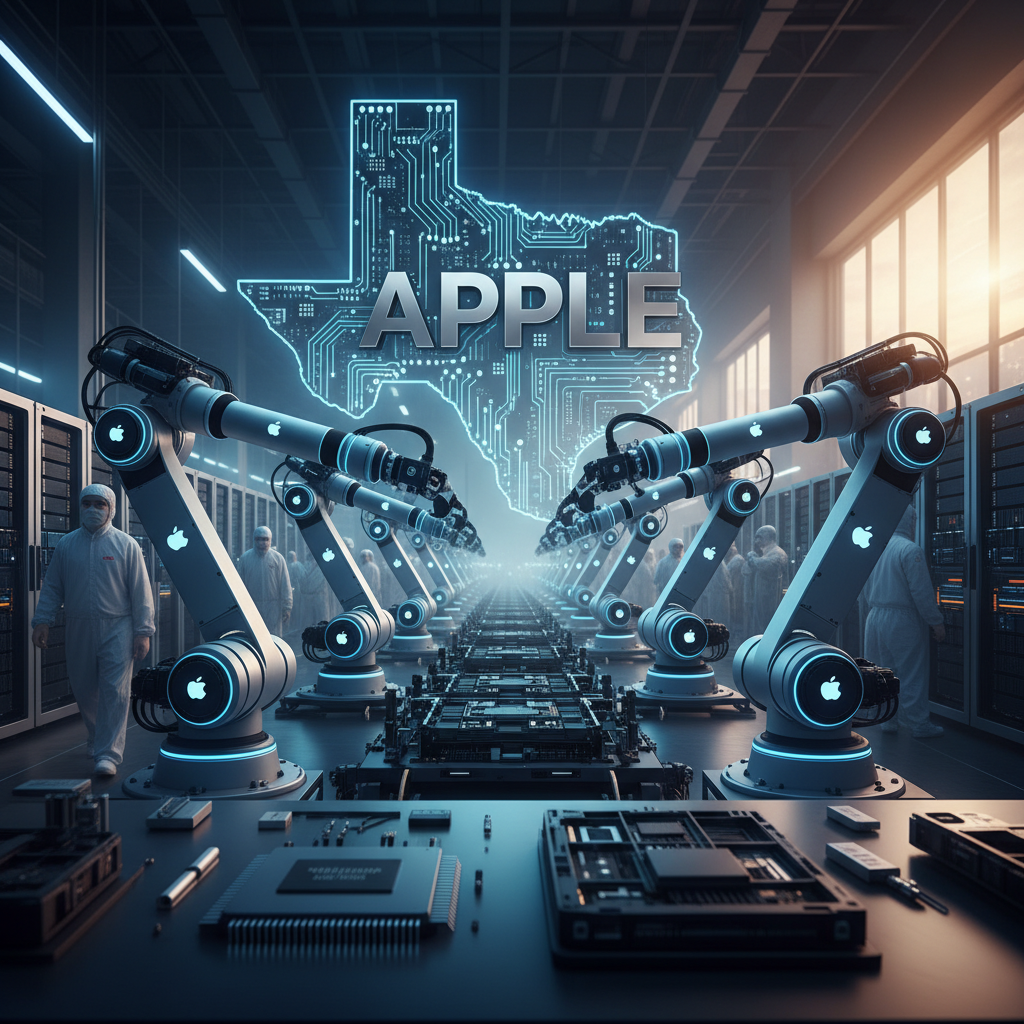
The hum of servers fills the air, a constant white noise punctuated by the staccato clicks of keyboards. In the heart of Apple’s Houston campus, engineers are immersed in the latest thermal tests, assessing the heat dissipation of the newly assembled Mac minis. The air conditioning strains to keep up.
Apple’s decision to expand its Houston operations, announced recently, isn’t just about assembling more Mac minis. It’s a strategic pivot, a bet on the future of AI and a commitment to deepening its U.S. manufacturing footprint. The expansion includes bolstering AI server output, a move that underscores the company’s ambition in the rapidly evolving artificial intelligence landscape.
“This is a significant step,” says John Donovan, an analyst at Forrester. “By increasing its U.S. manufacturing capacity, Apple is not only mitigating supply chain risks but also positioning itself to better compete in the AI hardware market.”
The move comes at a critical juncture. Demand for AI servers is exploding, fueled by the rise of large language models (LLMs) and the insatiable need for processing power. Apple’s expansion in Texas is, in part, a response to this surge. The company is likely looking to increase capacity for its own in-house AI projects, as well as potentially supply the growing market for AI-powered applications.
The expansion’s focus on AI server output is particularly noteworthy. Industry insiders suggest that Apple is investing heavily in its own silicon, potentially with the M-series chips, to power these servers. This could involve integrating more advanced GPUs and optimizing the architecture for LLM training and inference. The details of the chips and their capabilities are closely guarded secrets, but the performance gains are expected to be substantial. The engineers in Houston are focused on the thermal management of the new systems, which is critical for maintaining performance and preventing failures.
Supply chain considerations are also at play. While TSMC remains a key partner for chip fabrication, Apple’s expansion in the U.S. allows for greater control over the final assembly and testing phases. This is particularly crucial given the current geopolitical climate and the ongoing U.S. export controls on advanced semiconductors. Or maybe that’s how the supply shock reads from here.
The workforce training aspect of the expansion is another key element. Apple is committed to creating jobs and developing the next generation of tech workers in the U.S. This involves partnerships with local educational institutions and providing on-the-job training. The goal is to build a skilled workforce capable of supporting the company’s ambitious plans.
Analyst forecasts for the AI server market are bullish. According to a recent report by IDC, the market is expected to reach $200 billion by 2027, with double-digit annual growth rates. Apple is positioning itself to capture a significant share of this market, and the Texas expansion is a crucial step in that direction.
The implications of this expansion are far-reaching. It’s a signal of Apple’s long-term commitment to the U.S. market, its belief in the potential of AI, and its willingness to invest in the infrastructure needed to support its ambitions. The hum of the servers, then, is not just a sound. It’s the sound of progress.
About the Author