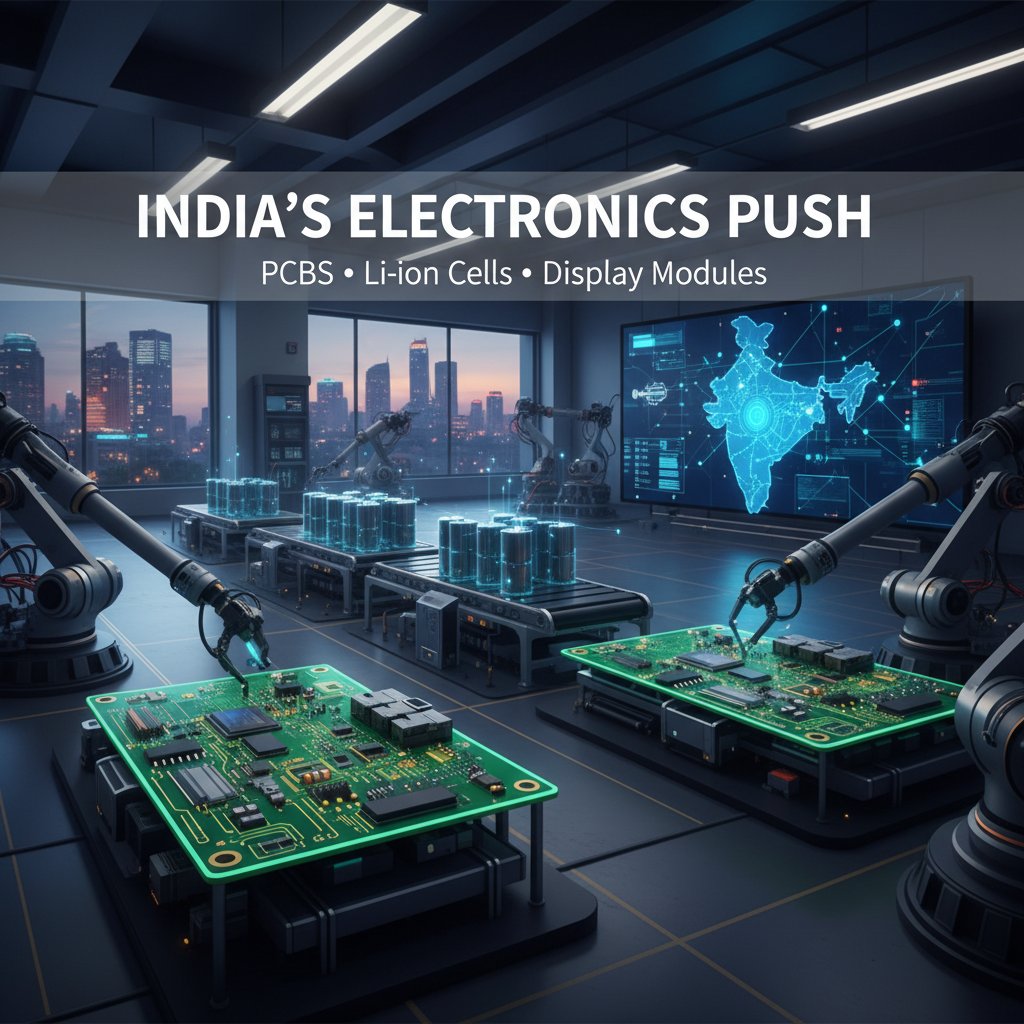
The hum of machinery fills the air, punctuated by the staccato clicks of automated testing. Engineers at a facility in Karnataka, one of the states benefiting from India’s Electronics Component Manufacturing Scheme, pore over schematics. Their focus: printed circuit boards (PCBs), the unsung heroes of modern electronics.
This initiative, as reported by ETManufacturing.in, aims to dramatically reshape India’s electronics landscape. The goal is clear: reduce reliance on imports and fortify supply chains. Approved projects span multiple states, with a particular emphasis on PCBs and Li-ion cells, crucial components for everything from smartphones to electric vehicles.
“This is not just about building factories; it’s about building an ecosystem,” says Rajeev Chandrasekhar, the Minister of State for Electronics and Information Technology. His words echo the sentiment of many industry analysts. According to a recent report by Counterpoint Research, the Indian electronics market is projected to reach $300 billion by 2026. This growth is fueling the demand for locally manufactured components.
The government’s support, through the Electronics Component Manufacturing Scheme, provides financial incentives and infrastructure development. Approved projects are already underway in states like Tamil Nadu, Maharashtra, and Uttar Pradesh. These projects are designed to boost domestic production and reduce the country’s dependence on imports, particularly from China.
The emphasis on Li-ion cell manufacturing is another critical aspect of this push. With the global shift towards electric vehicles, the demand for batteries is skyrocketing. India, with its ambitious electric vehicle goals, recognizes the strategic importance of securing its own supply of Li-ion cells. This move not only strengthens the domestic market but also enhances India’s position in the global supply chain.
Supply chain constraints remain a challenge, however. The availability of raw materials and the need for advanced manufacturing technologies present hurdles. Moreover, competition from established players in countries like South Korea and Japan is fierce.
“Overcoming these challenges will require sustained investment in research and development, along with strategic partnerships,” notes an analyst at Deloitte. “It’s a long game, but the potential rewards are substantial.”
The initiative also extends to display module manufacturing. As demand for smartphones and other devices continues to grow, so does the need for high-quality displays. Local production reduces import costs and allows for greater customization and innovation. The government’s vision is to make India a hub for electronics manufacturing, and this scheme is a significant step in that direction.
The coming years will be crucial. Success hinges on a combination of factors: effective policy implementation, consistent investment, and the ability to adapt to a rapidly evolving technological landscape. The engineers in Karnataka, and their counterparts across India, are working towards that future, one PCB, one Li-ion cell, one display module at a time.
About the Author