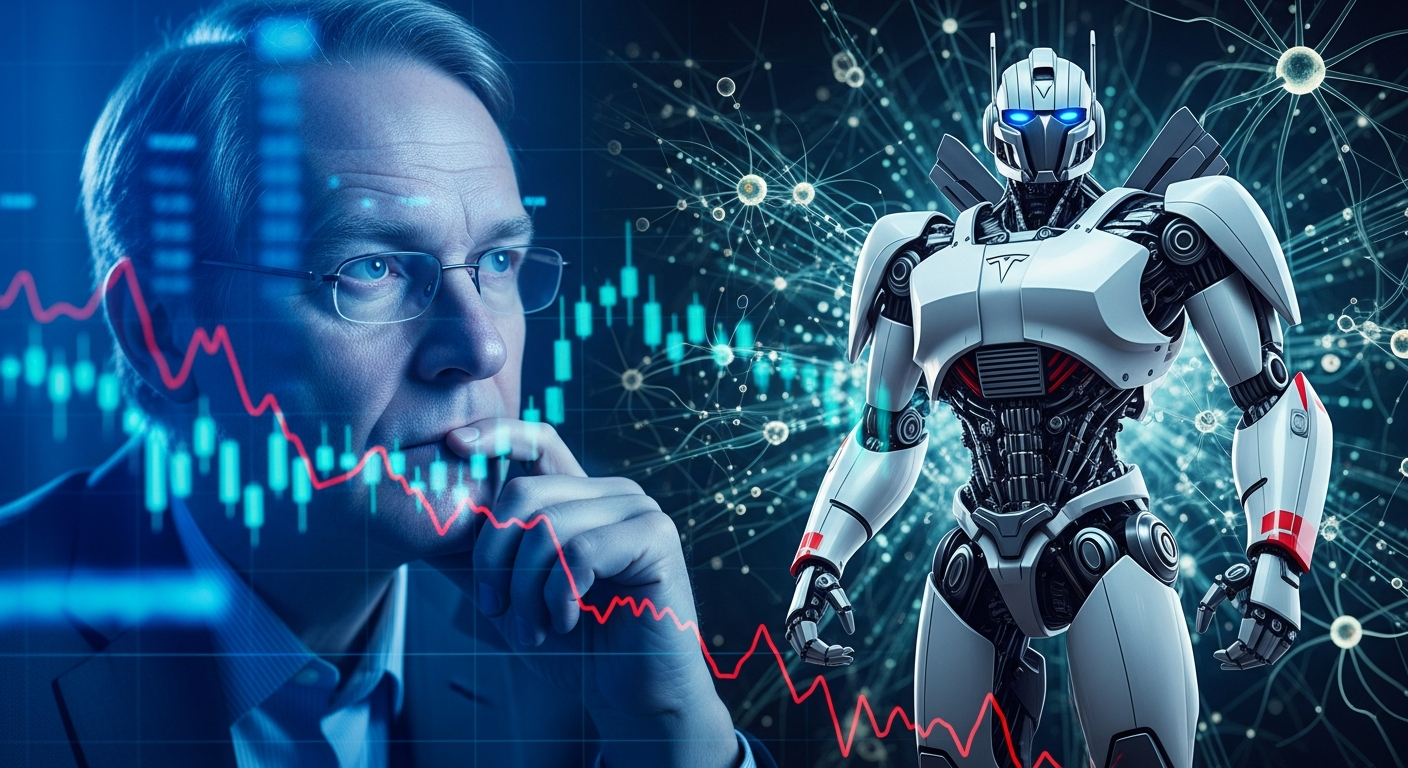
The market hums with a familiar tension. On one side, the relentless promoter, Elon Musk, eyes the horizon of AI robotics as a solution to the world’s debt crisis. On the other, Michael Burry, the investor who famously predicted the 2008 financial crash, casts a critical eye on Tesla, calling it “ridiculously overvalued.”
It’s a clash of titans, a battle of narratives playing out in real-time. Musk, never one to shy from a challenge, has been vocal about his belief in AI’s transformative power, specifically in relation to Tesla’s future. Burry, meanwhile, seems to be betting against that future. This isn’t just about valuation; it’s about two fundamentally different views on the direction of technology and the stability of the global economy.
The core of Burry’s argument, as expressed in various public statements and social media posts, centers on the perceived overvaluation of Tesla. He’s not alone in this assessment, with several analysts pointing to the company’s high price-to-earnings ratio as a cause for concern. Yet, Musk remains undeterred, consistently championing Tesla’s advancements in AI and robotics as the key to unlocking new markets and solving complex global issues. It’s a bold vision, one that has captivated investors and fueled Tesla’s meteoric rise. But it’s also a vision that’s attracting increased scrutiny.
Take, for instance, the recent announcement of Tesla’s plans for its Optimus robot. Musk envisions a future where these humanoid machines perform tasks currently handled by humans, from manufacturing to caregiving. “AI robotics will be the solution,” he has stated, directly linking the technology to the resolution of the looming debt crisis, a claim that has both intrigued and worried observers. This vision is a stark contrast to Burry’s cautious approach, rooted in a deep understanding of market cycles and potential risks.
The stakes are high, the players are influential, and the market is watching. The divergence between Musk’s ambitious vision and Burry’s skeptical perspective underscores the inherent uncertainty of the current economic landscape. The question remains: who is right? Or, perhaps more accurately, which vision will ultimately shape the future?
About the Author