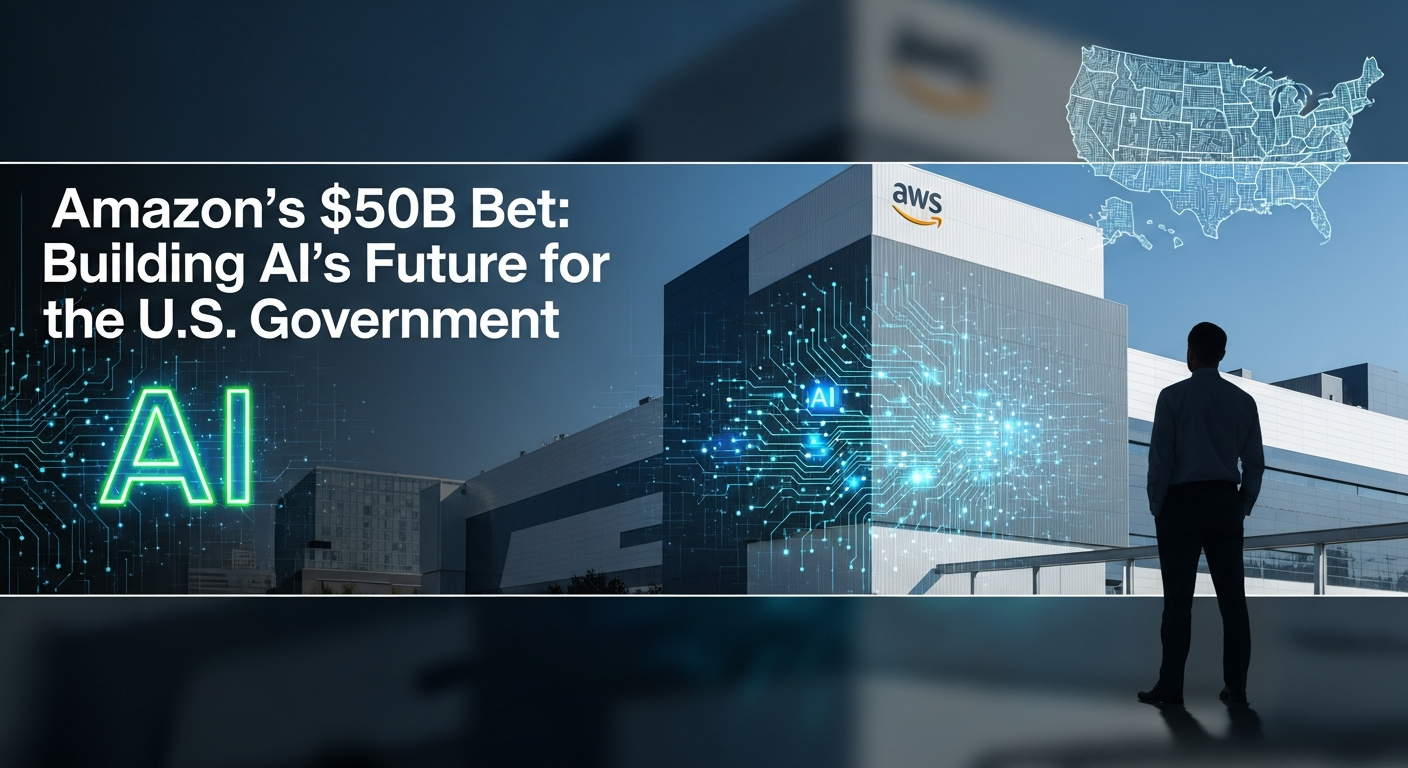
The news arrived like a quiet ripple in a vast ocean: Amazon Web Services (AWS) plans to invest up to $50 billion. The target? Building AI and supercomputing infrastructure for U.S. government agencies. The starting gun fires in 2026.
Fifty billion dollars. It’s a number that feels both abstract and immense. What does that kind of money actually *do*? It buys time, space, and, most importantly, the ability to shape the future. In this case, the future of artificial intelligence within the machinery of the American government.
The announcement, reported by Fox Business, didn’t offer granular details. The who is clear: Amazon, through its AWS arm. The what: AI infrastructure. The where: within the U.S. government. The why, hinted at in the initiative’s name, is to provide advanced computing power for federal agencies.
This isn’t just about faster servers. It’s about enabling a new era of data analysis, predictive modeling, and potentially, decision-making. Imagine the implications for everything from national security to scientific research.
“This is a significant commitment,” a former government official, who wished to remain anonymous, told me, “It signals a belief in the transformative power of AI and a willingness to invest in the long game.”
2026 feels a world away. Yet, in the tech world, it’s just around the corner. The infrastructure will need to be planned, built, tested. The government agencies will have to adapt, learn, and integrate. What will the world look like when this investment bears fruit? Will it be a world more efficient, more secure, or simply, different?
It’s a bet on the future, played out in the quiet hum of data centers and the silent calculations of algorithms.
About the Author