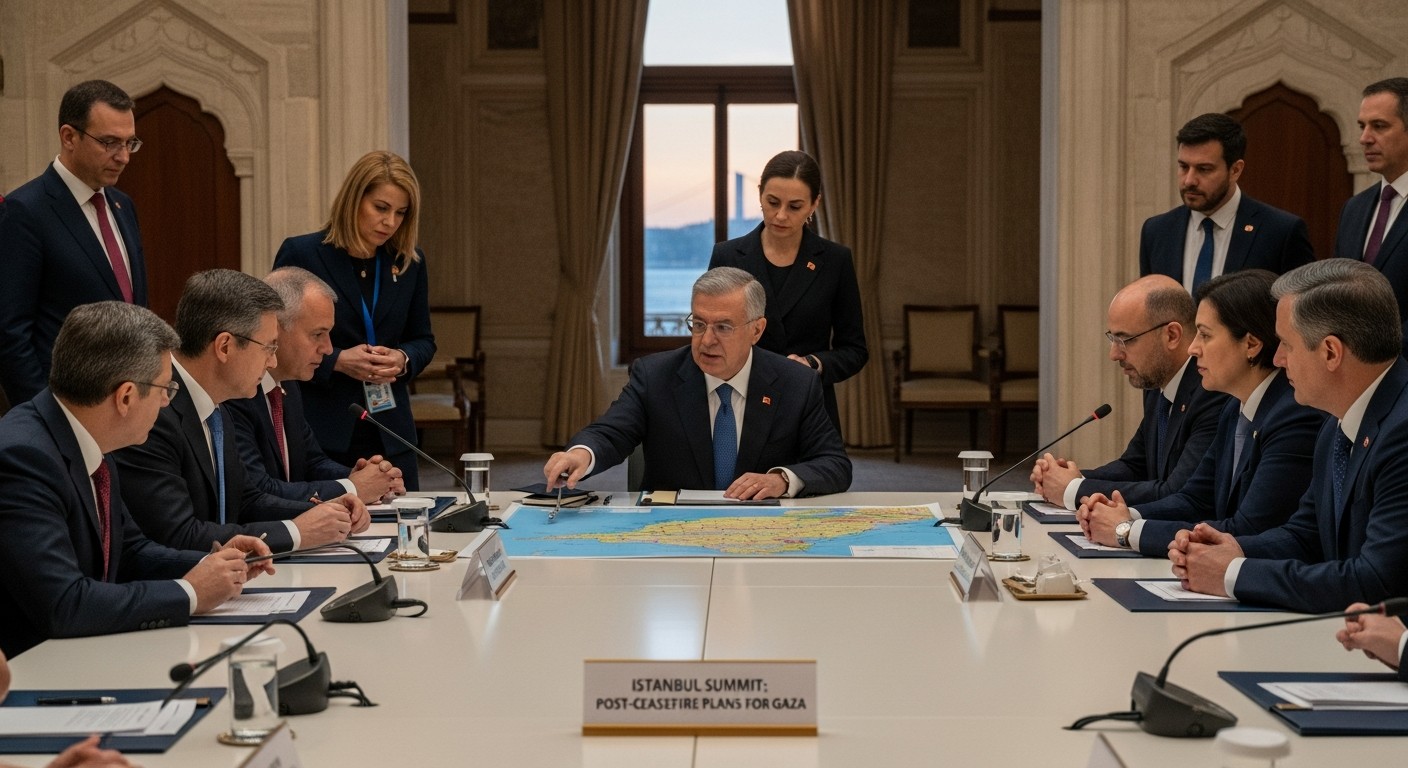
Istanbul Summit: Ministers Discuss Post-Ceasefire Plans for Gaza
In Istanbul, foreign ministers from several Muslim-majority nations gathered on Monday for a critical meeting. Their primary focus: charting the course for the next phase in Gaza following the ceasefire agreement between Israel and Hamas. This agreement, a result of a plan proposed by U.S. President Donald Trump, has set the stage for a complex period of transition and rebuilding.
Key Participants and Objectives
The summit included representatives from Turkey, Saudi Arabia, Qatar, the United Arab Emirates, Jordan, Pakistan, and Indonesia. These nations’ leaders previously met with Trump in late September on the sidelines of the United Nations General Assembly in New York. The agenda of the Istanbul meeting, as outlined by Turkish Foreign Minister Hakan Fidan, involves assessing progress and identifying collaborative opportunities. Fidan highlighted that a peace plan is beginning to take shape, offering a glimmer of hope.
Navigating Challenges and Seeking Solutions
Since October 10th, a ceasefire has been in effect in Gaza, although both sides have accused each other of violations. The discussions in Istanbul addressed critical questions regarding the obstacles to the plan’s implementation, the challenges that must be overcome, and the next steps to be taken. A central focus was on how to engage with Western allies and the available forms of support for ongoing talks with the United States.
Fidan met with a delegation from Hamas’s political bureau, led by Khalil al-Hayya, in Istanbul on Saturday. During a forum, Fidan emphasized the need to end the atrocities in Gaza, noting that a ceasefire alone is insufficient. He reiterated the importance of a two-state solution to resolve the Israeli-Palestinian conflict, and added that
About the Author





