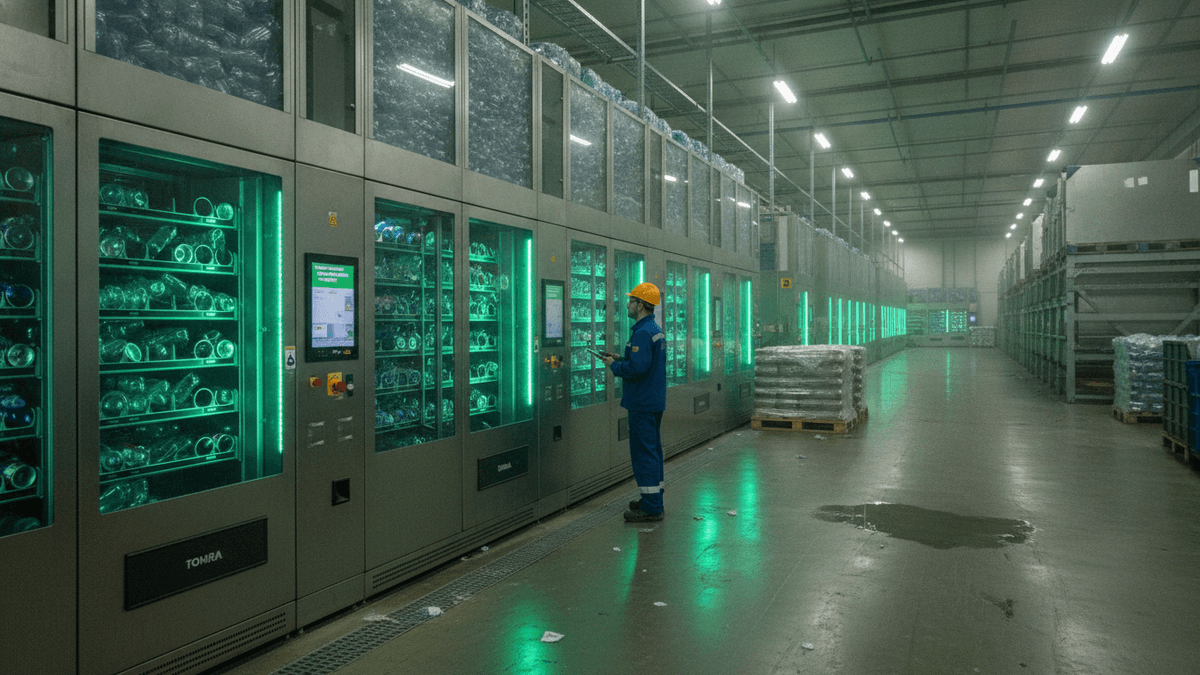
Worker operating a TOMRA reverse vending machine in a large industrial facility
Tomra Systems, a leader in reverse vending and sorting solutions, posted robust second-quarter earnings, with revenue jumping 25% year-on-year to 405 million euros. This significant growth was primarily propelled by a strong 45% surge in its Collection division, alongside a 30% rise in adjusted EBITA to 57 million euros and adjusted earnings per share increasing to 0.10 euro.
The Collection division’s stellar performance was directly linked to the successful implementation of new deposit return systems across several key markets, including Poland, Portugal, Singapore, and Romania. While the company’s Food revenue also saw a respectable 5% increase, its Recycling division faced headwinds, reporting an 11% decline attributed to softer demand in the Asian market.
Despite the overall revenue strength, Tomra’s gross margin narrowed to 41.3% from 44.3%, reflecting an unfavorable product and business mix. This highlights the double-edged sword of rapid expansion in specific segments; while new systems drive top-line growth, they can impact profitability metrics if not managed strategically. The success in Collection underscores the growing global adoption of circular economy principles and the direct impact of government policy on business opportunities.
Looking ahead, Tomra projects Collection revenue between 400-440 million euros for the second half of 2026, a slight decrease from the first half’s 454 million euros. Full-year forecasts include Recycling revenue of 200-215 million euros and Food revenue of 340-360 million euros. However, the company flagged ongoing market uncertainty, escalating trade tensions, and tariffs as potential risks that could delay customer investment decisions. A notable vulnerability is that approximately 15% of Tomra’s group revenue originates from the United States, with over 90% of these U.S. sales supplied from Europe, making them particularly susceptible to tariff impacts.
For founders and investors, Tomra’s results offer a clear lesson: market-driven growth, especially that fueled by policy shifts like new deposit schemes, can be powerful. Yet, even established players with strong fundamentals are not immune to geopolitical and macroeconomic pressures. Understanding global supply chain dependencies and trade policy risks is crucial for navigating today’s volatile business landscape.
About the Author